








Summer skiing ‘doomed’ on Swiss Zermatt glacier
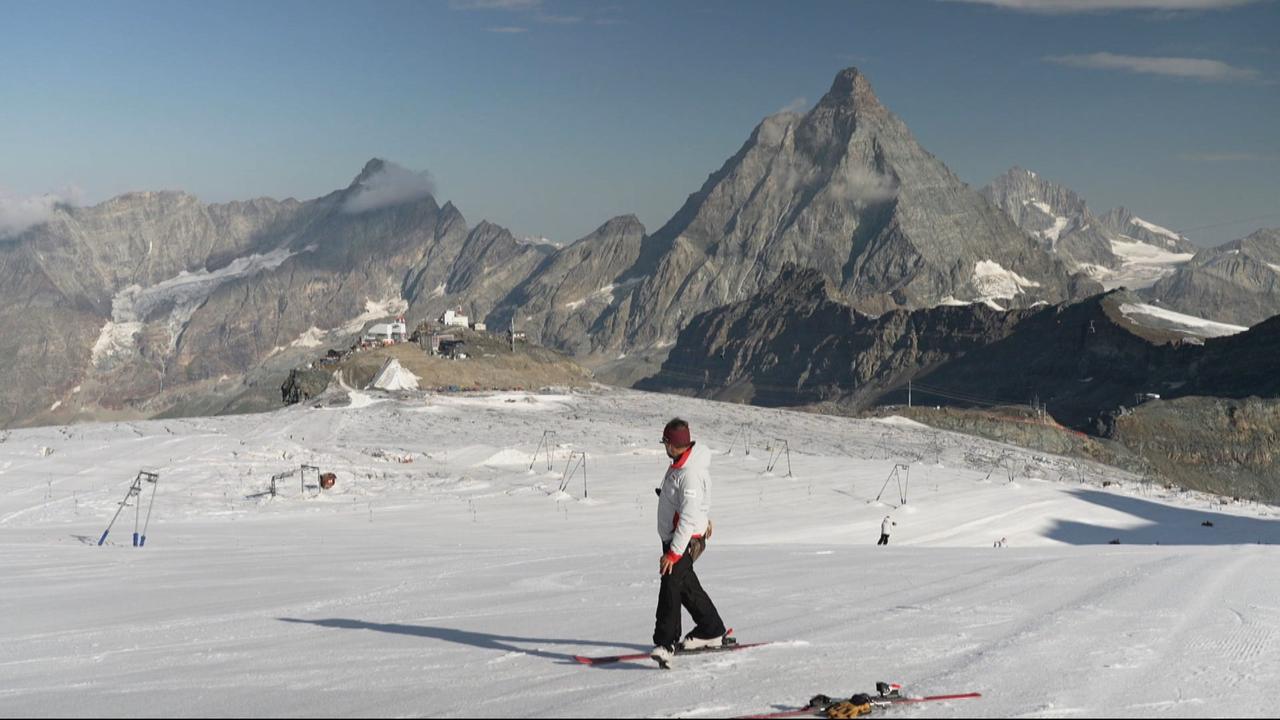
The melting of the Zermatt glacier forced the southern Swiss ski resort to suspend skiing last week. The glacier's retreat has rendered its facilities too unstable. Only the Swiss ski team can still train there, but in very poor conditions.
Select your language
Generated with artificial intelligence.
Listening:
Summer skiing ‘doomed’ on Swiss Zermatt glacier
The Zermatt ski lifts had to take the unusual decision to suspend summer operations on the Theodul Glacier on August 1.
The persistent heat, the lack of nighttime cooling, and the significant melting of the glacier are compromising the stability of the ski infrastructure, such as ski lifts.
Martin Hug, director of Zermatt Bergbahnen, stressed that “the safety of customers and employees is our absolute priority at all times”.
More
The international consequences of a glacier-free Switzerland
For the Swiss national team, however, this closure does not mean the end of activities altogether. The training slopes prepared in Zermatt remain accessible to certain Swiss-Ski teams, but in significantly degraded conditions.
This exception is made possible by an agreement signed last year between Swiss-Ski and the resort in canton Valais. “For us, it’s really very efficient, because in an hour or two, training is over and we can go recover,” Olympic team champion Tanguy Nef told Swiss public broadcaster RTS. “But afterwards, it’s hard to see the glacier darker and less accessible.”
Large summer ski area
This situation also highlights the importance of the contract between Swiss-Ski and the Zermatt Bergbahnen. Thanks to this contract, Swiss elite teams continue to benefit from access to one of the largest summer ski areas in Europe.
More
Why Switzerland is among the ten fastest-warming countries in the world
In recent years, Zermatt has become a key training ground for speed skiers. Downhill training at nearly 4,000 metres altitude offered conditions no longer found in many other glacier ski areas.
For these first few days of the new season, the skiers focused primarily on their physical conditioning. The most important thing was to get back together as a team, regardless of the snow conditions. “The goal is to get back on skis, have my boots on, and get a feel for what’s going on,” explains slalom world champion Loïc Meillard.
The closure in Zermatt is much more than just a short-term weather problem. It’s yet another sign of the extent of the changes that climate change is bringing to alpine skiing. Time slots for summer training on glaciers are shrinking, while maintaining the slopes and facilities on the ice is becoming more expensive.
“Summers like this have catastrophic effects on glaciers, so probably in Zermatt, we will still be able to practice summer skiing in the coming years, but in the long term, it is clear that summer skiing is doomed,” says Christophe Lambiel, geomorphologist and lecturer and researcher at the University of Lausanne.
Faced with this situation, the Swiss team must adapt. “We don’t have the summers of a few years ago,” said Matteo Joris, coach of the Swiss team. “We must adapt. If the glaciers close in July and August, we’ll go straight to the southern hemisphere.” In a few days, and as every year, the Swiss team will head to South America and New Zealand for a month to experience real winter conditions.

More
Swiss glaciers have already used up their winter reserves
+ How we produce English news
Translated from French, reviewed by an English Department journalist.
External Content

In compliance with the JTI standards
More: SWI swissinfo.ch certified by the Journalism Trust Initiative

You can find an overview of ongoing debates with our journalists here . Please join us!
If you want to start a conversation about a topic raised in this article or want to report factual errors, email us at english@swissinfo.ch.