








Swiss await US Supreme Court ruling on tariffs
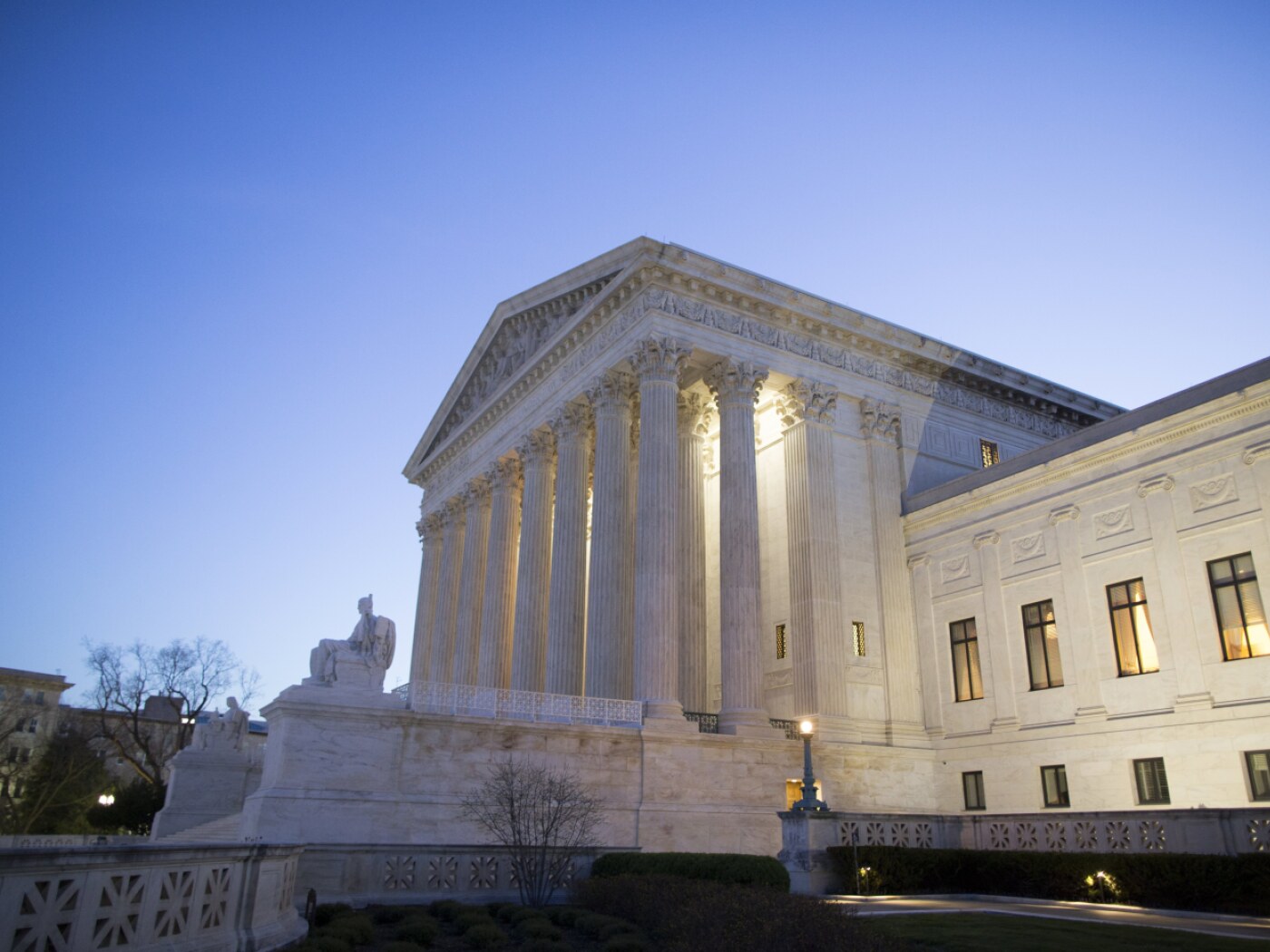
The United States Supreme Court is set to rule on the legality of President Donald Trump's tariff policy, which also impact Swiss imports duties.
Select your language
Generated with artificial intelligence.
Listening:
Swiss await US Supreme Court ruling on tariffs
+Get the most important news from Switzerland in your inbox
A hearing will take place in November, according to a Supreme Court document.
Last week, Trump’s government applied to the Supreme Court to clarify whether a certain emergency law legitimises the tariffs imposed by the US President on numerous countries.
+ How US tariffs are impacting the Swiss economy
Trump had previously suffered a defeat before a US appeals court. A dozen US states, among others, had originally filed a lawsuit against his tariff policy. The appeals court had denied Trump the authority to impose far-reaching tariffs on imported products by invoking an emergency law. However, the Court of Appeal’s decision was not due to come into force until October 14, which gave Trump time to challenge it.
The decision includes the country-specific tariffs first announced by Trump at the beginning of April, which affect dozens of the US trading partners. Switzerland is one of them. A tariff of 31% on most Swiss products was announced at the beginning of April.
The US government then granted deadlines so that countries could continue to negotiate. As a result, some tariff rates changed. This also applies to Switzerland: most exports to the US have been subject to tariffs of 39% since August 7.
Open questions
The tariff rate for Swiss exports is therefore significantly higher than that for other countries – particularly the European Union (EU). Most EU products are subject to 15%. However, unlike Switzerland, the EU has already concluded an agreement with the US. A key question is how the legal dispute will affect trade with countries that have reached an agreement with the US.
More
What is a tariff? A quick guide
The US government fears for its deals and explicitly mentions the EU in its application to the Supreme Court. Six important trading partners and the EU have already concluded framework agreements on the basis of tariffs imposed under the Emergency Powers Act.
In doing so, they have accepted customs agreements that have been heavily readjusted in favour of the US, according to the report. If the tariff authorisation were to be denied, this would bring the US “to the brink of economic disaster”.
Trump had used a law from 1977 for his far-reaching tariffs on many products from abroad. This states that a president can issue decrees in the event of a crisis without having to appeal to Congress. However, tariffs are a core competence of the US parliament, the court of appeal had emphasised. The judges had thus criticised Trump’s legal reasoning and at the same time initially put a damper on his aggressive trade policy.
Federal government keeps low profile
According to the head of the Swiss-US Chamber of Commerce, Rahul Sahgal, the appeal court’s judgement weakened the US government’s position vis-à-vis Switzerland. Sahgal considered it possible that the US Supreme Court would allow a limited application of the Emergency Powers Act as a basis for tariffs.
He said this in an interview with the NZZ am Sonntag at the end of August – after the judgement appeals court was announced. “The tariff of 39% must be reduced as quickly and significantly as possible.”
The federal government has recently been vague about how Switzerland intends to achieve this. Economics Minister Guy Parmelin travelled to the US last week and held talks with government representatives in Washington.
For tactical reasons, the Federal Department of Economic Affairs, Education and Research did not provide any details on the content of the various talks. Switzerland sees good opportunities for both countries, Parmelin wrote on social media platform X following the talks.
More

Translated from German by DeepL/mga
We select the most relevant news for an international audience and use automatic translation tools to translate them into English. A journalist then reviews the translation for clarity and accuracy before publication.
Providing you with automatically translated news gives us the time to write more in-depth articles. The news stories we select have been written and carefully fact-checked by an external editorial team from news agencies such as Bloomberg or Keystone.
If you have any questions about how we work, write to us at english@swissinfo.ch

In compliance with the JTI standards
More: SWI swissinfo.ch certified by the Journalism Trust Initiative

You can find an overview of ongoing debates with our journalists here . Please join us!
If you want to start a conversation about a topic raised in this article or want to report factual errors, email us at english@swissinfo.ch.