








One size does not fit all: Zurich architects reevaluate Modernism’s legacy
Nearly a century after the rise of Modernism, its clean lines and universal ideals still define much of Swiss and international architectural thinking. Yet beneath the surface lie forgotten narratives and exclusions. Two architecture professors at the federal technology institute ETH Zurich discuss how to reframe this legacy.
Emerging in the 1930s amid the turmoil of the interwar years, Modernism embraced mechanisation, new technologies and mass production as tools to build affordable, functional design attuned to the needs of the working class.
Today it shapes how our homes are organised, from the proportions of rooms to the layouts of our kitchens and even the objects we use in them. More than a historical movement, it became a marker of taste, refinement and connoisseurship.

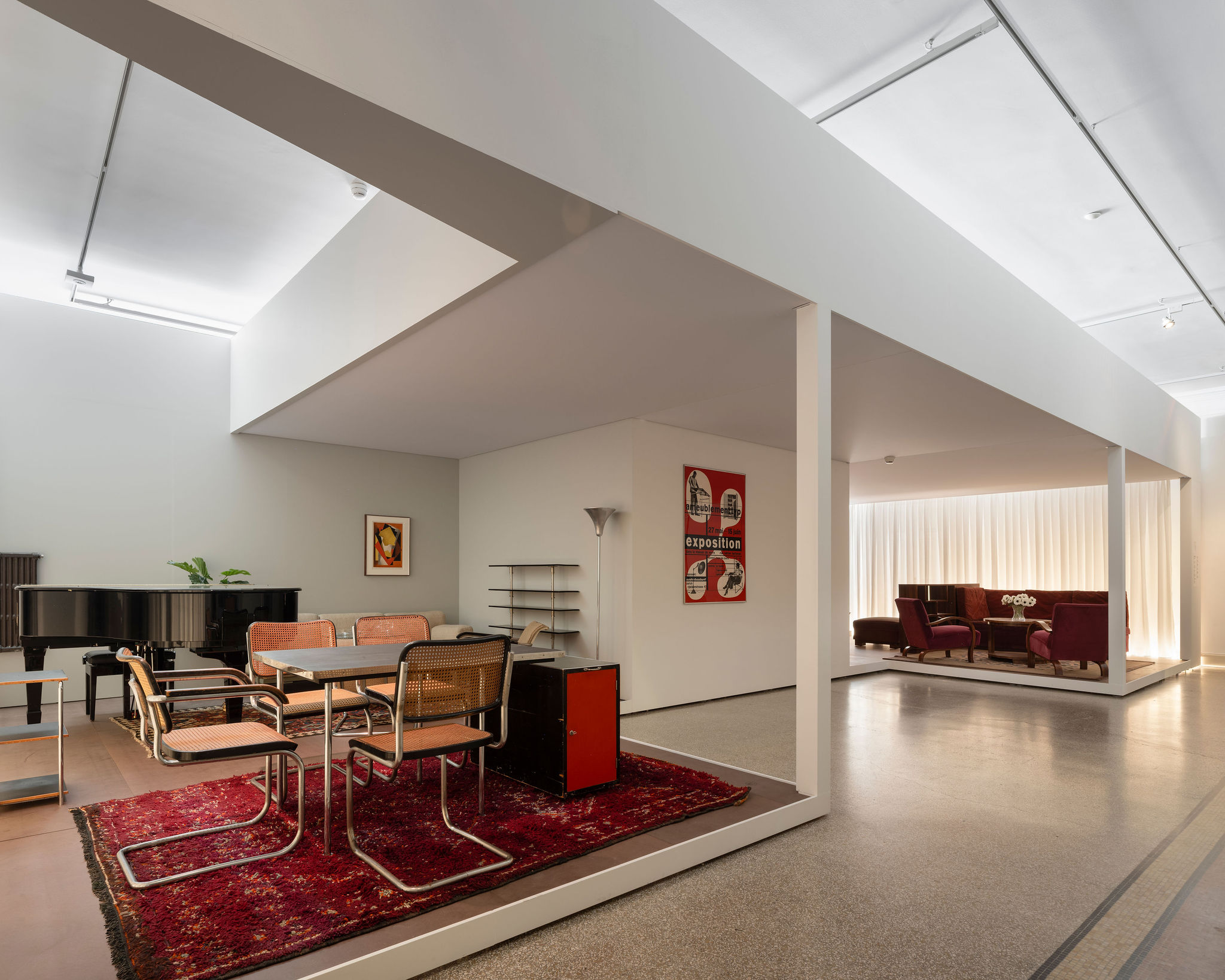
Its persistence was especially evident in the recent exhibition And it began so marvelously at the Musée d’Art et d’Histoire in Geneva, which ended in November. The exhibition traced Modernism across architecture, urbanism, art, ceramics, wallpaper and furniture in both Zurich and Geneva, demonstrating how deeply its aesthetics and values still frame everyday life.
In parallel, the Pavillon Le Corbusier in Zurich presented Vers une architecture: Reflections, marking the centenary of Le Corbusier’s seminal book. For the occasion, a group of architects and educators were invited to reflect on its ongoing relevance, including the ETH Zurich architecture professors An Fonteyne and Anna Puigjaner, both of whom have their own architectural practices alongside their teaching.

Reframing the past
Puigjaner’s starting point for rethinking Modernism is to revisit the portrayal of Le Corbusier as a lone genius instead of looking at him as part of a team. “Acknowledging the collective effort is crucial,” she notes, “because architecture is never the product of a single mind.” She cites Charlotte Perriand, a collaborator of Le Corbusier, whose innovative ideas such as opening the kitchen to the living room in the Unité d’Habitation in Marseille, a residential block, redefined domestic space.

Puigjaner also points to the historical context in which Modernism emerged: a faith in technology as a neutral tool for societal evolution, especially in its use of steel.
“We’re deeply aware of the moment that we’re living in, in which climate change plays a big role in our habitat. We cannot perpetuate processes of extraction as if nothing is happening. The use of steel, for example, is not neutral. Steel implies a process of extraction, colonialism and labour exploitation that we cannot deny when producing architecture. And we’re much more aware of the consequences of technological procedures and advances.”
Fonteyne explains that Modernism was a top-down attempt to improve urban living conditions for the masses: an admirable aim, but one that relied on the belief that everything needed to be new.
“The new ways of building, new ways of living, new aesthetics and new standards led to forgetting everything that existed before that.” The tabula rasa approach, she stresses, erased existing urban life, along with its histories, aesthetics and knowledge of how people lived together.

Urban logic
Modernism’s urban logic emerged from a top-down belief that cities, and the people in them, could be optimised through order and standardisation. Modernist planning relied on zoning, prioritising efficiency over social continuity or human scale.
“Mixed-use is something that Modernism has always prevented from happening,” Fonteyne explains. “The idea was to make a clean sheet of paper and come up with ideas that fit everywhere. The small scale, the human scale, was never developed.”
The urban and architectural consequences are severe. Buildings based on 1930s Modernist principles, such as Cinq Blocs in Brussels or Amsterdam’s Bijlmermeer, already fail to meet contemporary standards of liveability and urban function.


In Brussels, for example, the 1960s Cinq Blocs development – high-rise slabs placed on an empty green plane in line with Modernist logic – has been emptied out and will be demolished after decades of social isolation, poor maintenance and unliveable conditions, displacing the long-standing community that once lived there.
Bodies, standards, and exclusion
Puigjaner frames the problem of standardisation as a broader postwar tendency, not the work of any single office. “It was not only the office of Le Corbusier but a general tendency that emerged as a consequence of the two world wars, in which rigid norms became standard – and with that, a lot of exclusion,” she says.
This drive to standardise produced new measurement systems and design rules, most famously Le Corbusier’s Modulor, based on the “normal” human body. Postwar architecture, Puigjaner argues, codified particular proportions and behaviours, effectively designing for an idealised, able-bodied, nuclear-family occupant.

These norms had clear domestic consequences that were exported worldwide. The modern kitchen, developed within a Eurocentric framework of domestic life, assumed a single style of cooking: enclosed preparation, limited heat, minimal smells, and a nuclear-family model of use.
When this standardised kitchen was introduced into Singapore’s post-colonial independence public housing, it was treated as a “neutral” solution intended to serve all households equally. Yet Singapore’s multicultural cooking traditions – often involving stronger heat, more intensive frying, and semi-outdoor preparation – did not fit this universal template. The result was a domestic space that unintentionally constrained cultural practices and generated friction within dense housing blocks.

“The kitchen has always been a contested space,” Puigjaner says. “In Singapore, the modern kitchen was designed as neutral, so everyone would have the same kitchen. It became extremely problematic, and it was thanks to the hawker centres – collective food courts – that cooking and eating became a collective bonding act.” The example shows how Modernist design often failed to account for real cultural complexity.
A similar mismatch appears in Zurich today: nearly half the population lives alone, and digital technologies have transformed where and how people work, socialise and cook. Yet new housing continues to reproduce Modernist typologies built around fixed room functions and the nuclear-family model, leaving little room for the flexible, multi-purpose spaces contemporary life requires.
One of the things Puigjaner’s office in Barcelona, Maio Architects, developed in its project 110 Rooms was a solution to this problem. The building offers an adaptable approach: each apartment can be reconfigured, with no predefined room functions, allowing any room to serve as a bedroom, living room or kitchen. Residents can expand or reduce the size of their apartment as their professional or family situation changes, avoiding the need to move.
The allure of simplicity
Asked why the Modernist narrative persists – and why it is so difficult for other narratives to find space and visibility – Fonteyne points to the seductive clarity of its story. “It’s a simple story. Everyone can understand it. Its coherence makes it easy to teach, reference and reproduce.” It is tied to the same logic of standardisation: one measurement, one body, one principle repeated everywhere.
Puigjaner adds that this persistence is also about comfort. “It’s more comfortable to perpetuate existing knowledge than to be critical of it. Familiar narratives provide security, while questioning them exposes hidden hierarchies and unsettles long-held assumptions. It also perpetuates the systems of power within the discipline: problems remain invisible to those who have never had to live them.”

Edited by Catherine Hickley and Eduardo Simantob/ts

In compliance with the JTI standards
More: SWI swissinfo.ch certified by the Journalism Trust Initiative

You can find an overview of ongoing debates with our journalists here . Please join us!
If you want to start a conversation about a topic raised in this article or want to report factual errors, email us at english@swissinfo.ch.