








UN Human Rights Council demands investigation into Iran’s ‘brutal’ repression
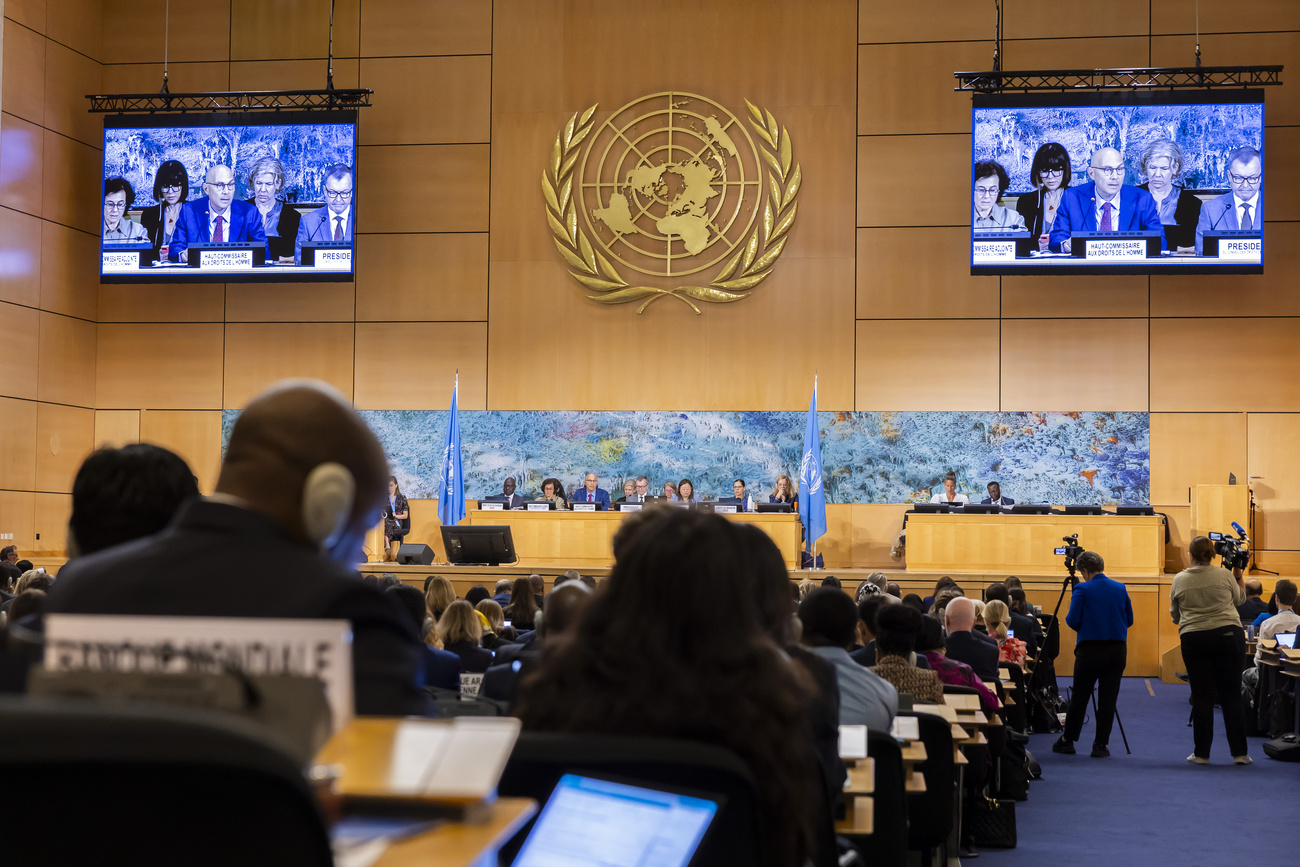
The Geneva-based UN Human Rights Council has condemned Iran for rights abuses and mandated an investigation into a recent crackdown on anti-government protests that killed thousands of people in January.
Select your language
Generated with artificial intelligence.
Listening:
UN Human Rights Council demands investigation into Iran’s ‘brutal’ repression

Meeting for a special session on January 23, the United Nations Human Rights Council decided to launch an “urgent investigation” into the crackdown on demonstrations in Iran in recent weeks. Its 47 members expressed their deep concern at the “unprecedented” scale of the violence perpetrated by the country’s security forces.
Since December 28 waves of protests have broken out across Iran sparked by the rising cost of living. Rights groups say bystanders were among those killed during the biggest crackdown since Shi’ite Muslim clerics took power in the 1979 revolution. Tehran has blamed “terrorists and rioters” backed by exiled opponents and foreign foes the US and Israel. The Norwegian-based NGO Iran Human Rights has confirmed 3,428 victims, but fears that the real death toll could exceed 20,000.
Given the urgency, some 50 NGOs had called for a special UN rights council session to be organised, which requires the agreement of a third of its member states.
Extended mandates approved
Friday’s resolution on Iran, approved by 25 votes to 7, with 15 abstentions, extends the mandate of the International Fact-Finding Mission on Iran by two years, and requires it to extend its investigation to recent events. The mandate of the Special Rapporteur on Iran will also be extended by one year.
The fact-finding mission was set up by the rights council in November 2022, initially to investigate the repression of demonstrations that broke out following the death in custody of the young Iranian woman Mahsa Amini. It has since concluded that the Iranian authorities committed crimes against humanity, including murder, imprisonment, torture and rape.

Crisis of impunity
Raha Bahreini, an Iran researcher at Amnesty International, said after the vote that she “welcomed the extension of the investigation mechanism”. In her view, the international community must “recognise” that justice cannot be served at the national level in Iran, where there is “a crisis of impunity”.
“We call on all UN member states to join us in calling for Iran to be referred to the International Criminal Court. It is time to go beyond condemnations and find concrete ways to ensure that justice is done at international level,” she added.
At the opening of the session, the UN High Commissioner for Human Rights Volker Türk called on the Iranian authorities to end to their “brutal repression”, stating that this “does not solve any of the country’s problems, but on the contrary creates conditions conducive to further human rights violations, instability and bloodshed”. Referring to “thousands of victims, including children”, he stressed the difficulties for his office in verifying the facts due to communications cuts and the lack of access to the country for his teams.
In reply, Iran’s ambassador in Geneva said he was “here [in Geneva] to state the facts and defend [his] people”, describing the demonstrations that intensified from January 8 onwards as “organised violence, including terrorist attacks, destruction of property and armed actions against civilians and the forces of law and order”.
Citing a “national survey”, the diplomat said 3,117 lives had been lost, 2,427 of them “killed directly as a result of terrorist operations”. He added: “The Islamic Republic of Iran does not recognise the legitimacy or validity of this special session and the resulting resolution.”
>> Read about how the Geneva-based UN Human Rights Council is being used to push through motions that fail in New York.
More
Is the Human Rights Council becoming a mini-Security Council?
North-South divide
While the special session received the support of more than half the council members, some countries voiced their disapproval during the debates.
Several African, South American and Asian countries denounced the “instrumentalisation of human rights”, which they see as a pretext for “interference” in the affairs of sovereign states. In their view, respect for human rights can only be achieved through “dialogue” and “cooperation” rather than confrontation.
They also denounced the “double standards” of the UN Human Rights Council, whose investigations have historically targeted developing countries. This reflects a growing divide between Western countries and the so-called Global South, particularly since the war in Gaza.
Here, China was among the most aggressive states. Its representative stressed that Beijing “defends the right of all countries to independently choose their own path in the development of human rights”. He added that China opposes “the imposition of specific human rights mechanisms on countries without their consent”, referring to the council’s investigations.
For its part, Switzerland welcomed the organisation of the special session on Iran and “urged the Iranian authorities to put an immediate end to the violence of mass arrests and the blocking of the Internet, to refrain from imposing the death penalty, including in connection with demonstrations, and to take concrete de-escalation measures”.
The United States has not been a member of the UN rights council since the return of President Donald Trump but can still attend as an observer; however, it was not present in the Assembly Hall of the Palais des Nations on Friday.
>> Read more about how China is rewriting human rights norms.

More
How China is rewriting human rights norms
Additional resources
The extension of the mandate of the Iran Fact-Finding Mission and that of the Special Rapporteur will require additional resources, according to a UN rights official.
The investigation mechanism will need a total of $2.97 million, of which $2.92 million (CHF2.25 million) have already been budgeted, while the rapporteur’s mandate will cost $451,700 a year instead of the $440,500 planned so far.
At a time when the UN is facing a serious budgetary problems, caused by late payments and reduced contributions from several member states, including the US, it is not clear if these funds will be released.
In February 2025, the council decided to set up a special commission of inquiry to document abuses committed in the Democratic Republic of the Congo. In December, Türk indicated that the commission had still not been able to begin its work due to a lack of resources. Other fact-finding missions, including the one on Myanmar, have also sounded the alarm about the lack of funding.
Edited by Virginie Mangin/adapted from French by AI/sb/ds

In compliance with the JTI standards
More: SWI swissinfo.ch certified by the Journalism Trust Initiative

You can find an overview of ongoing debates with our journalists here . Please join us!
If you want to start a conversation about a topic raised in this article or want to report factual errors, email us at english@swissinfo.ch.