





Lausanne hospital skin factory races to save Crans-Montana fire victims
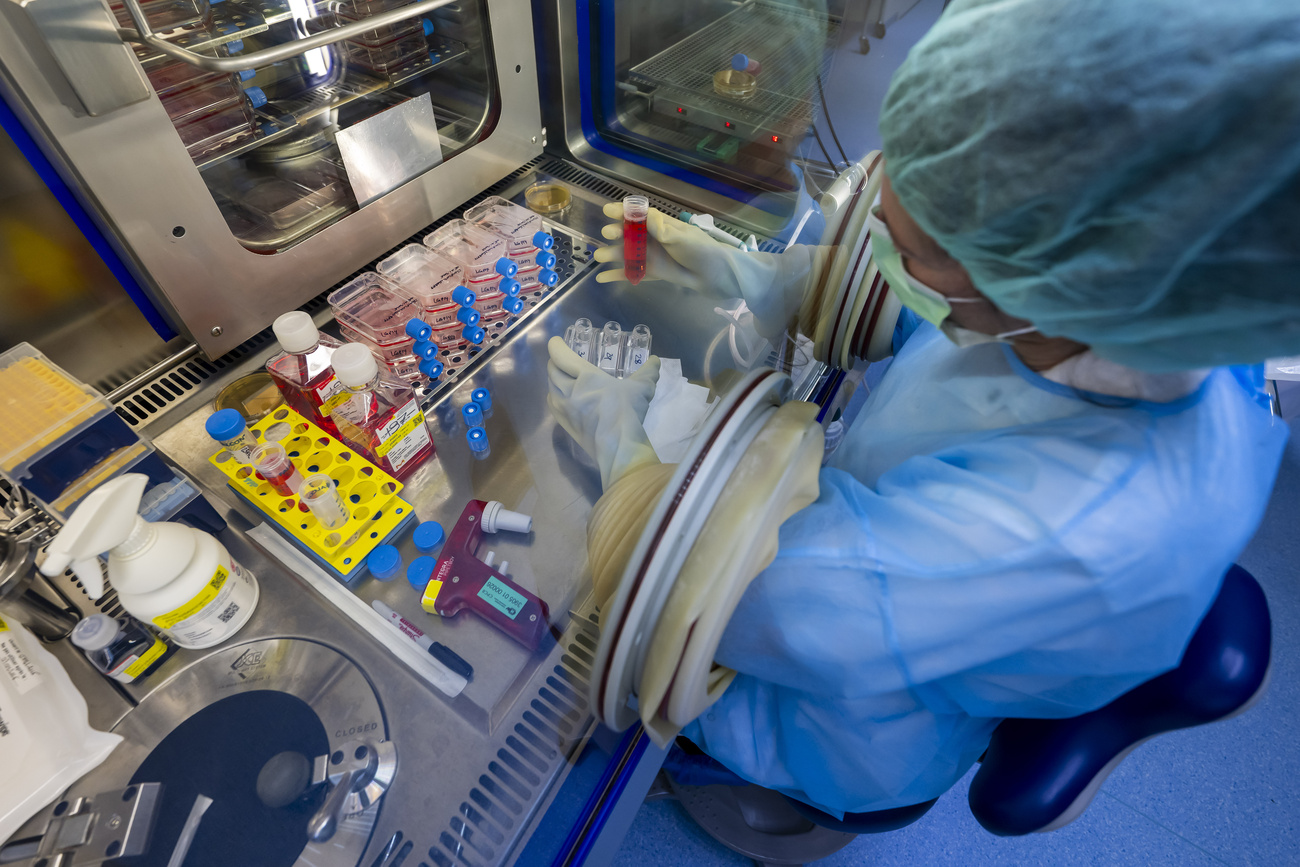
After the deadly fire in Crans-Montana, the skin factory at the cell production centre of the Lausanne University Hospital (CHUV), the only one of its size in Europe, is working at full capacity to help save severe burn victims.
Select your language
Generated with artificial intelligence.
Listening:
Lausanne hospital skin factory races to save Crans-Montana fire victims
+ Get the most important news from Switzerland in your inbox
“There is emotion,” but “for now, we are focused on action. The priority is to help these patients as much as possible,” whether they are hospitalised in Switzerland or abroad, Laurent Carrez, technical pharmacist in charge of the centre, located in the Swiss town of Epalinges, near Lausanne, told AFP news agency.
Since the tragedy in Crans-Montana, which left 40 dead and 116 injured, dozens of whom are still hospitalised, “we have been working seven days a week”, he said.
This centre – the only one capable of producing so much skin tissue while complying with Swiss and European legislation, according to the CHUV – works with pieces of healthy skin taken from the severely burned victims in Crans-Montana to avoid the risk of rejection.
“From 10 square centimetres of healthy skin, we are able to produce between 1 and 3 batches of 2,600 square centimetres. The 2,600 square centimetres represent roughly the surface area of a back,” explains Carrez, who points out that this body tissue, produced through cell reproduction, does not contain hair or sweat glands.
More
Fire victims treated in Zurich with skin from Dutch donors
To date, the centre has received 15 requests for skin grafts related to the Crans-Montana fire, whereas it normally produces grafts for around 20 patients per year.
This centre plays “a very important role” because “when 50 to 60%” of the body surface area is burned, “we have to grow skin in laboratories because we couldn’t do it simply by using the remaining healthy skin,” explains Olivier Pantet, a specialist in severe burns at the CHUV.
In a clean room, pharmacy technicians and medical laboratory technicians, dressed in lab coats, work calmly around the culture media – a nutrient preparation – in which skin cells are bathed to reproduce.
So far, “we have received biopsies from patients. We have recovered and stored their cells” and “we are about to begin the second phase, which is the most critical: the multiplication of keratinocyte tissue, i.e., skin,” explains Carrez.
This phase should last about three weeks, during which the cells, placed in boxes, multiply naturally until they touch each other and then form layers by stacking on top of each other.
“Then, at a certain point, they will stop growing, and that’s when we know they are ready. You can also see it in the appearance of the cells (…) They have achieved the desired function, that is, their tissue function, and are ready to form the equivalent of skin,” describes Carrez.
Next comes the work of coordinating with hospitals to “graft these skins” which, once they have “reached maturity,” must be applied within “the following two days.”
The success of these grafts is not always guaranteed. “If 80% of grafts take, we are very happy, it’s an excellent result,” says Pantet of the CHUV, a hospital that is currently treating seven patients with severe burns from Crans-Montana.
While waiting for these grafts, doctors can apply airtight dressings, pieces of skin from deceased donors, or fish skin to the burned areas.
New year’s tragedy
According to preliminary findings, the tragedy was caused by sparks from sparklers coming into contact with acoustic foam installed on the ceiling of the basement of the bar where the fire broke out.
According to Pantet, many of the victims in Crans-Montana have burns that cover a large area and are also deep.
To treat these severely burned patients, the CHUV ensures that they are hydrated and their temperature is controlled, given their lack of skin barriers: they are admitted to heated rooms at a high temperature of around 30 degrees Celsius, with particularly high humidity.
Once the grafts have been performed, doctors must also monitor the positioning of the joints during the healing process, using splints in particular, before a long rehabilitation process, explains Pantet.
Adapted from French by AI/jdp
We select the most relevant news for an international audience and use automatic translation tools to translate them into English. A journalist then reviews the translation for clarity and accuracy before publication.
Providing you with automatically translated news gives us the time to write more in-depth articles. The news stories we select have been written and carefully fact-checked by an external editorial team from news agencies such as Bloomberg or Keystone.
If you have any questions about how we work, write to us at english@swissinfo.ch
External Content

In compliance with the JTI standards
More: SWI swissinfo.ch certified by the Journalism Trust Initiative

You can find an overview of ongoing debates with our journalists here . Please join us!
If you want to start a conversation about a topic raised in this article or want to report factual errors, email us at english@swissinfo.ch.