








How poring over old journals gives insight into right-wing extremism today

Swiss historians are analysing periodicals published by right-wing networks after the Second World War. This research can help in understanding the communication strategies of today’s right-wing extremists.
Select your language
Generated with artificial intelligence.
Listening:
How poring over old journals gives insight into right-wing extremism today
When representatives of the political far-right from Europe and the United States gathered at a summit on the Portuguese coastExternal link to talk about “aesthetics” and “the avant-garde”, “memes” and “vibes”, “media work” and “terminology”, this had more to do with the pre-internet era than might seem at first glance.
This so-called Remigration Summit was, in large part, organised from Switzerland, a Swiss far-right activist told the magazine Republik during the event.
Digital platforms and social media are key communication and mobilisation tools for extremist groups. Through disinformation in particular – which is increasingly AI-generated – they create a kind of counter-public sphere.

Switzerland has long played a role in European far-right networks.
In order to understand how fascist and far-right ideologies have been able to spread, build networks and reorganise themselves since the Second World War, academics are increasingly turning their attention to so-called counter media.
The term counter media encompasses publications that define themselves as being in opposition to a media landscape portrayed as mainstream, hegemonic or elitist.
The first counter-media outlets to describe themselves as such often had a subversive and progressive character and gave a voice to marginalised issues and groups. They included, for instance, feminist magazines of the 1970s and 1980s, such as the West Berlin-based Courage.
Researchers, meanwhile, also use the term to refer to anti-democratic, conspiracy-theory-driven and far-right publications and platforms. In the 21st century, these often call themselves “alternative media”.
Magazines as a handy medium
In the mid-20th century, “magazines were the most exciting medium for political discourse”, says historian Franca Schaad. She’s taking part in a Swiss research projectExternal link, run by the University of Fribourg and the Bern Academy of the Arts, looking at the historical precursors of today’s counter media.
Schaad is writing her dissertation on representations of masculinity in periodicals of the New Right, many of which were founded in Germany and Switzerland from the 1960s onwards. Compared to books, magazines were quicker and cheaper to print. As Schaad explains, “this meant that even small groups and individuals could afford to spread their messages”.
1968 protesters: an enemy and a model
This development coincided with a “structural transformation of the public sphere”, as the philosopher Jürgen Habermas wrote in 1962. The Nazi dictatorship had destroyed press freedom in Germany from 1933 onwards and left a vacuum in the media market after 1945. A few large media companies came to dominate this space. “The ’68 movement took issue with this,” says Schaad.
The left-wing student movement pushed for social and political change in Germany, Switzerland and other countries. The right-wing milieu viewed the ’68ers with some ambivalence. On the one hand, the leftists were their enemy; on the other hand, their publishing activities were a model.
Many right-wing magazines copied the do-it-yourself style of the left-wing periodicals of the time, with their extensive use of collages and stencil cut-outs. “The aesthetic arose from what was in vogue and technically possible,” says Schaad.
Read our article on how political movements across Europe formed networks after the Second World War:

More
How the far right became a Europe-wide movement
Harking back to Antonio Gramsci
Drawing on the ideas of the Italian communist Antonio Gramsci, many right-wing journalists and intellects adopted the view, borrowed from leftist circles, that “changing hearts and minds” was a necessary step before taking political power. The goal was to penetrate culture, the “pre-political sphere” and public opinion.
As well as exchanging and discussing theories, right-wing journals of the 1960s to the 1980s also sought to test how the “boundaries of what can be said” could be shifted. “How could they make an ideology, in which inequality and violence play a major role, socially acceptable again?” asks Schaad rhetorically, and immediately provides the answer: “By presenting themselves as intellectual and rhetorically distancing themselves from fascism; whereas, in reality, the positions and worldview had not changed and were still nationalistic and ethnocentric.”
The result was a euphemistic, somewhat coded language. This is also evident in the term New RightExternal link. In Europe, including SwitzerlandExternal link, this self-designation spread in the second half of the 20th century among groups ranging from the radical right to violent far-right extremists. The label New Right serves, in part, to obscure their links to National Socialism and right-wing extremism, explains Schaad. It has, nonetheless, also become established in academic research. The Counter Media project uses it too.
Algorithms amplify right-wing content
Nowadays, members of the New Right often refer to themselves as the “alternative right” in order to reach more moderate supporters.
“It is dangerous to underestimate the communication style and language of the right,” says Franziska Marquart, a communications and media specialist at the University of Copenhagen, whose research covers political communication and disinformation via social media.
Thus, memes and the ridicule of political opponents are typical communication strategies used by far-right extremists. “Packaging problematic content in a humorous way helps normalise and trivialise it,” says Marquart.
Recent studies show that platforms such as TikTok amplify far-right content because their algorithms reward populist and emotional posts. “When you scroll randomly, there is a high risk of coming into contact with far-right content, especially for new users,” the academic explains.
A question of trust
According to Marquart, radical and extreme counter media – or their digital “bubbles” – influence voting behaviour only in a small number of people and in conjunction with other factors such as racist attitudes. It has been proven that counter media undermine trust in politics, the media and democratic institutions.
Public trust is comparatively high in Switzerland. In our ‘In Focus’ section, you will find numerous articles on this topic:
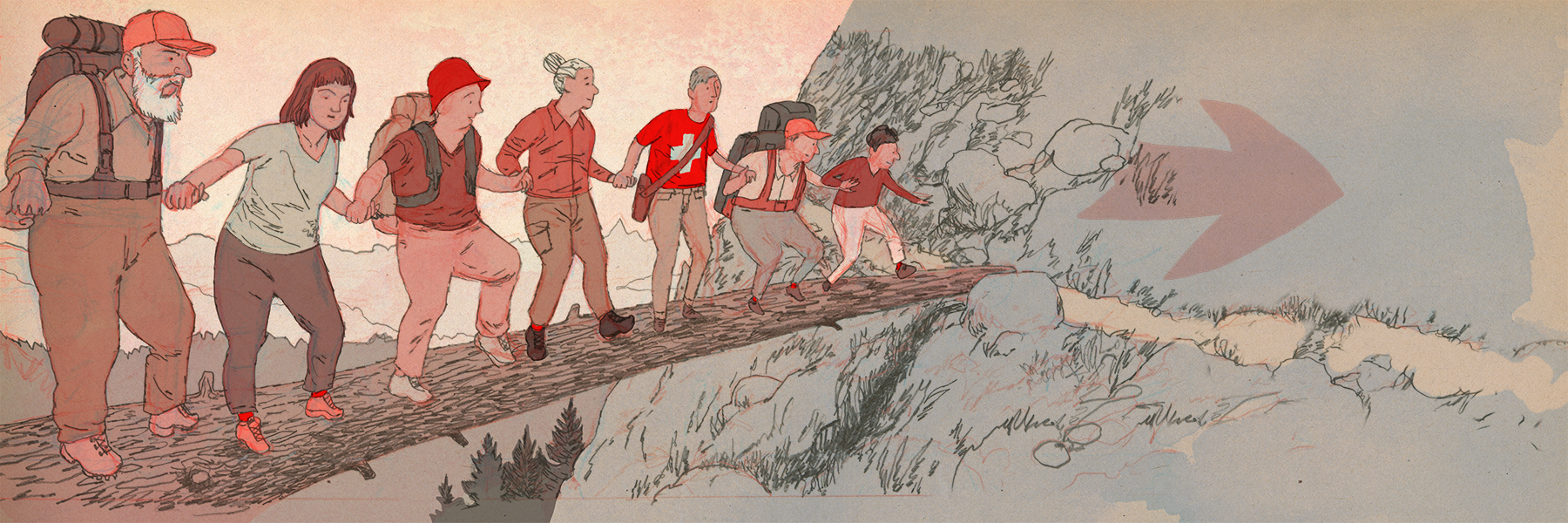
More
Why people in Switzerland trust the state
Counter media that spread disinformation and inflammatory material are all the more problematic when authorities and governments produce such content themselves, says Marquart, referring to Donald Trump’s Truth Social platform. The public’s fundamental trust in the state, in turn, influences whether right-wing populist and extremist views are more likely to be heard.
Writing competitions and freedoms
The right-wing magazines of the 20th century also sought to engage readers through emotionalised and sensationalised content and deliberate disinformation.
“Periodicals such as Nation Europa and Im Brennpunkt served as platforms,” says the historian Schaad. Through features such as self-tests, writing competitions and letters-to-the-editor pages, they aimed to create a sense of community.
The magazines of that era also frequently targeted a young readership, by focusing on current issues and communication trends. In the wake of the 1968 movement, more and more left-wing political magazines popped up at universities, as did right-wing conservative publications such as the Neue Studenten-Zeitung. Schaad cites the Neue Studenten-Zeitung, as well as the publications Abendland, Schweizerzeit and Memopress, as the most influential journals of the New Right in German-speaking Switzerland at that time.
While the reach of the Swiss periodicals was significantly less than that of their German counterparts, Schaad says, Switzerland was important as a transnational “hub” for the scene – and still is today. Reasons for this include its multilingualism and the “considerable freedom for far-right events” compared with neighbouring countries, she adds.

Influence of Armin Mohler and Emil Rahm
Switzerland also had an impact on the New Right through individuals active on the international stage. These included the journalist Armin Mohler and Emil Rahm, heir to the Rimuss drinks company, who published a Christian conspiracy-theory magazine.
Mohler had wanted to join the Waffen-SS in Nazi Germany. After the war, he popularised the idea of a “conservative revolution” among European right-wing extremists.
Today’s far-right extremists refer explicitly to their historical role models – meaning they are potentially interested in the same sources as historians. Contemporary historical research too long paid too little attention to these political magazines, Schaad laments.
Edited by Benjamin von Wyl. Adapted from German by Julia Bassam/gw

In compliance with the JTI standards
More: SWI swissinfo.ch certified by the Journalism Trust Initiative

You can find an overview of ongoing debates with our journalists here . Please join us!
If you want to start a conversation about a topic raised in this article or want to report factual errors, email us at english@swissinfo.ch.