








An advocate for the laws of war in a world that no longer believes in them

Alain Délétroz’s job involves meeting with warlords to convince them to protect civilians. As director general of the NGO Geneva Call, Délétroz pursues this mission even as the United States and other countries set an increasingly poor example.
Select your language
Generated with artificial intelligence.
Listening:
An advocate for the laws of war in a world that no longer believes in them

Alain Délétroz, 190cm tall, has the ideal stature for his unusual work: encountering some of the most ruthless armed groups on the planet to raise their awareness of the laws of war. His intense gaze compels attention, but his calm, measured voice and affability reveal a profound humanism and sensitivity.
Swissinfo met with him recently to discuss his career. Although he has travelled the world, he remains true to his roots in canton Valais and offered us coffee and Swiss chocolate while we spoke.
When asked what led him, in 2017, to accept his current post, he replied: “From a very young age, I’ve been drawn to what makes humans remain human even in the worst circumstances.” His unshakeable “faith in humanity”, he explained, evolved from his Catholic upbringing and propelled him into humanitarian work. He began his career in 1994 as an International Committee of the Red Cross (ICRC) delegate in Moscow.
“What struck me in my various jobs, especially during my first years as a young delegate, was seeing that this spark of humanity can be found in the hearts of people who have committed the worst crimes,” he said. “In fact, that is what Geneva Call works on.”
In sensitising armed groups to the Geneva Conventions that define the laws of war, the NGO originally aimed to fill a gap in the humanitarian sector. A quarter-century later, Geneva Call has established itself as a key player among Geneva’s international organisations. It is also one of the most discreet, although Délétroz willingly let Swissinfo peek behind the curtain.
Spark of humanity
Today, Geneva Call is in contact with more than 200 armed groups scattered across the globe. Approaching them and gaining their trust requires a thorough understanding of local circumstances, so over the last ten years the organisation has developed a network of field offices.
“It’s no longer staff from the Geneva headquarters who [fly in] to initiate dialogue. Our local colleagues do this work,” Délétroz explained. He then joins them later, when there is an opportunity to meet with high-ranking commanders.
How does he manage to convince warlords, with whom he seemingly has nothing in common, to respect international humanitarian law that is alien to them? “A purely legal argument is insufficient, in itself, to bring about a change in behaviour by armed groups that have committed, sometimes for years, serious violence against civilian populations,” he said. “You have to find something else.”
This “something else” is precisely the “spark of humanity” that Délétroz referred to throughout our meeting. “You have to try to find the thing that, in their mental framework or ideology, allows you to forge a connection,” he said. But he clarified that there is “no formula”.

His mastery of languages, including Quechua (which he learned as a young man from indigenous Peruvians) and Russian, surely is an enormous asset. So is his deep faith, which he has maintained throughout his life, and which he nourished as a seminarian for two years in the Spiritan missionary religious congregation within the Catholic Church.
Délétroz emphasises the importance of cultural and religious factors for these armed groups, which are invariably pursuing what he called “a cause”.
“If you question it, it’s over. Obviously, when I arrive in certain conflict [zones], as a [civilian], it is difficult for me to convince myself that their cause is just,” he admitted. But humanitarian neutrality allows him to set aside political considerations. “We don’t discuss the reasons people are fighting each other, but rather the way in which they are doing this and their responsibility towards civilian populations.”
This can lead to interactions that, to an outside observer, might seem surprising or even shocking. “I was recently on the phone discussing a delicate matter with a commander no one would describe as gentle. At the end of our conversation, he told me, ‘You and I share the same values’,” Délétroz said with an embarrassed laugh. But his job, by definition, is to speak with everyone.
When he describes his many trips to war zones – recently, for example, to the Democratic Republic of the Congo and soon to Ukraine and the Middle East – Délétroz carefully avoids naming his interlocutors. But this does not stop him from speaking more frankly than is typical in the discreet world of Geneva’s international organisations.
More
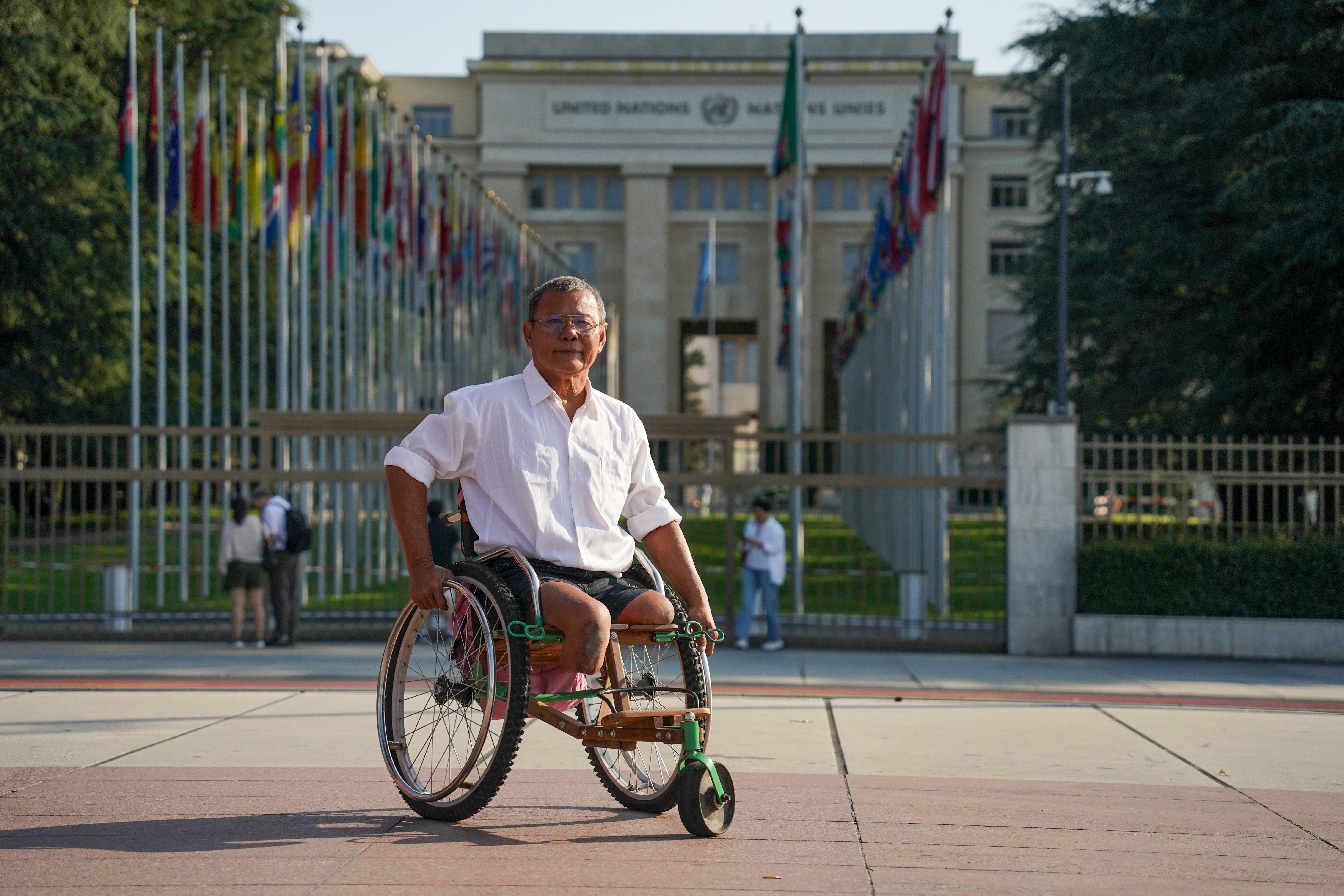
Cambodia’s Tun Channareth renews fight for mine-free world in Geneva
Erosion of international humanitarian law
The mission of Geneva Call has perhaps never been as difficult as it is today. It is challenging to convince armed groups to respect the Geneva Conventions when party states aren’t doing so themselves.
“Not a single national army engaged in combat is behaving properly,” Délétroz observed bitterly. He laments the widespread “erosion of international humanitarian law” in places as varied as Ukraine, Gaza, and Sudan.
“Since the Israeli bombardments of Gaza, several commanders of armed groups in the Middle East have told us very clearly: ‘Don’t talk to us about the Geneva Conventions anymore. If such horror can happen before our eyes without anyone caring, why should we respect these laws?’,” Délétroz said.
His teams therefore have to look elsewhere for ideas – in the codes of conduct of other militias or in religious texts that advocate similar rules.
“Contrary to what you might think, the vast majority of these groups wish to keep talking,” Délétroz was keen to point out. He nonetheless acknowledges that certain groups, notably jihadists, reject any kind of dialogue.
From his office overlooking the main United Nations square in Geneva, Délétroz has also noted that the nature of conflicts is evolving. “The biggest change in the last ten years is the area on the map of the world controlled by armed groups,” he said. This has expanded significantly and now encompasses over 200 million people. Certain militias have become de facto authorities that administer entire territories.
These changes have also transformed the work of his organisation, which currently has an annual budget of roughly CHF20 million ($25 million). “Initially, we focused mainly on the behaviour of combatants,” Délétroz said. “Today, we also offer training in the management and protection of civilian populations.”

Remaining hopeful
We asked Délétroz whether, after ten years of this work, he has any specific regrets. He thought for a moment. “When I saw the footage of October 7th, I said to myself that we had made a mistake in not engaging in dialogue with Hamas,” he said, “because none of the groups we work with kill civilians with garden tools.”
Geneva Call had never approached the Palestinian movement as many other humanitarian organisations were already active in the Middle East. The NGO had therefore chosen to focus its efforts on other conflicts, particularly in Africa.
At 62, Délétroz, father of two sons and three daughters, refuses to give way to pessimism despite the erosion of international humanitarian law, a deteriorating security environment, and the funding crisis in the humanitarian sector.
“What motivates me is seeing people who used to commit crimes change their behaviour, establish rules for their troops, and punish violations,” Délétroz said. “This is what gives us the strength to continue.”
Edited by Samuel Jaberg. Adapted from French by K. Bidwell/gw
This profile is the first in a series dedicated to the individuals who embody the trends shaping International Geneva today. The next installment will feature Alain Werner, director of Civitas Maxima, an NGO that tracks down war criminals from Geneva at a time when international justice is under pressure.

More
Our newsletter on geopolitics

In compliance with the JTI standards
More: SWI swissinfo.ch certified by the Journalism Trust Initiative

You can find an overview of ongoing debates with our journalists here . Please join us!
If you want to start a conversation about a topic raised in this article or want to report factual errors, email us at english@swissinfo.ch.