





Swiss arts outlook for 2026: the perks of inequality

Select your language
Generated with artificial intelligence.
Listening:
Swiss arts outlook for 2026: the perks of inequality
From record inheritances to Gulf power plays, 2026 promises to be a year when money talks louder than ever in the cultural arena. Also check out our exhibition picks in Switzerland and what’s to come in the Swiss film world.

Inheritances in the eight digits and higher are growing. Economic players jostle on how to tax them – or not. But inheritances certainly create a thriving environment for the arts market.
ResearchExternal link by the Swiss bank UBS concluded that the super-rich are inheriting record levels of wealth as they pass down billions of dollars to their children, grandchildren and spouses. Most of the inheritances are expected to come from the US, followed by India, France, Germany and Switzerland. In the Alpine country alone $206 billion (CHF165 billion) will be inherited in the next 15 years, according to the bank.
In another UBS study, the 2025 editionExternal link of The Art Basel and UBS Survey of Global Collecting, the focus is on high-net-worth individuals (HNWI), their interests across regions and generations, and their spending patterns.
The study identified two main trends: HNWIs collectors allocated an average of 20% of their wealth to art, up from 15% in 2024. HNWIs with over $50 million in assets averaged 28%. Gen Z collectors (born during the late 1990s and early 2000s) also reported higher-than-average allocations, at 26%.
The other trend is that 84% of the HNWIs surveyed inherited artworks, accounting for almost 30% of the works they owned. Almost 90% of Gen Z collectors who inherited works kept them. The authors believe that it shows a tendency to continue family tradition and build up their collections, but another reason could be that, in view of a slight downward trend in the last two years, most of them prefer to wait for a more auspicious moment to sell.

Bad times, good times
One year ago, before US President Donald Trump took office, the mood at Art Basel Miami Beach – the last big fair of the year, and usually a thermometer of the market – was of “cautious optimism”.
The expression was repeated over and over this year in the trade press in view of the tariffs war and uncertainties surrounding US policy. But seeing the late sales of blue chips in the Miami fair in December, reinforcing the trends observed in both Art Basel Paris and Frieze London in October, and the rebounds of the auction market in the second half of 2025, the stress now is more on “optimism” than on “caution”.
The very rich are back in buying mood, and not only art. The big auction houses, such as Christie’s and Sotheby’s, have invested extra energy in luxury goods to offset the previous downward trend of artworks. And it seems to have paid off: Christie’s jewel auctions in Geneva raised over $72 million in May and $60 million in November; the house also sold a Fabergé egg for a record £22.9 million (CHF24.5 million) in London in December.

Geographic shift
However, the art power centres are shifting to the Arabian Gulf. One of the indicators is that the region is the most recent battlefield in the geopolitical sabre-rattling between Art Basel and Frieze, the world’s leading international art fairs.
Art Basel Qatar will see its first edition in February, and in November Frieze inaugurates its own venue in Abu DhabiExternal link, where Sotheby’s has just inaugurated its first annual Collectors’ Week (this past November).
The emirate’s sovereign wealth fund has a minority stake in the British-founded, New-York based multinational auction house. Abu Dhabi already has a Louvre “franchise”, but now it has just opened two new home-grown mega-museums, the Zayed National Museum and a Natural History Museum.
Meanwhile, Art Review’s yearly list of the 100 External linkmost influential people in the field included two of the region’s art leaders among the top ten.
Sheikha Al-Mayassa bint Hamad bin Khalifa Al-Thani, the sister of the current emir of Qatar and chair of Qatar Museums, that comprises a dozen institutions and heritage sites in the country, rose from the 21st spot last year to second. She was followed by curator Sheikha Hoor Al Qasimi, the youngest daughter of the ruler of Sharjah, president of Sharjah Art Foundation (Sheikha Hoor Al Qasimi was in the first place of the list last year).
Sharjah is one of the seven emirates of the UAE, and it hosts the oldest arts biennial in the region – since 1993. New galleries are opening in Saudi Arabia and Dubai. The Gulf caters to elites from Asia, Africa, and the West, and the Middle East, of course. Add to it an environment of laxer taxes and tariffs, the Gulf tends to play an expanding role in the art market in the next very few years.

More
Art Basel expands to Qatar despite the drums of war in the Middle East
With and without Koyo in Venice
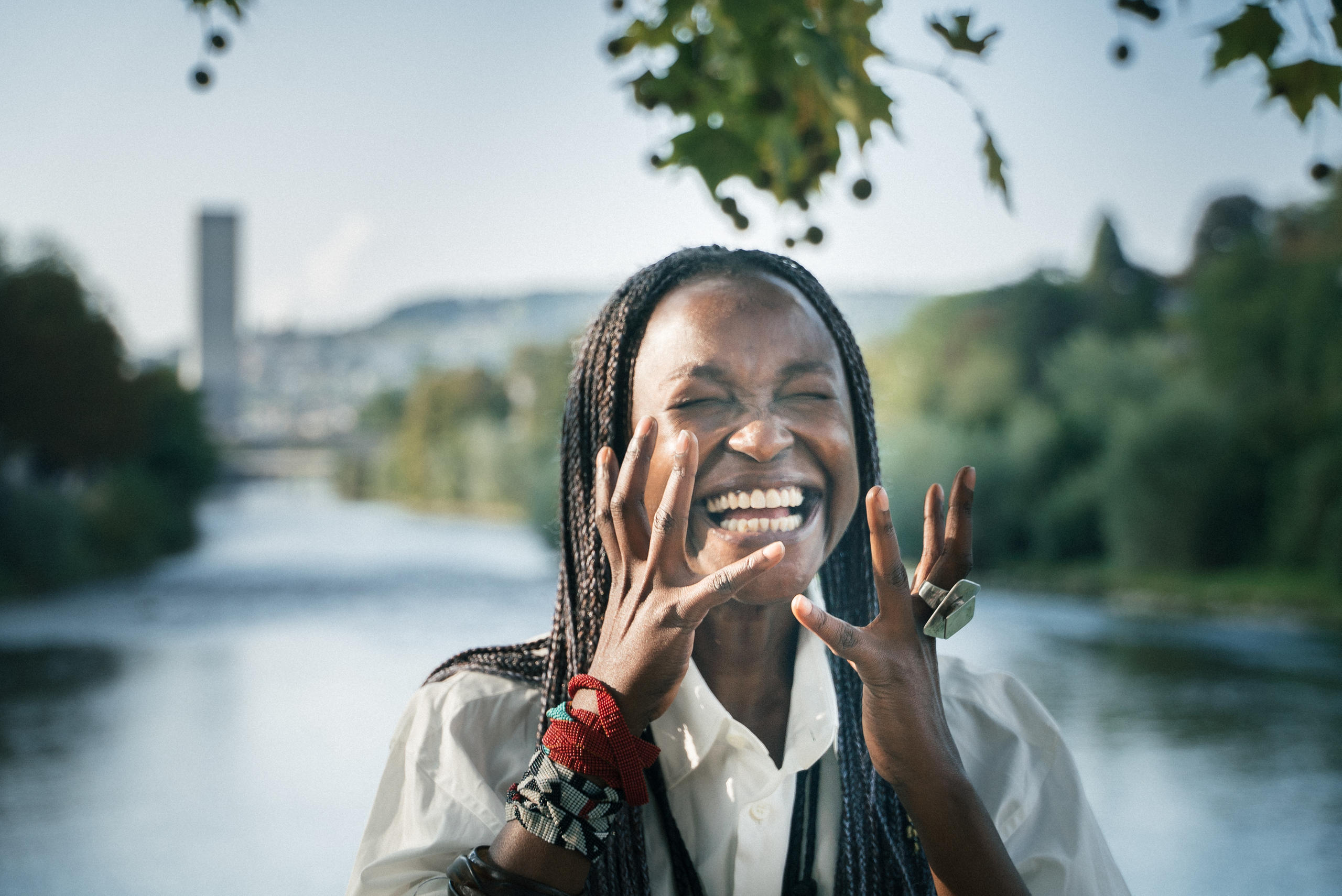
The Old Continent, though, hasn’t yet lost all its glitter and attention. The 61st Venice Biennale starts in early May amid a lot of anticipation. The announcement of Swiss-Cameroonian curator Koyo Kouoh as artistic director of the show was auspiciously greeted in the art world – Kouoh has been without doubt one of the most important art agents of the last decades.
Her sudden death in May, at the age of 58, left an unreplaceable gap, but the interim curators vow to “follow the project just as Kouoh conceived and defined it, with the purpose of preserving, enhancing and disseminating her ideas and the work she pursued”.
The Swiss Pavilion in Venice this year chose a Swiss collective with a pan-European range of work to represent the country with the installation “The Unfinished Business of Living Together”. The concept devised by curators Gianmaria Andreetta (Lugano/Berlin), Luca Beeler (Zurich) and artist Nina Wakeford (London) was developed by the full team further consisting of Miriam Laura Leonardi (Zurich), Yul Tomatala (Geneva) and the collective Lithic Alliance (Zurich/Brussels).
Based on a 1978 episode of the Swiss debate TV show Telearena, discussing sexual orientation, “the project seeks to examine the conditions and possibilities of tolerance and belonging as well as forms of social division”. Considering the very scant information on the project, all we can infer right now is that there are many voices, representing all linguistic regions of Switzerland, creating hopefully an inspiring polyphony.
More
Koyo Kouoh: Art is in the cracks, not in the polish
Treats for the eyes and senses
2026 will also bring several mind-boggling exhibitions in Swiss museums. A brief selection:
Kunsthaus Zürich: until February the Zurich Fine Arts Museum is focusing on two outstanding women:
![Lygia Clark at the I Exposicão de Arte Neoconcreta [1st Neo-Concrete Exhibition] in front of her Unidades [Unities], Rio de Janeiro 1959.](https://www.swissinfo.ch/content/wp-content/uploads/sites/13/2025/12/Lygia_Clark_Exposicao_Arte_Neoconcreta.jpg?crop=0px,461px,2796px,1866px&w=580&ver=619cf403)
The Brazilian Lygia Clark started her career deeply influenced by the Concrete Art movement led by the Swiss artist Max Bill. But she would soon overcome Max Bill, Concretism, and the very tenants of art…


… and the Genevan Alice Bailly, one of the first Modernist Swiss women. Like many of her contemporaries, her life and work have spent decades buried under the fame and glory of her male peers.
In October the museum is also putting together, side by side, the work of the Austrian Maria Lassnig and the Norwegian master Edvard Munch, of whom the Kunsthaus holds the largest collection outside Norway. The bold juxtaposition of the two artists, whose careers did not cross during their lifetimes, “allows for a new reading of their art”, write the curators.
As for the Emil Bührle collection, from March 20, new artworks will be displayed in parallel with the section dedicated to the provenance research on artworks suspected of being acquired under duress from Jewish collectors. The museum has also announced that a whole new presentation of the collection is slated to open in early 2027.

Kunstmuseum Basel: A grand retrospective of Lee KrasnerExternal link came to Bern in 2020, and now it’s the time of Krasner’s contemporary Helen Frankenthaler, a major abstract artist of post-war America, in Basel – from April to August. Frankenthaler’s show will be followed by a wide exhibition of Roy Lichtenstein’sExternal link prints of every phase of his career. And in March the museum opens the exhibition “The First Homosexuals 1869-1939”, turning a spotlight on the early visibility of same-sex desire and gender diversity in the arts.

The Geneva Arts and History Museum (MAH Genève) is showing until April the exhibition Elles. Contemporary Australian Indigenous Women Artists, with a remarkable selection of works that reinvent the millenary spiritual and cultural heritage of Australia.

Otobong Nkanga at the Lausanne Cantonal Fine Arts Museum: the Nigerian artist based in Brussels is probably one of the most significant of the post-colonial African generation. This retrospective, conceived in partnership with the Modern Art Museum of Paris, is on show from April to August.

Finally, highlights of 2026 at the Zentrum Paul Klee in Bern: a show dedicated to the Brazilian landscape architect Roberto Burle Marx, who added an organic touch to the futuristic design of the capital Brasilia, among a multitude of works.

And another dedicated to German artist Kurt Schwitters, whose oeuvre crossed all the artistic action of the first half of the 20th century, through several genres and media – Dadaism, constructivism, surrealism, poetry, sound, painting, sculpture, graphic design, typography, and installation art.

Our film picks
Several Swiss films slated to be released in cinemas and on platforms next year made a tour of international festivals in 2025. Our team of critics around the world followed attentively the journey of some of the most outstanding:

More
Sri Lankan artist challenges Swiss museums over looted heritage

More
Swiss filmmakers take on virtual reality to draw viewers into ecstasy and exile

More
Milagros Mumenthaler: a filmmaker crossing currents between Switzerland and Argentina

More
Swiss silence, wartime shame, and one girl’s fight against patriarchy

More
Behind the cranes, Jean-Stéphane Bron exposes the architecture of inequality

More
Swiss-Kenyan filmmaker sets lo-fi love story in hi-tech future
But the state of the industry and the creative mood of the field will only become clearer in late January, when the Solothurn Film Festival, the main national festival, opens.
Apart from the competition for the Prix de Soleure, the event holds a few other well-curated sections. This year the ‘Histoires’ programme presents nine works created by Swiss filmmakers in New York between 1978 and 1992. It’s a very broad constellation, capturing in their frames “from Basquiat to Brad Pitt”: Downtown 81, Face Addict, Johnny Suede, Little Noises, Candy Mountain – some of them can be watched in the platform filmo.chExternal link, but only in Switzerland.
Critic Alan Mattli, editor of the film magazine FilmbulletinExternal link and long-time Swissinfo collaborator, has the following films in sight: Thomas Imbach’s Nacktgeld (The exposure); Autour du feu (Around the fire), by Laura Cazador & Amanda Cortes; Lydia: Aufzeichnungen aus dem IrrenhausExternal link (Lydia: Notes from the madhouse), by Stefan Jung; Namaste Seelisberg, by Felice Zenoni; and Der Mann auf dem KirchturmExternal link (The man on the church spire), by Edwin Beeler.
>> So far, only Thomas Imbach’s The Exposure has a public trailer available with English subtitles:
External Content
Edited by Mark Livingston/ts

In compliance with the JTI standards
More: SWI swissinfo.ch certified by the Journalism Trust Initiative

You can find an overview of ongoing debates with our journalists here . Please join us!
If you want to start a conversation about a topic raised in this article or want to report factual errors, email us at english@swissinfo.ch.