








Penalties and peculiarities of the Swiss Highway Code

The Swiss Highway Code is one of the most detailed and strict on the continent. Updated annually, it reflects some of the magnificent obsessions typical of the Swiss mentality and customs.
Select your language
Generated with artificial intelligence.

Listening:
Penalties and peculiarities of the Swiss Highway Code
Driving on a Swiss road will probably soon strike you as being “very Swiss”: liberal, rational and fussy. Traffic lights, for example, show orange before red, and also before green. With orange, however, it is forbidden to go through the lights, unless braking would endanger someone else. Rather, it serves as a warning, and to ease traffic flow.
Unlike in other countries on the continent, where information is mostly at the side of the road and on signs, in Switzerland the stripes on the asphalt play an essential role. It is on the road surface that the division of a carriageway into cycle lanes, reserved for public transport and preselection art, is visible.

The laws can be found on the website of the Federal Roads Office (FEDRO) External linkand the subject is regulated by the Federal Road Traffic Act. Federalism, then, turns everything into a jungle of rules, with aspects that are the responsibility of the cantons and municipalities. Crucial is the 74-page Ordinance on Road Traffic Regulations.
Hands off the horn
Obligations reflect Swissness, from attention to detail to a passion for order and cleanliness.
Forget about honking your horn in protest or to greet a friend. Article 29 of the ordinance calls horns “warning signals”, lumps them in with high beams, and specifies that they are used only “if traffic safety requires it”. Two cases are covered: to attract the attention of distracted onlookers or to negotiate a tight bend without a view. When night falls, honking is permitted only in the event of danger.
The ordinance warns about noise – such as keeping the engine running unnecessarily, accelerating too quickly or “constantly making unnecessary laps in built-up areas”. In 2025, the noise produced by exhaust pipes was added, particularly if it crackles, an offence for which there is a penalty of up to CHF10,000 ($12,850).
In addition, it’s forbidden to load and unload the car carelessly and to slam the doors. Also prohibited are “other nuisances” such as splashing pedestrians in wet conditions.
The ordinance specifies that one must drive in such a way that other road users “are disturbed as little as possible”. Fussy Switzerland has put this in the Code, because if you are rude, there must be a chance to bring you to heel, legally.
Hefty fines
There is zero tolerance when it comes to parking. Parking is expensive, and you have to live in Switzerland for a few years to understand the logic. There is timed parking, free parking for 60 or 120 minutes with a parking disc; there are white and blue stripes; there is no concept of parking without paying in the cities, and controls are frequent.

Punishments for speeding are heavy. They range from CHF40 to thousands of francs and the withdrawal of a driving licence. Here are the Swiss speed limitsExternal link.
The rules are many, and so detailed that the best strategy behind the wheel is to live in paranoia. For example, the tyre tread must be at least 1.6 millimetres deep. An insufficient tread can be punished with a fine of CHF100. If the tyres are very worn, the licence can be revoked for at least one month.
More
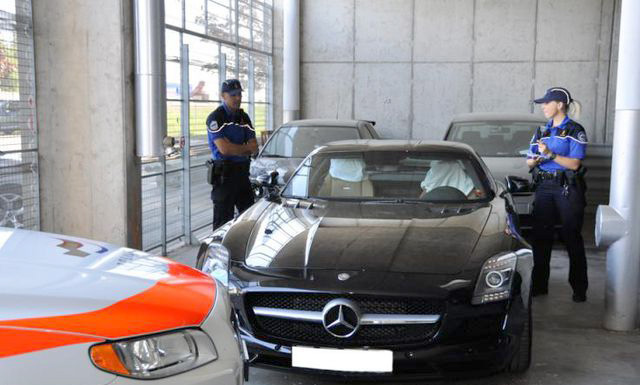
Driver faces $1,000,000 speeding fine
In the Swiss Code, trams always have right of way. Not only over cars, but also over pedestrians. So get the idea out of your head that the juggernaut on rails will eventually stop if you are crossing a road – it won’t.
Round and round
Roundabouts are a magnificent Swiss obsession. So common, in fact, that on the website of the Touring Club of Switzerland (TCS) there are animations External linkon how to use them. A Swiss favourite is to decorate the centre of them with floral arrangements or works of art, some examples of which are in this gallery published by Swissinfo.

The legal term is “mandatory roundabout areas”, but in canton Ticino they call them rotonde. The Italian-speaking region has the highest proportion of undisciplined people on roundabouts, according to the website of the Ticino cantonal police.
The obsession with detail has led to the inclusion in the Road Traffic Ordinance of paragraphs so obvious that they seem unnecessary. Thus it is forbidden to drive the wrong way down a one-way tunnel, and children may ride a bicycle only if they are able to pedal.
The national need for cleanliness has also taken over the highway code. In Switzerland, a vehicle’s headlights, mirrors and windows must be clean. So much so that if you turn up for the inspection with a dirty car, they send you home.
The driver must see the roadway “with a 180° view”. So hanging trinkets from the rearview mirror can result in a fine, a warning, up to and including having your licence taken away. Watch out for snow: in Switzerland you risk a fine if you only clear part of the windscreen. The good citizen has a squeegee in the car to free the roof and glass from snow and ice.

On Alpine roads, uphill vehicles and heavy goods vehicles have priority. If you meet in a narrow passage, it is therefore the one who is descending who has to back up, unless the other is in the vicinity of a lay-by. If, however, you encounter a PostBus External link(the yellow bus with the three-tone horn), bear in mind that Article 38 of the Ordinance gives the driver of a public transport vehicle the powers of a traffic warden: they can tell us what to do and we must obey.

Unlike many surrounding countries, winter tyres are not compulsory in SwitzerlandExternal link. But we all have them fitted as soon as the warm weather is over, because by law the vehicle “must always be safe”. So if you have an accident in winter in a vehicle sporting summer tyres, you risk a fine and insurance claims. It is a classic of the Swiss mentality: liberal, with an iron fist. The meaning is: “Choose how you behave – and if you want to be punished.”
Etiquette and customs
If in Switzerland you pass another car in a narrow passage, wave. When crossing at the zebra crossing, thank the motorist. Children learn in primary school how to cross roads, because it is traditional for them to go to school alone. They wear reflective waistcoats and wave their hands after crossing.
The issue of zebra crossings is central to the Swiss culture of civic coexistence. So much so, in fact, that newspaper Blick devoted a survey to it: “How do people who read our paper behave on zebra crossings?”External link Out of 20,000 people, only 1% said they did not acknowledge the motorist who stopped to let them pass.

You only have to put your big toe on the crosswalk for cars to stop. This makes Swiss tourists a potential public danger: try doing the same on a busy street in Rome.
Given the abundance of bicycles, there are numerous rules on the use of two-wheeled vehicles. FEDRO dedicates a page on its website to the CycloGalateoExternal link.
Motorways and vignettes
Switzerland was the first country, in 1984, to introduce the vignette certifying payment of motorway tax. Since 1994, the vignette has been enshrined in the Constitution. The sticker changes colour every year and is now also in digital form. Not having it results in a fine of CHF200; anyone who tampers with it or uses it more than once can be punished with a prison sentence of up to three years.
More
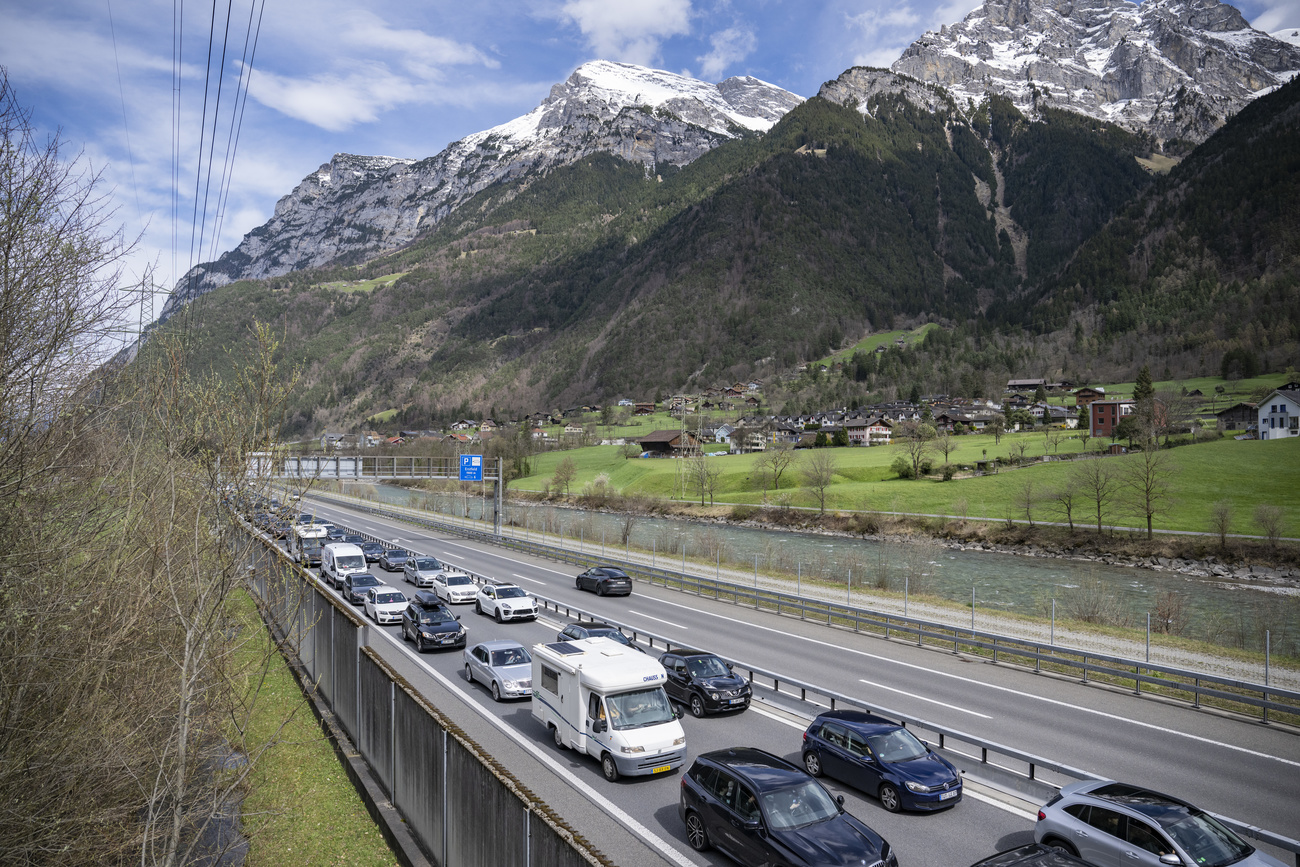
Why cars still reign supreme in ‘rail-nation’ Switzerland
As of 2021, it is compulsory to create an “emergency corridorExternal link” in the middle of the motorway carriageway, as soon as slowdowns occur, to ensure the passage of emergency vehicles. Those who do not comply can be fined CHF100, with high penalties if assistance is prevented, including prosecution and confiscation of the driving licence.

The Swiss make fun of themselves for the perfection of their roads, which are resurfaced so often that the federal authorities felt obliged to justify themselves in the Frequently Asked Questions: “With respect to road maintenance, are the Swiss perfectionists?”. The 2023 figures of the Federal Statistical Office confirm the widespread perception: “The maintenance, operation and expansion of the road infrastructure cost the public purse CHF7.7 billion.”
Edited by Samuel Jaberg. Translated from Italian by AI/ts
How we translate with AI
We use automatic translation tools, such as DeepL and Google Translate, for some content.
Each translated article is carefully reviewed by a journalist for accuracy. Using translation tools gives us the time for more in-depth articles.
Learn more here about how we work with AI.
More


In compliance with the JTI standards
More: SWI swissinfo.ch certified by the Journalism Trust Initiative

You can find an overview of ongoing debates with our journalists here . Please join us!
If you want to start a conversation about a topic raised in this article or want to report factual errors, email us at english@swissinfo.ch.