








Can Switzerland’s cantonal police meet today’s challenges?

Switzerland’s longstanding system of independent cantonal police is facing issues it wasn't designed to tackle, including police misconduct and international crime. Criminologist Daniel Fink recently co-authored a book that addresses these difficulties.
Select your language
Generated with artificial intelligence.

Listening:
Can Switzerland’s cantonal police meet today’s challenges?

In Switzerland, as in many countries, police misconduct and excessive use of force spark heated debate. Recently, the police’s image was tarnished by several scandals in Lausanne, including racist messages on police WhatsApp chats, and the death of a Nigerian man during his arrestExternal link.
Daniel FinkExternal link and his co-author Silvia Staubli have just published a book called La police en Suisse (The Police in Switzerland) as part of the Savoir Suisse collection, a series that presents the latest research on a wide variety of Swiss topics. Fink, an expert in criminal statistics, highlights the current challenges faced by police, including operational efficiency, democratic legitimacy, and the constraints of Switzerland’s federal system.
Daniel Fink is an associate member of the faculty of law, criminal justice, and public administration at the University of Lausanne. He was previously a lecturer at the University of Lausanne and the University of Lucerne, and for 15 years he was in charge of the Crime and Criminal Justice section of the Federal Statistical Office (FSO). He was also a delegate of the International Committee of the Red Cross and, from 2018 to 2024, a member of the UN Subcommittee on Prevention of Torture.
For the past three decades, Fink has published research on policing, justice, and prisons. His book La prison en Suisse (Prison in Switzerland) was also included in the Savoir Suisse collection.
Swissinfo: In your book, you describe the discovery, last year, of Lausanne police officers making racist remarks in WhatsApp chats. The public was shocked by this news. Do you consider this behaviour an isolated incident or a sign of structural problems within the Swiss police?

Daniel Fink: Extremism exists in every police force. There are people everywhere whose only objective is to maintain order in society and arrest criminals, and who attach less importance to respect for human rights, presumption of innocence, and the principle of proportionality.
It’s also not entirely a coincidence that more incidents of misconduct have occurred in canton Vaud. The Savatan police academy there has already been heavily criticised for its security-focused approach and its militarised instruction, both of which can have an effect on behaviour.
A recent study, conducted as part of [Switzerland’s] national action plan to combat radicalisation, showed that radicalisation exists within the [Swiss] police, but that it’s limited in scope. However, it becomes a problem when radicalised individuals encourage one another and when a code of silence surrounds misconduct, as happened in Lausanne.
Swissinfo: Should Swiss police training be changed in order to prevent this type of abuse?
D.F.: We already made significant progress in the last century by moving from completely localised training to more standardised training. Diplomas are now awarded by commissions that are independent from the cantonal police forces.
However, we still don’t have a truly uniform training programme because the country has seven (and soon will have nine) different police academies, which have very different approaches. This creates a lack of consistency in their programmes.
Education about respecting human rights in police work should also be improved. Many hours of instruction are devoted to how a person should be arrested, but the training doesn’t sufficiently address the fact that interventions should be proportionate and respect people’s dignity.
Swissinfo: Public trust in the police is essential for officers to be able to do their jobs, as you explain in your book. Do you think the misconduct in Lausanne has undermined Switzerland’s trust in its police?
D.F.: For the moment, the police still enjoy a good reputation in Switzerland, according to various surveys. But obviously these scandals shake our image of a fair and law-abiding police force. When this type of event occurs, it is therefore necessary to take action.
I believe that the relevant political leaders, the commanders, and the police unions have a duty to spell out very clearly the requirements regarding human rights, arrests, and how to manage demonstrations. These are the elements that, in the long run, assure the legitimacy of the police.
Swissinfo: You also note that the available mechanisms for complaints and mediation are often insufficiently independent. Is this a weakness of the Swiss police system?
D.F.: Yes. Switzerland is regularly criticised for not having established, in every canton, the mechanisms that should exist for bringing a complaint against those authorised to use force.
The situation varies from canton to canton: some have established a body within the justice ministry; others within the police force itself. Switzerland is therefore lagging behind in creating institutions that are at once functional, truly independent, and adequately staffed.
Swissinfo: The Swiss police are regularly accused of racial discrimination. In 2024, the European Court of Human Rights ruled that the Swiss police were guilty of racial profiling. Should more be done to prevent this?
D.F.: Yes, the police should put mechanisms in place to curb these practices, but they should also communicate the existing efforts to combat them. The Zurich city police force offers an example of this.
Since 2018, it has been using an app to document all checks carried out. This measure has reduced the number of identity checks from roughly 26,000 to 11,000 per year. Has security been compromised as a result? No, the situation has not changed at all, according to Zurich’s deputy police commander.
>> Read our investigation of racism in the Swiss police force:
More
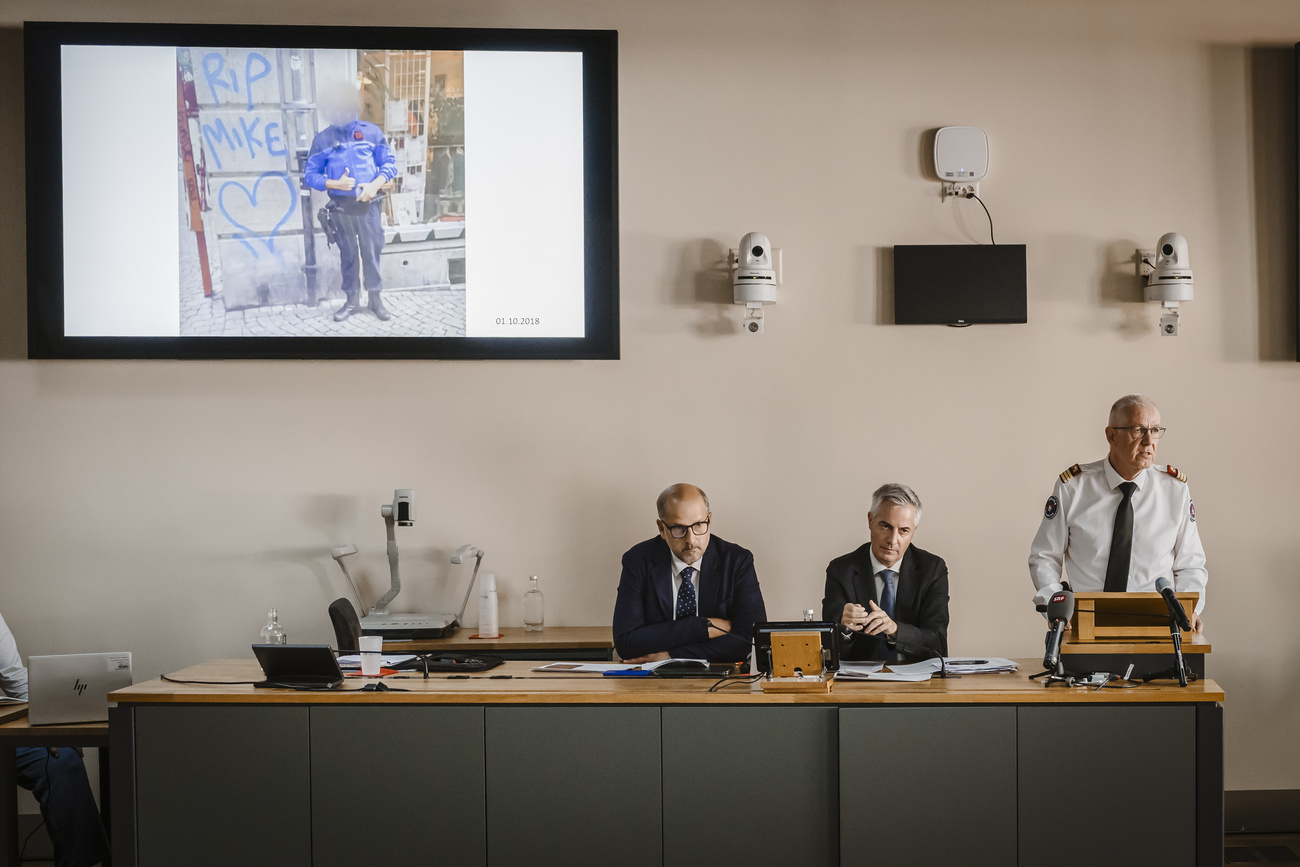
Racist chats among Lausanne police – an isolated case in Switzerland?
Swissinfo: In Switzerland, the police remain a cantonal responsibility. Is this federal model a strength or a weakness
D.F.: Today it’s becoming a weakness. Federalism in policing is a legacy of the early 19th century. During the period of the Helvetic RepublicExternal link [1798-1803], a national police force was planned, but the cantons firmly opposed this centralisation.
Since the 1803 Act of Mediation [that ended the Republic], all attempts at centralisation have failed, and the cantonal police have remained very independent. Today, the Federal Office of Police, founded around 1900, still only has limited authority: coordination between cantons for certain cases, representation abroad, and providing resources like the DNA database for locating missing persons.
In all other matters, each police force operates independently. This results in doctrines and practices that vary widely from one canton to another. To give just one example, some police forces recruit only Swiss citizens while others also accept foreign residents.
Swissinfo: Is the cantonal model up to the task of combatting cybercrime and terrorism in addition to upholding international standards for human rights?
D.F.: Faced with crime that is becoming increasingly international, this model is showing its limitations. Each canton still tends to function in a kind of “ivory tower”, and attempts are being made to compensate for this fragmentation by introducing technical tools for coordination. But these mechanisms remain largely insufficient.
This raises the question of whether police federalism remains relevant in the face of supranational phenomena such as cybercrime or organised crime. In my opinion, if the system remains unchanged, then we’re heading towards increasing inefficiency.
Swissinfo: How would you design the Swiss police of the future?
D.F.: Having observed internal conflicts within various countries for the International Committee of the Red Cross and for the United Nations, I believe it is impossible to live without police in modern society. A police force is necessary, but it should be strictly regulated and supervised, especially when it deploys force. It must also be aware of its specific role and do everything it can to be transparent about what it does and how it does it, and be able to justify it.
Edited by Samuel Jaberg. Adapted from French by K. Bidwell/gw

In compliance with the JTI standards
More: SWI swissinfo.ch certified by the Journalism Trust Initiative

You can find an overview of ongoing debates with our journalists here . Please join us!
If you want to start a conversation about a topic raised in this article or want to report factual errors, email us at english@swissinfo.ch.