








Governments and industry must work across the cocoa and gold sector to address child labour

Select your language
Generated with artificial intelligence.

Listening:
Governments and industry must work across the cocoa and gold sector to address child labour
Ending child labour in western Africa needs a more holistic approach on the ground that addresses the social and economic systems at play. This means all stakeholders – governments, industry, buyers and regulators - must sit around the table together.

Swiss companies play a central role in global agricultural supply chains such as coffee, cocoa, or palm oil. With that influence comes exposure to some of the most entrenched human rights risks worldwide. Nowhere is this more evident than in the in the cocoa sector in the Ivory Coast and Ghana, where child labour remains widespread despite decades of corporate commitments and monitoring.
The core challenge is not awareness nor the absence of sustainability strategies. It is that human rights risks in many sourcing countries are systemic, while corporate responses remain fragmented and siloed. Companies are left to operate in governance gaps where states are unable or unwilling to enforce fundamental rights, including labour protections, and where individual corporate action can neither substitute for public authority nor deliver lasting change.


More
Truth or tale: is Swiss chocolate tainted by child labour?
Becoming more efficient and effective in addressing systemic human rights risks therefore requires broader and more ambitious forms of collaboration. To date, most companies participate in industry initiatives designed to pool resources and expertise. However, our recent field research in southern and western Ivory Coast confirms that existing collaborations must extend beyond engagement with industry peers and civil society alone.
In West Africa, the cocoa sector is facing a convergence of structural and market-driven crises. Climate change-related changes in weather patterns and cocoa swollen shoot disease that kills cocoa trees contribute to significantly reduced yields, undermining farmer incomes and rendering cocoa cultivation increasingly unviable. The volatility of the cocoa price – prices reached nearly $13,000 per tonne in late 2024 to early 2025 before falling back to about $6,100 per tonne by October 2025 – has compounded these pressures.
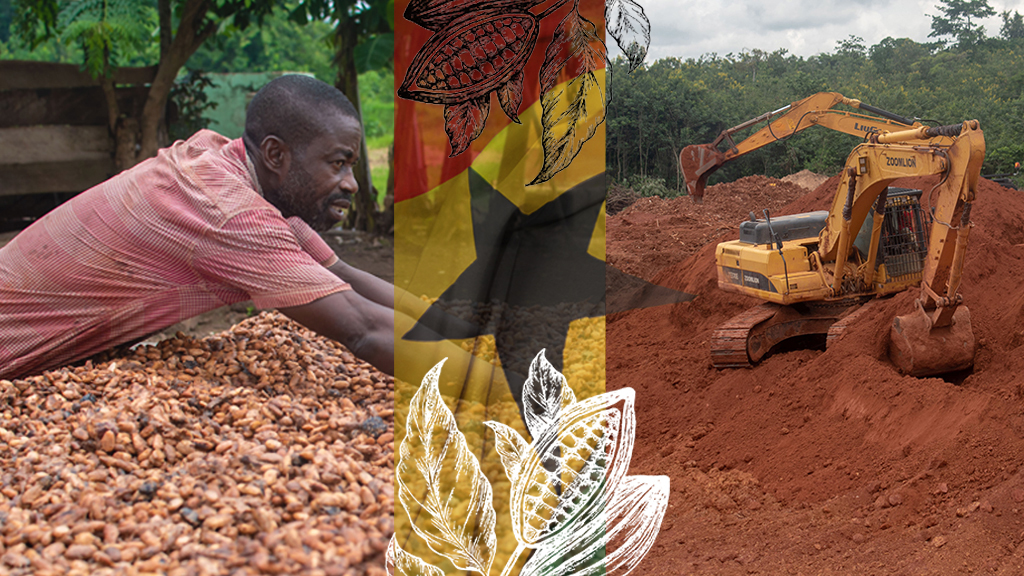
As a result, many farming families are pivoting to alternative sources of income, including rubber and palm oil production or turning to illegal artisanal gold mining. Driving through western Ivory Coast, we saw rubber plantations lining the roads. Rising global gold prices – as much as 55% in 2025 crossing the $4,000/oz mark for the first time in October 2025 – have triggered a new gold rush in Ghana and Ivory Coast, fuelling the rapid expansion of informal artisanal mining. In one farming community we visited in Ivory Coast, the sound of machinery from a nearby illegal gold mine was impossible to ignore. The village chief declined to discuss mining, explaining that doing so could put him at risk. However, in separate conversations, women in the community confirmed that their sons are involved in gold mining and that they support this work, as income from cocoa alone is no longer enough to feed their families.
More
How gold mining in Ghana is threatening Swiss chocolate
Alongside the expansion of gold mining has come widespread mercury pollution, as the metal is commonly used to separate gold from ore. Once released into rivers and farmland, this toxic substance contaminates ecosystems and threatens to make a return to agriculture increasingly difficult. In Ghana, we were told that gold mining has already destroyed cocoa production in some areas. During our research trip in Ivory Coast, we observed rivers had turned murky and discoloured. Locals told us that the water changes colour with mining activity and that fish have already died, cutting off another vital source of income for their livelihoods.
Gold mining and associated water discoloration (due to chemical used) can also be tracked by satellite technologies, as demonstrated by data shared with us by the FarmStrong Foundation. In a conversation with an official of the local ministry for water and forests, it becomes clear that they do not have the capacity to systematically test the water quality and therefore also rely on anecdotal evidence from the field. These dynamics underscore that sustainability challenges are fundamentally regional in nature and require coordinated, cross-sectoral responses involving a wide range of stakeholders.

More
Child labour risks in chocolate supply chains go beyond just cocoa
For decades, cocoa manufacturers have focused on eliminating child labour from their supply chains. Yet as the livelihood landscape for cocoa farmers shifts, ensuring future supply and child-labour-free production will only be possible if companies acknowledge the intersections and interdependencies among commodities at the local level. Chocolate manufacturers, together with the government of the Ivory Coast, as well as foreign governments that benefit from these commodities such as Switzerland, are well positioned to convene companies sourcing rubber, palm oil, and gold, and to bring them into innovative initiatives capable of holistically assessing community needs. Such initiatives must recognise that farming and extractive sectors increasingly coexist and must do so safely and responsibly. In parallel, companies and foreign governments must use their collective voice to encourage stronger government engagement and to share responsibility for the provision of essential infrastructure and social protection. In Ivory Coast, persistent gaps in birth registration continue to impede children’s access to education, a challenge that can only be addressed through effective state action. Local government officials often require additional institutional and material support to fulfil their mandates. In one documented case, the absence of basic administrative infrastructure—specifically a printer and reliable internet access—was the primary obstacle preventing the processing of birth certificates.
Cross-commodity initiatives in the agricultural sector already offer promising precedents. The Fair Labor Association’s Harvesting the Future programme piloted a multi-stakeholder, cross-commodity approach in Turkey to address human rights risks affecting migrant workers. By bringing together local governments, industry associations, and buyers from the food and cosmetics sectors, the initiative addressed recruitment practices and child protection in a more integrated and context-responsive manner.
The Swiss government has an important role to play. To date, it has provided substantial support to multi-stakeholder initiatives across individual commodity supply chains, including coffee, cocoa, and gold. The next step is to create incentives for holistic, cross-commodity initiatives that better reflect realities on the ground and enable Swiss companies to meet their sustainability commitments more effectively. In West Africa, smallholder farmers often depend on multiple income-generating activities. Unless these complex social and economic systems are addressed comprehensively, eliminating child labour in one sector risks merely displacing it into another. Given the importance of both cocoa and gold to Switzerland, and the growing entanglement of these sectors in West Africa, the region presents an ideal context for a cross-commodity pilot project.
Overcoming siloed approaches to sustainability is no longer simply a matter of ambition. It has become a business necessity for companies and a policy imperative for governments committed to responsible sourcing and sustainable development.
Edited by Virginie Mangin and Anand Chandrasekhar
The views expressed by the author do not necessarily reflect those of Swissinfo.

In compliance with the JTI standards
More: SWI swissinfo.ch certified by the Journalism Trust Initiative

You can find an overview of ongoing debates with our journalists here . Please join us!
If you want to start a conversation about a topic raised in this article or want to report factual errors, email us at english@swissinfo.ch.