








Switzerland is water-rich. So why are 151 towns rationing it?

Switzerland has more water than it uses. Yet this summer, at least 151 municipalities have banned residents from filling pools or watering gardens. We looked at why these limitations are in place.
Select your language
Generated with artificial intelligence.
Listening:
Switzerland is water-rich. So why are 151 towns rationing it?

On June 22, residents of five villages in canton Fribourg received the same message: limit your water use. No filling or refilling swimming pools, no watering gardens, no washing vehicles or terraces.
It is a puzzling situation for a country that’s often called the water tower of Europe. Despite low rainfall this year, Switzerland is not running out of water. But it is spread unevenly across the country, leading some communities to fear running low while others have nothing to worry about.
>> At the end of July, the overall picture in Switzerland was dry – if not critical:

More
Sparse rainfall and heatwaves have put Switzerland on drought alert
More than 194 municipalities (essentially villages and towns) have asked residents to save water. And according to Swissinfo’s count as of July 24, at least 151 have gone further, imposing enforceable bans on certain uses of water, with fines of up to CHF2,000 ($2,439).
What those bans actually amount to varies hugely. Some are strict: in one village in canton Ticino, whether you can water your flower beds depends on the day – and on whether your house number is odd or even. Elsewhere a vegetable patch may be watered by hand but not with a hose, on pain of a CHF1,000 fine. Meanwhile plenty of municipalities facing the same weather conditions have imposed no measures at all, and simply asked residents to be careful.
No national database
Nobody counts this at a national level. The 26 Swiss cantons are responsible for water distribution in the country, but local areas can enact their own rules. And only a few cantons track which of their municipalities have acted: Fribourg, for example, requires every municipality to report measures and publishes them on a map. By the canton’s own tally, 40% have issued recommendations or restrictions this summer.
“The precise reasons behind these appeals are not known to us,” says Julie Boillat, a hydrogeologist at the canton’s environment office. France, by comparison, lists its state-ordered drought restrictions in a live national register, VigiEau.
To try to shed more light on the situation, Swissinfo used a digital tool to scan the official websites of all 2,110 Swiss municipalities and verified the notices through a manual review.
Seen as an overview, the restrictions offer insights on why some communities in a water-rich country are running dry, and why restrictions can vary so sharply between areas which are just a few kilometres apart.
>>>>The map below is based on research by Swissinfo into each Swiss municipality’s water preservation status. If you would like to inform us of your municipality’s status, a change or an error, please write to english@swissinfo.ch.
External Content
Why some places turn off the water
The notices rarely say why water is being rationed, but a review of the limitations reveals three general reasons. The first is a genuine shortage. Supplies that draw on local springs run low relatively early in a drought, because a spring’s flow can drop within days while deeper groundwater takes far longer to react. In Rossinière, a mountain village in canton Vaud, local authorities banned watering gardens because springs were drying up, warning residents that a passing thunderstorm would not be enough to refill them.
The second reason is cost. Pfungen, which lies 20 kilometres from Zurich, relies primarily on its own springs, and buys additional drinking water from neighbouring Winterthur to cover peaks in consumption and to compensate when its springs yield less.
The purchase runs according to a contract that sets a price for an agreed volume of water over several days. If Pfungen goes past that amount, the price is five times higher. Since customers’ rates are fixed in advance, the municipality cannot pass the difference directly on to residents, although under Swiss cost-recovery rules all costs eventually feed into the regular water tariffs.
So, before reaching its contractual limit, Pfungen asked residents to stop watering lawns, skip the car wash and take shorter showers. The aim, the municipality told Swissinfo, was “to protect natural water resources, to ensure the stability of our distribution network at all times, and not to exceed the maximum purchase volume”. It worked: consumption fell, helped by holiday absences, and the limit was never crossed.
Around 90% of Swiss utilities can buy water from a neighbour if necessary, estimates the Swiss Association for Water, Gas, and Heat (SVGW), thanks to connections built over decades, and contracts. It is a resilient system, but it means two villages can face the same weather and share the same aquifer yet respond quite differently, depending on deals they have signed and the pipes they have built.
The third reason is plumbing. On a hot evening, when everyone is home showering and watering gardens at the same time, a network built for normal demand can simply run dry. Infrastructure “is not designed for peak demand as high as it occurs in periods of heat”, says Christos Bräunle, spokesman for the SVGW.
>> The next challenge? A data centre boom also means more demand for Swiss water:
More
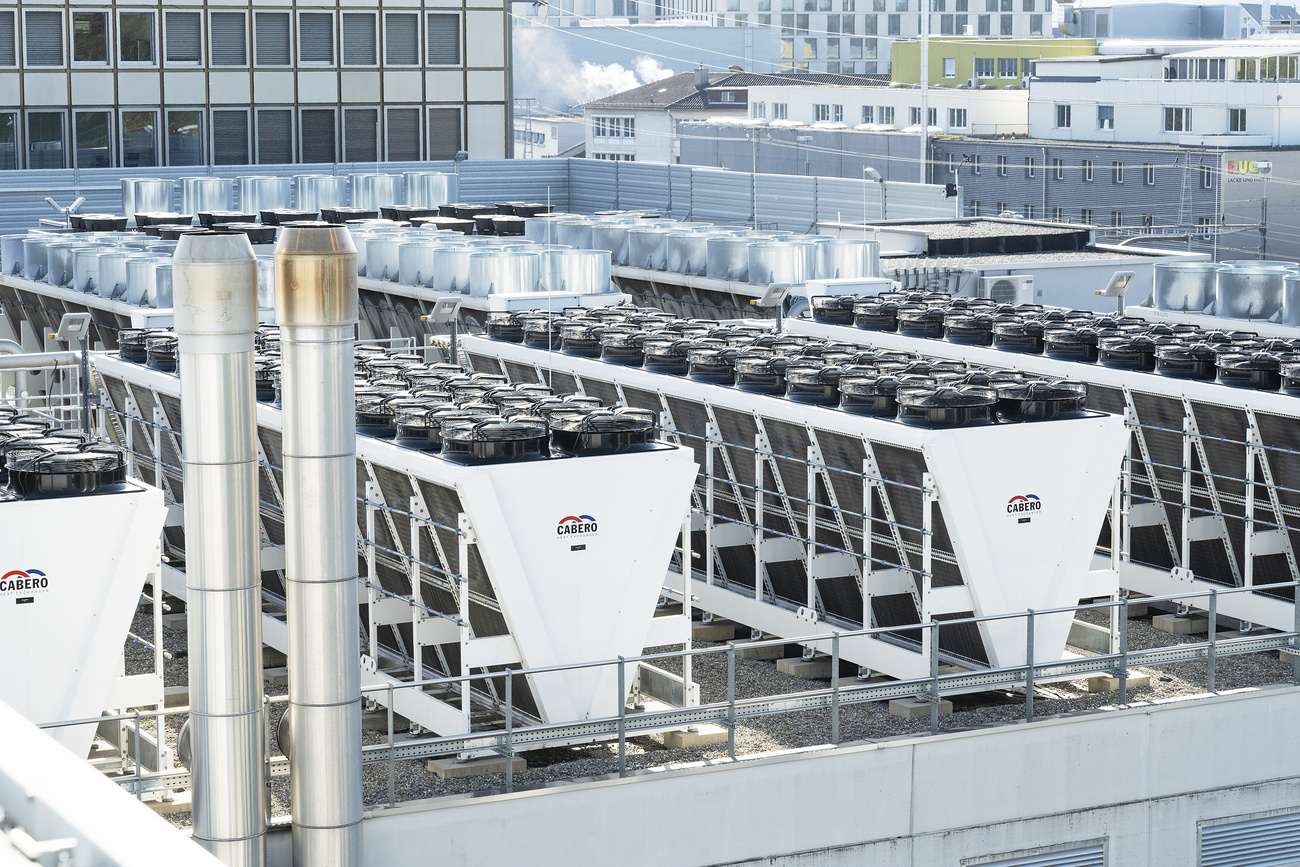
How AI data centres risk straining Switzerland’s water resources
One drought, a hundred rulebooks
Because decisions are taken at the most local level of government, what a resident is allowed to do with water depends less on how much water there is than on which village they happen to live in.
And the rules can be very specific. In Coldrerio, in Ticino, houses with even-number addresses are allowed to water flowerbeds on Mondays, Wednesdays and Fridays; odd numbers get the other days.
Cantons have their own rules, but these sit alongside the local ones rather than replacing them: they restrict water taken from rivers and lakes to protect fish, not water from the tap.
Canton Appenzell Inner Rhodes, watching its brown trout die in the shrinking Sitter, its largest river, banned withdrawing water from streams. Cantons can also disagree with their own municipalities: on July 16, St Gallen declared that drinking water was “guaranteed everywhere” even as several of its communal utilities appealed for restraint.
And federal authorities measure and advise on restrictions, but can only issue orders if there is a “severe shortage” of water – a situation whereby cantons could not ensure at least four litres of drinking water per person per day.
Not the last summer
During the 2018 drought, the Swiss army flew helicopter after helicopter of lake water up to alpine pastures whose springs had failed. In 2022, the country’s warmest year on record, tanker trucks supplied municipalities in Ticino and Neuchâtel, while 19 cantons in total asked residents to save water; in August, army helicopters were again active, taking water from Lake Montsalvens in canton Fribourg up to cattle on parched alpine slopes.
What carried the country through those summers was plumbing – the same inter-utility transfers which are now under strain. Each dry year hardens the arrangement. A spring-fed village that has been self-sufficient for a century signs a supply contract with its neighbour; the buy-and-ration system that began as emergency improvisation settles into permanent infrastructure.
What happens next
Municipalities have one tool they almost never use to limit water consumption: price. A utility is allowed to make water more expensive when it is scarce, as long as the mechanism is written into its tariff rules in advance. Several French cities including Toulouse now do exactly that. No Swiss utility company does, the SVGW says. Swiss water is cheap enough, at CHF2.30 for 1,000 litres, that the price would have to rise many times over before anyone changed habits, so municipalities instead turn to appeals, and then bans.
Parliament has demanded a national water strategy, expected to be ready at the end of 2027. But its scope looks set to be limited: the Federal Office for the Environment (FOEN) told Swissinfo that the number of utilities “plays no decisive role” and the responsibilities of cantons and municipalities “remain unchanged”. The patchwork of reasons and rules described here is not under review; under the constitution, water remains a cantonal matter.
As such, the rules will continue to be written village by village. The water tower of Europe is not running dry. But summer by summer, it is discovering that having enough water and being able to deliver it, everywhere, on the hottest evening of the year, are not the same thing.
Between April and June 2026, Swiss precipitation reached just 56% of the 1991 to 2020 average, matching 1976 as the driest since records began in 1901. According to MeteoSwiss, such summers are likely to become more frequent: a drought that occurred once a decade in the 1991 to 2020 period now arrives roughly every seven years, and would come every three in a world three degrees warmer.
Source: MeteoSwiss
Join the debate:
More

Edited by Gabe Bullard/Virginie Mangin/dos

In compliance with the JTI standards
More: SWI swissinfo.ch certified by the Journalism Trust Initiative

You can find an overview of ongoing debates with our journalists here . Please join us!
If you want to start a conversation about a topic raised in this article or want to report factual errors, email us at english@swissinfo.ch.