








How AI data centres risk straining Switzerland’s water resources
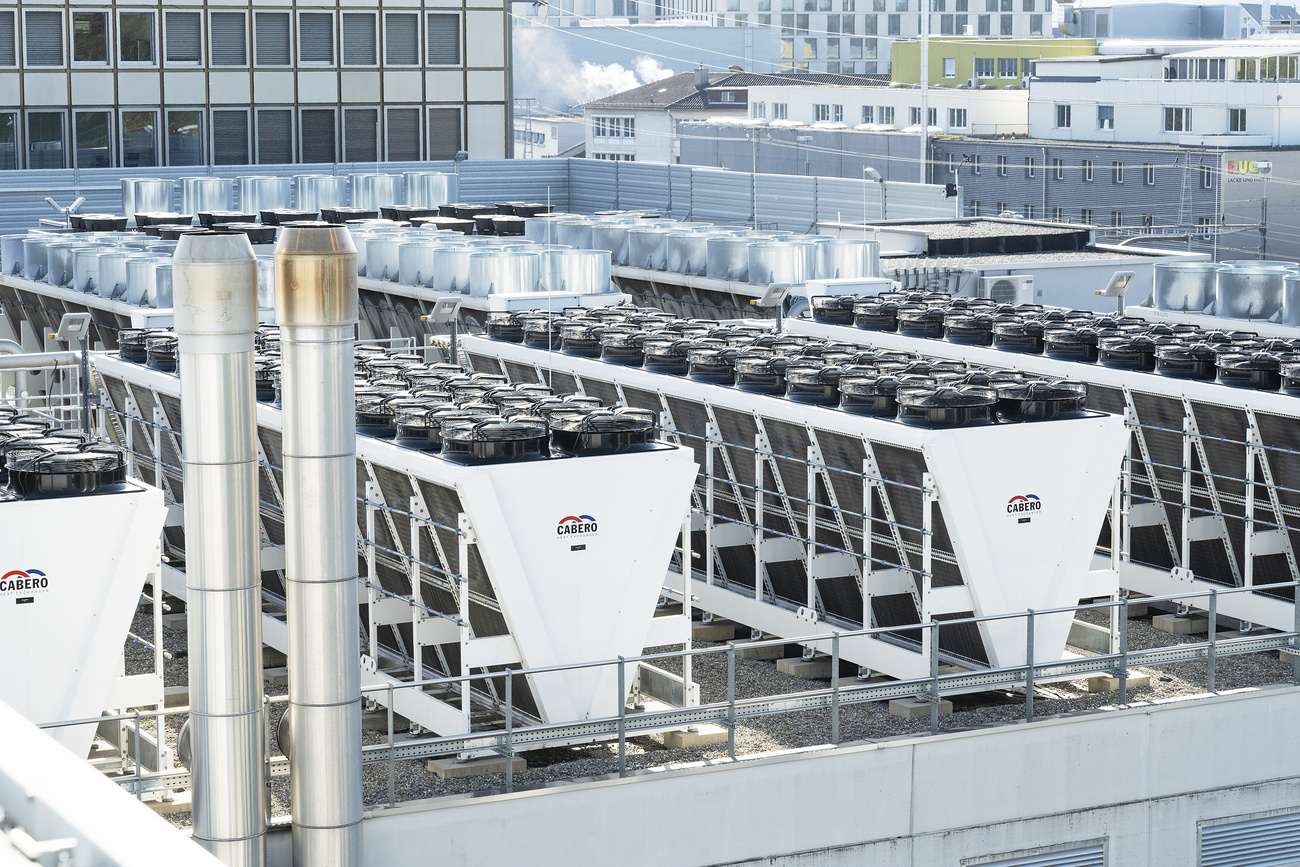
Artificial intelligence (AI) and geopolitical tensions are accelerating the construction of data centres in Switzerland, increasing demand for infrastructure that could strain the country’s water supply.
Select your language
Generated with artificial intelligence.
Listening:
How AI data centres risk straining Switzerland’s water resources

Switzerland is often described as the “water tower of Europe”: a country with abundant lakes and glaciers, where some of the continent’s major rivers originate. But this abundance may be put to the test by the rapid expansion of data centres – the IT infrastructure that keeps the digital world running.
Today, Switzerland hosts around 120 data centres, with about 20 more under construction, giving it one of the world’s highest concentrations of data centres per capita. The growing adoption of artificial intelligence is accelerating this expansion. High-performance servers used for AI consume more energy and generate more heat, increasing the need for intensive cooling systems – many of which rely on water.
“More and more companies – and people in general – are using AI. So cooling demand will just go up as AI computing systems become increasingly complex,” says David Atienza Alonso, a professor at the Swiss Federal Institute of Technology Lausanne (EPFL) and an expert in AI computing architectures.
Geopolitics may further amplify this trend. The emergence of data centres as targets in armed conflicts and the growing global competition for AI dominance are pushing many countries to build digital infrastructure within their own borders. Switzerland is no exception, having placed sovereignty at the centre of its digital strategyExternal link.
“Everyone wants greater control over data and where it is stored, which requires local infrastructure,” Atienza Alonso says. “But this implies building more and more data centres, with a growing impact on both water and energy consumption.” If this trend continues, he warns, “we may reach a point where electricity and water supply can be challenging to provide in some regions, if the needs of AI infrastructure are not anticipated early on”.
The ‘invisible’ water consumption of data centres
Despite water being essential to data centres’ operations, there are few official figures on how much water the sector uses. At the global level, the International Energy Agency (IEA) estimatesExternal link current consumption at around 560 billion litres per year and predicts it will rise to 1.2 trillion litres by 2030 – a volume comparable to the annual water consumption of around ten million households. Most of this water is used for cooling data centres and for producing the electricity to power them.
Beyond cooling, data centres also have a significant indirect water footprint through the electricity they consume.
“When you use electricity, you also use water,” says Javier Farfan Orozco, a researcher in technologies for a sustainable future at Åbo Akademi University in Finland.
In Switzerland, where a significant share of electricity comes from hydropowerExternal link, this connection is particularly relevant. Reservoirs used for power generation can lose substantial amounts of water through evaporation, depending on local climate conditions – a factor that is often overlooked in public debate, Farfan Orozco says.
Thermal power plants, including nuclear – one of the main sources of electricity in Switzerland – also require water, mainly for cooling.
Given that data centres already account for an estimated 6–8% of Switzerland’s electricity consumption, this indirect water use further amplifies their overall impact.

In Switzerland, there is no law requiring operators to disclose their water use. But according to estimates by Atienza Alonso, Swiss data centres already account for about 1% of national freshwater consumption – roughly equivalent to the needs of 400,000-800,000 people.
One issue with water use is the size of data centres. Small and medium-sized facilities are generally efficient, thanks to new technologies, and can be relatively easily connected to local water systems with limited impact.
But even with ongoing improvements in cooling technology, large-scale facilities will continue to require very high volumes of water and will need to be built near rivers or lakes, Atienza Alonso says. So-called “hyperscale” data centres – exceeding 20 megawatts and powering cloud and AI services – can consume more than one billion litres of water per yearExternal link, equivalent to a town of 10,000 to 50,000 people.

More
Swiss organisation wins award for tracking data centre pollution
More efficient technologies, but not enough
Major data centre operators are rapidly expanding their infrastructure in Switzerland to meet AI demand, particularly around Zurich and Winterthur. The company Vantage, for example, is building a new campusExternal link covering around 34,000 square metres – roughly five football fields – with a total capacity of 40 megawatts, comparable to the electricity consumption of a mid-sized city. This level of power also implies more complex and intensive cooling needs.
Industry players often tout their efficiency when questioned about power and water needs. Companies such as Vantage and Green say they use advanced cooling systems that significantly reduce direct water consumption, including using outside air and closed-loop systems where water is recirculated. (Vantage did not return a request for comment; information was taken from its websiteExternal link.)
However, these solutions do not eliminate the need for water altogether. “Closed-loop systems still require significant amounts of water initially and often lead to higher electricity use for dry cooling,” Atienza Alonso says.

Peak demand, the real challenge
Total water demand tells only part of the story. Data centres need varying amounts of water depending on conditions outside.
“During peak periods, water demand can increase dramatically,” says Shaolei Ren, a professor of electrical and computer engineering at the University of California, Riverside.
A recent studyExternal link co-authored by Ren shows that in summer months, data centre water use can triple compared to the annual average, with daily peaks up to ten times higher.
In Alpine countries such as Switzerland, these peaks can be even more extreme, potentially reaching up to 30 times the annual average for water consumption, according to Ren. This could create significant infrastructure challenges and even tensions with other local users, such as agriculture and households. This is already playing out in other countries, where data centres have secured preferential agreements on water access from local utilities.
“In the United States, data centre water supply is often considered a high priority,” Ren notes. A new data centre under construction in the US state of Indiana, linked to Meta through its subsidiary Orla LLC, has been granted priority over other commercial users in the case of water shortages, according to documents reviewed by our editorial team.
In Switzerland, water management is handled at the cantonal and municipal levels, with access decisions made case-by-case. In practice, drinking water supply for households has traditionally taken precedence, according to the Federal Office for the Environment (FOEN).
These decisions may soon fall under greater public scrutiny as data centres pop up around the country. In canton Schaffhausen, Stack Infrastructure has obtained a permit to use 55,000 cubic metres of water per year for its site in Beringen – roughly equivalent to the annual consumption of around 500 Swiss households.
>> The electricity demand of data centres is also growing rapidly in Switzerland:

More
Can Switzerland’s power grid keep up with its data centres?
Are there solutions to the unstoppable growth of data centres?
With economies increasingly driven by data and AI, and a broader push to localise digital infrastructure, the expansion of data centres appears unlikely to stop.
But David Atienza Alonso believes their impact can still be mitigated by rethinking how they are designed. One option is to build smaller, more distributed facilities to avoid excessive local concentration of demand. New cooling technologies also show promise: systems that use water more precisely to cool chips directly could reduce water use by up to a factor of 100, he says.
However, these measures won’t solve the problem entirely. “We need to fundamentally rethink how we build data centres and develop AI models,” Atienza Alonso says. This would mean shifting away from large, general-purpose AI models – such as those underlying ChatGPT – towards more specialised ones that can run more efficiently. “If we continue on this path, pressure on water and energy resources will become increasingly difficult to manage.”
Join the debate:
External Content
Edited by Gabe Bullard/vdv/ts

In compliance with the JTI standards
More: SWI swissinfo.ch certified by the Journalism Trust Initiative

You can find an overview of ongoing debates with our journalists here . Please join us!
If you want to start a conversation about a topic raised in this article or want to report factual errors, email us at english@swissinfo.ch.