








What Switzerland needs to learn from earlier and longer heatwaves

Select your language
Generated with artificial intelligence.

Listening:
What Switzerland needs to learn from earlier and longer heatwaves
Switzerland's heatwave season is getting longer. The exceptional heatwave that hit the country in June exposed how difficult it is to cope with these new climate extremes, writes Sonia Seneviratne, a climate scientist at the Swiss Federal Institute of Technology ETH Zurich.

The heatwave that hit Switzerland at the end of June was historic in scale, as MeteoSwiss noted. Its intensity was nevertheless consistent with climate model projections. These show that the number of extremely hot days will rise sharply as global warming continues, a conclusion also highlighted in the latest report by the Intergovernmental Panel on Climate Change (IPCC). The same trend is reflected in Switzerland’s most recent national climate scenarios.
The main lesson for both the public and policymakers is clear: today’s climate, which has already warmed to almost the 1.5°C threshold set by the 2015 Paris Agreement, poses major risks to society.
A heatwave in June is far more disruptive than one in July or August because much of the population is fully active. Schools were among the sectors particularly affected.
Heatwaves have become much more frequent in Switzerland since 2018
The June heatwave fits a broader trend in Switzerland’s changing climate. Before 2003, heatwaves were extremely rare. Since 2018, they have become a regular feature of Swiss summers.
What made this year’s heatwave exceptional was its timing — in June, rather than later in the summer. However, climate projections suggest heatwaves are likely to arrive earlier and become more frequent and more intense in future.
As global temperatures continue to rise, the heatwave season is expanding. Periods of extreme heat now occur as early as June and as late as September – months that rarely experienced such conditions in the past.
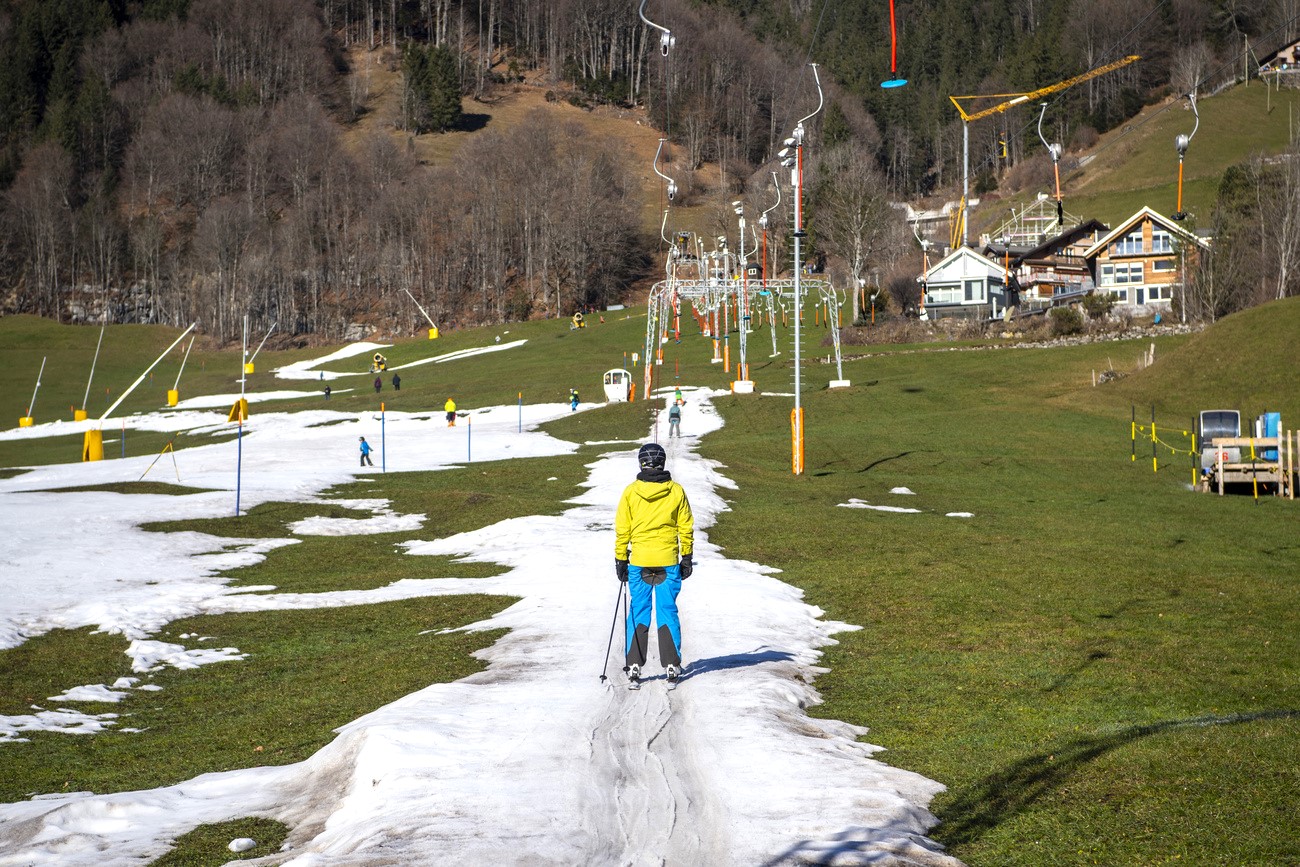
More
Five numbers show how the climate is changing in Switzerland
Human-caused emissions are driving the increase
The connection between heatwaves and human-caused greenhouse gas emissions is firmly established by both observations and climate models. A recent study by the World Weather Attribution network concluded that greenhouse gas emissions substantially increased both the likelihood and the intensity of the recent European heatwave.
Most of these emissions come from burning fossil fuels such as oil, gas and coal. According to the study, a June heatwave of this intensity is now almost 300 times more likelyExternal link than it was in 2003.
The heatwave exposed gaps in preparedness
The June heatwave is estimated to have caused around 200 deaths in Switzerland. Thousands more heat-related deaths were recorded elsewhere in Europe. Many of the victims were elderly people living alone who died at home. More support is needed to help vulnerable people remain safe during periods of extreme heat.
Older people are not the only group at risk. Children, pregnant women and others with heightened health vulnerabilities can also suffer serious health consequences. Heatwaves also reduce productivity, particularly among people working outdoors.
Switzerland is nevertheless better prepared than it was two decades ago. The 2003 heatwave caused substantially more deaths, and emergency planning has improved since then.
Even so, this year’s event exposed significant shortcomings, particularly in schools. In many classrooms, temperatures became almost unbearable, forcing pupils to attend lessons and, in some cases, sit examinations in extreme heat.
More

Schools and cities need to adapt
The school calendar may need to be reconsidered. In Zurich, the summer holidays do not begin until mid-July, while in many other cantons they start, at the soonest, in early July.
Given the growing likelihood of extreme heat in late June and early July, this appears increasingly late. One option would be to shorten school days during the hottest weeks and move end-of-year examinations to May.
Adaptation also requires changes to the built environment. More trees and green spaces can help reduce the urban heat island effect, which often makes cities significantly hotter than surrounding rural areas. Building designs, too, need to be rethought to cope with more frequent and more intense heatwaves.

More
Climate solution for the future: How to keep cities cool during heatwaves?
Reducing dependence on fossil fuels
Adaptation measures are essential, but they will not be enough on their own. Unless we address the underlying cause of climate change, there are clear limits to how much societies can adapt.
Greenhouse gas emissions need to fall rapidly, both in Switzerland and globally, if warming is to be stabilised. This means halving emissions by around 2030 and reaching net zero by 2050 at the latest. Achieving this requires ending our dependence on fossil fuels such as oil, gas and coal.
In Switzerland, emissions could be reduced substantially by replacing petrol-powered cars with electric vehicles. Oil- and gas-fired heating systems should likewise be replaced by heat pumps or geothermal energy.
At the same time, investment in renewable energy – including solar, wind and hydropower – is essential to provide the additional electricity required without generating carbon emissions and while minimising environmental impacts.
The June 2026 heatwave was entirely consistent with observed climate trends and with what scientists expect as long as global greenhouse gas emissions continue to rise. Switzerland has reduced its emissions in recent years, but not fast enough to remain on a pathway consistent with limiting global warming to 1.5°C.
As a wealthy country that is itself increasingly affected by climate change, Switzerland has strong reasons to accelerate its energy transition. That would not only reduce emissions but also make the country less dependent on volatile international oil and gas markets.
The views expressed here are those of the author and do not necessarily reflect the views of Swissinfo.
Edited by Samuel Jaberg. Translated from French by Catherine Hickley/ac

In compliance with the JTI standards
More: SWI swissinfo.ch certified by the Journalism Trust Initiative

You can find an overview of ongoing debates with our journalists here . Please join us!
If you want to start a conversation about a topic raised in this article or want to report factual errors, email us at english@swissinfo.ch.