








As aid stalls in Haiti, can attack drones and soldiers end gang violence?

Haiti’s epidemic of gang violence has worsened just as donors such as Switzerland cut their aid budgets. As an expanded international military mission prepares to deploy, the question is whether tougher security measures can finally break the downward spiral.
Select your language
Generated with artificial intelligence.
Listening:
As aid stalls in Haiti, can attack drones and soldiers end gang violence?

Each time Diego Da Rin visits the Haitian capital of Port-au-Prince, he sees the latest scars from the city’s gang wars, with buildings newly blown up and roads destroyed.
“You see the aftermath of intense clashes between gangs and the security forces,” said the Haiti expert for the International Crisis Group think tank. “The gangs have put up barricades to completely block access to the neighbourhoods they control.”
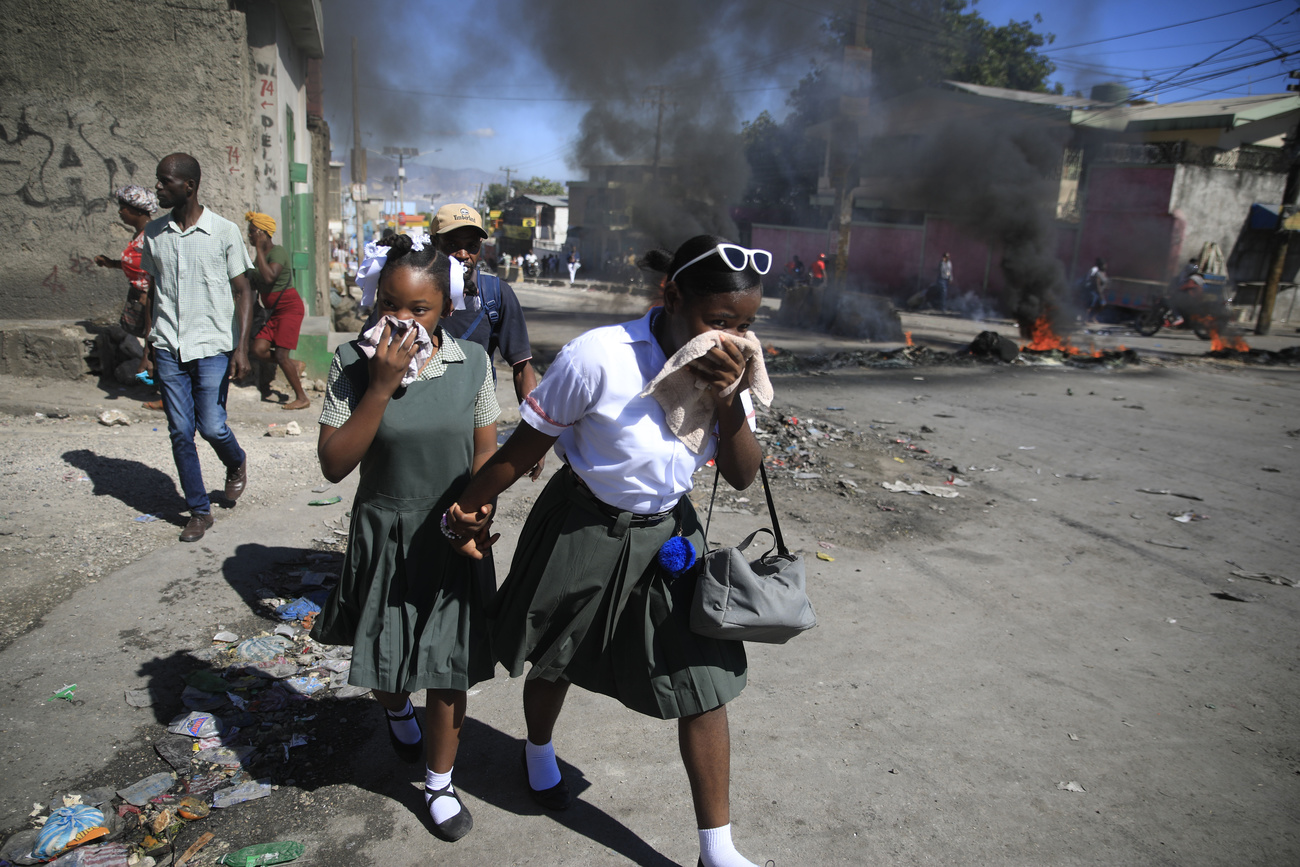
These are no-go zones for police, with gunmen lying in wait in ditches dug around abandoned buildings or on lookout from upper floors. Residents – over 1.4 million of them – have been forced to flee to avoid kidnappings, rape and murder.
For years Haiti, the poorest country in the Western hemisphere, has been spiralling into a complex crisis of gang violence, political instability and a failing economy. Armed groups control most of the capital and are moving into nearby regions of Artibonite and Centre. The United Nations says over four million Haitians need $880 million (CHF686 million) in emergency food, water and shelter this year alone.
Help, though, is evaporating. Donors met just a quarter of the $908 million the UN sought for Haiti last year as many rich countries cut their aid budgets. Although Switzerland is a top donor to the UN appeal, it has a modest CHF8 million ($7 million) for its own humanitarian office in Haiti – less than halfExternal link of a previous annual average of $17.6 million for development and humanitarian support.
This reduction came after the Swiss Agency for Development and Cooperation (SDC) stopped its bilateral development cooperation in Haiti at the end of 2023 as part of a broader withdrawal from Latin America. Helvetas was among the NGOs that, as a result, were unable to see some of their long-term, Swiss-funded projects through to the end.
More
As Switzerland leaves Haiti, Swiss NGOs fight to stay on
“We Swiss are known for quality”, said Esther Belliger, the charity’s regional coordinator for Latin America and the Caribbean. “Countries, and especially those with a fragile context like Haiti, need long-term engagement” for a durable impact. Instead, she said, Haiti is a “forgotten crisis and a neglected, isolated island” that gains little attention amid disasters elsewhere.
The biggest hit has come from Haiti’s most important donor, the United States, which in January 2025 dismantled its USAID agency. Roughly 80%External link of US-funded programmes on the island have screeched to a halt. Instead, President Donald Trump’s administration is focusing on helping Haiti restore security, a strategy that carries risks for aid groups as well as potential payoffs.
“We define [stability] as A, no collapse of the state and B, no mass illegal migration onto US shores,” Henry Wooster, the US envoy to Haiti, told a congressional panel in February. “Everything we do […] is anchored to that singular objective.”
Drones a threat to civilians, humanitarians
The US has thrown its support behind the country’s interim leader, Prime Minister Alix Didier Fils-Aimé, who heads a national security task force. In March 2025, the task force began deploying drones and around 100 foreign contractors supplied by Vectus Global, a US private military company set up by Erik Prince, former head of defunct mercenary firm Blackwater. That firm courted controversy, notably for the killing of 14 civiliansExternal link in Iraq in 2007.
After years of lacklustre operations, security forces are now seeing some gains in the fight against the gangs. The use of unmanned drones, Da Rin said, has allowed them “to strike inside strongholds” that were otherwise impenetrable.
That may be essential if elections that have been delayed since President Jovenel Moїse was assassinated in 2021 are to go ahead later this year. A more effective counter to gang violence could bring some level of security to the population.
Yet drone operators have killed civilians, including eight childrenExternal link last September, and pose dangers to aid groups trying to help ordinary people. A drone hit a clinic operated by Médecins sans Frontières (MSF) in November. Two months later a former volunteer at the same site was killed in crossfire between gangs and security forces.

“This is in a gang-controlled area where we happen to be the only actor providing medical care,” said Diana Manilla-Arroyo, head of mission for MSF in Haiti. “If we’re not there, nobody else will be.”
‘A catastrophic financing gap’
Providing aid in such conditions is tough. Few commercial planes are permitted to land in Haiti, with authorities unable to guarantee safety after several jets were hit by ground fire, said Da Rin. In Port-au-Prince, roads are blocked or damaged, and gangs run illegal tolls along key access routes. Donors including Switzerland therefore rely heavily on local groups to reach populations in need.
Among its activities, Swiss charity Helvetas provides cash and livestock to 550 households of internal refugees in the country’s south with support from the municipality of Zurich. Yet most aid groups struggle to get funding even for urgent needs like these or for longer-term development objectives, Belliger said, adding: “Haiti faces a catastrophic financing gap”.

Prospects worsened after USAID was shuttered, leaving fewer dollars to go around for large agencies such as UNICEF and small non-profits alike, she said.
The shortfall is especially evident in education and health, sectors previously heavily funded by the US. All but one public hospital with surgery capacities in Port-au-Prince are closed, says MSF. Its own ambulance service stopped running a year ago after convoys transporting patients came under repeated attack from law enforcement on suspicion some were injured gang members.
“It’s a compromise we’ve had to make because of the lack of guarantees to the security of patients and staff,” Manilla-Arroyo said, adding the charity maintains a dialogue with authorities to ensure it can operate safely. “The healthcare gaps are enormous.”
Responding to ‘a multi-faceted crisis’
In its clinics, MSF is seeing more rapes. “It’s clear the gangs are using sexual violence to subjugate and control communities,” Manilla-Arroyo said.

In response, Switzerland launched programmes in Port-au-Prince and southern Haiti that it expects will assist some 10,000 survivors of gang violence, in particular women and girls.
The Alpine nation will continue its humanitarian work in Haiti in the coming years, given the “multi-faceted crisis,” while coordinating with other donors to meet needs as efficiently as possible, a spokesperson for the Swiss foreign ministry told Swissinfo. The lack of funds “is a reality in Haiti, as it is in many other humanitarian contexts,” he said.
A new gang suppression force
Whether Haiti can exit its crisis may become clearer in the coming months. A US-backed international military mission approved by the UN Security Council in autumn is set for a first deployment, reportedly by soldiers from Chad and Sri Lanka, as soon as April.
The Gang Suppression Force (GSF) will replace a small, underfunded Kenyan-led security mission with a larger 5,500-strong contingent and a more offensive mandate to target the gangs. Still, it remains to be seen whether the mission can increase stability.
“If the new force is composed of well trained and equipped personnel, it could really change the balance of power on the ground,” said Da Rin. The UN runs a trust fund for the military missionExternal link, which in recent months has received pledges from Canada, Mexico, France, Austria, Germany and Qatar. Switzerland, for its part, has no plans to offer financial or material support to the GSF, the foreign ministry said.

More
Our newsletter on geopolitics
Getting the upper hand on the gangs would be a significant breakthrough for Haitian authorities, Da Rin said, but force alone won’t solve the country’s problems.
Dialogue will be needed to tackle thorny issues, such as persuading gang leaders to release the many children recruited, often forcibly, into their ranks. The Crisis Group analyst is sceptical these will be resolved quickly or in time for elections in August.
“To have safe polls, and regain control of significant portions of the capital and the Artibonite and Centre departments in the next five months, seems unrealistic.”
Edited by Tony Barrett/vm
More


In compliance with the JTI standards
More: SWI swissinfo.ch certified by the Journalism Trust Initiative

You can find an overview of ongoing debates with our journalists here . Please join us!
If you want to start a conversation about a topic raised in this article or want to report factual errors, email us at english@swissinfo.ch.