








The beneficial effect of avalanches on Alpine glaciers
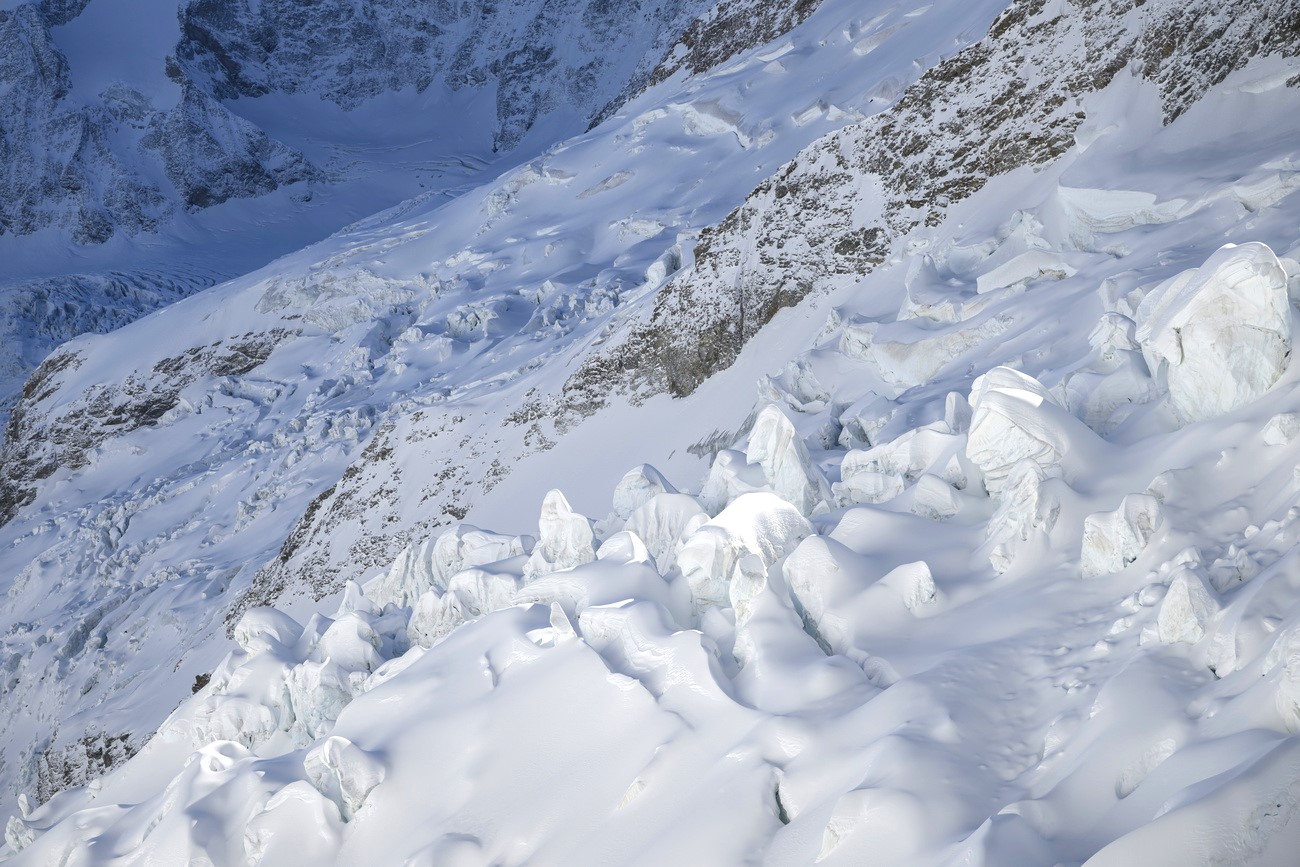
Avalanches help many glaciers in the Alps and around the world survive longer in the face of global warming, according to an international study.
Select your language
Generated with artificial intelligence.
Listening:
The beneficial effect of avalanches on Alpine glaciers

Sudden, spectacular and often deadly: avalanches are among the main natural hazards in the Alps and other mountainous regions. They can be deadly for skiers and can sweep away buildings, roads and entire villages.
However, their impact is not always purely destructive. They play a crucial role in the survival of many glaciers in Switzerland and worldwide, which are disappearing due to the warming planet. In some regions, over a fifth of the snow covering glaciers – and compensating for their melting – comes from avalanches.
This is the conclusion of an international studyExternal link led by the Swiss Federal Institute for Forest, Snow and Landscape Research (WSL), which for the first time quantified the impact of avalanches on the planet’s roughly 200,000 glaciers. The analysis was based on satellite measurements and models that calculate glacier evolution and snow mass movements.
“Avalanches are impressive and dangerous phenomena. Until now, we had no idea of their influence on glaciers,” Marin Kneib, a WSL glaciologist and lead author of the study, told Swiss public radio RTS. “Now we know that avalanches are an important factor for glaciers.”
>> Since over 130 years, Switzerland has played a key role in monitoring glaciers worldwide, as this article explains:

More
Why the Swiss are leading efforts to track melting glaciers
Avalanches slow the melting of smaller glaciers
Glaciers result from a balance between snow accumulation and ice melt. Snow protects glaciers from rising temperatures; over time, it compacts and turns into ice.
The WSL study found that globally, 3% of the snow accumulating on glaciers comes from avalanches. The contribution varies by region and glacier, reaching about 11% in the Alps.
In the eastern Himalayas, the share rises to 19%, and 22% in New Zealand, according to the analysis. “We were surprised. We didn’t expect the effect to be so significant in the Alps and globally,” Kneib commented.
In some cases, especially on smaller glaciers, over 50% of the snow originates from avalanches. Thanks to this additional input, Alpine glaciers smaller than one square kilometre, such as the Länta Glacier in southeastern Switzerland, could withstand climate change longer, according to the glaciologist.
The importance of avalanches is therefore expected to grow as glaciers retreat. However, Kneib stressed that this is not a “salvation”, but merely a “slowdown” of an inevitable decline. “By 2100, we will still lose more than 80% of the ice volume in the Alps compared to 2000,” he said.
+ World glaciers, local melting and global impactsExternal link
In some regions, such as the tropical Andes in South America, the opposite effect occurs: avalanches remove more snow than they deposit. Due to excessively steep glacier surfaces, snow masses slide away before they can turn into ice. Avalanches have almost no impact in northern flat regions such as Iceland, Greenland, and the Russian Arctic.

Improving forecasts for individual glaciers
Knowing how much snow falls on glacier surfaces helps predict their future evolution. Glaciers are vital water sources during summer and dry periods, especially in Central Asia and the Andes, where tens of millions of people depend directly on meltwater.
Understanding how ice masses will evolve also allows forecasting natural hazards associated with them. Glacier retreat destabilises mountain slopes – as happened in the Swiss mountain village of Blatten, in canton Valais – and leads to the formation of lakes that can suddenly overflow, causing devastating floods.
The WSL study on avalanche impact aims to inspire the development of a new generation of more accurate glacier models, Kneib explained. These tools will enable precise forecasts of individual glacier melting, with implications for hydropower production, agriculture, and natural hazard management.
Global warming reduces snowfall at low and mid-altitudes. But less snow does not necessarily mean fewer avalanches. The Swiss Institute for Snow and Avalanche Research (SLF) predictsExternal link an increase in wet-snow avalanches – formed from water-rich snow – and a decrease in dry-snow avalanches, typical of powder snow, above 1,800 metres.
Safety services can hardly trigger wet-snow avalanches artificially. The only measure to protect infrastructure and people is the temporary closure of risk areas, according to SLF. The good news is that avalanches should reach valley areas less frequently.
Edited by Virginie Mangin/sb

In compliance with the JTI standards
More: SWI swissinfo.ch certified by the Journalism Trust Initiative

You can find an overview of ongoing debates with our journalists here . Please join us!
If you want to start a conversation about a topic raised in this article or want to report factual errors, email us at english@swissinfo.ch.