








When sperm crosses borders, national safeguards fall short
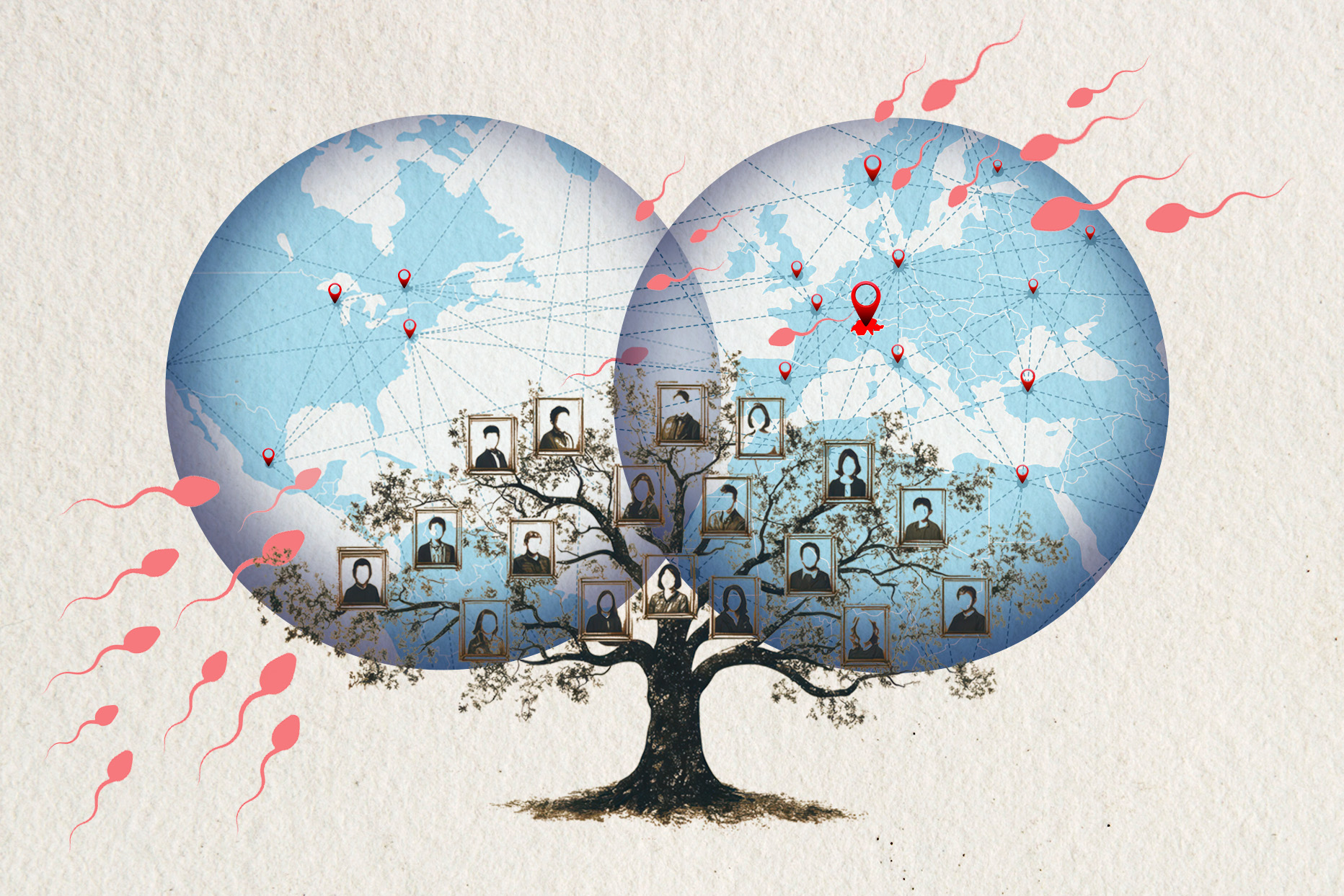
Europe’s booming fertility industry has been rocked by revelations that the sperm of a Danish donor used to conceive at least 197 babies carried a cancer-causing genetic mutation that has already led to the deaths of some children. Switzerland’s strict regulations make scenarios of this scale unlikely.
Select your language
Generated with artificial intelligence.
Listening:
When sperm crosses borders, national safeguards fall short

In recent years, sperm donation has produced family trees of unprecedented size, stretching across countries and, in some cases, continents. Stories of “mass donors” have captured public attention, most recently through the Netflix documentary series, The Man with 1,000 Kids. It focused on a Dutch donor whose sperm was used to conceive hundreds of children across the world, exposing loopholes in the industry’s regulations.
Such cases have raised concerns not only about the psychological impact on children who discover they have dozens of half-siblings but also highlighted the risk of consanguinity – the possibility of unknowingly forming relationships with close genetic relatives.
An international investigative journalism project published in December exposed another potentially devastating medical consequence. According to the 14 public broadcasters involved in the probe, one donor whose sperm was used to conceive at least 197 children across 14 European countries over 17 years unknowingly passed on a rare genetic mutation associated with a very high lifetime risk of cancer, a condition known as Li-Fraumeni syndrome. Affected children are likely to develop some form of cancer including leukaemia, brain tumours and breast cancer during their lives. An unknown number have already fallen ill or died.
Switzerland, which was not among the countries affected, has comparatively strict safeguards that make scenarios of this scale unlikely. They include a law that limits the number of children per sperm donor to eight, although it doesn’t specify whether this is a national or global total.
But these protections don’t come with cast-iron guarantees. Clinics – both in Switzerland and other countries – do not systematically screen donors for rare genetic mutations such as the one identified in Denmark, and sperm routinely circulates across borders through international sperm banks. In practice, this means that national rules can reduce the risks but not fully contain them.

‘Wild West’
The result, critics argue, is a cross-border market where oversight may well stop at national boundaries, but biological consequences do not. With the sperm of mass donors moving freely across borders, and in the absence of an international donor registry, the industry has been described by one European regulator as the “Wild West”.
Assisted reproduction and sperm donation is increasing across the developed world including Switzerland, and the Danish case has put screening firmly under the spotlight.
Demand for sperm donation is increasing, driven by rising infertility rates, wider acceptance of assisted reproduction, more supportive policies, and inclusion in insurance coverage. In Europe, the sperm bank market is estimatedExternal link to grow from €1.57 billion (CHF1.46 billion) in 2023 to over €2 billion by 2033. Denmark – home to the world’s largest sperm bank, Cryos International – is the leading exporter.
In Switzerland, however, the use of donor sperm remains relatively limited compared with other developed countries. From 2001 to 2024, 4,782 children were conceived via sperm donation, according to dataExternal link from the Federal Office of Public Health – roughly one out of 400 total births in the country during that same period. In 2024, there were 111 such births, roughly in line with the annual average since 2019, and 935 registered sperm donors, up from 777 in 2020.
In Switzerland, the lawExternal link stipulates that donors must be aged 18 to 45 and live in the country. The screening process requires clinics to pay particular attention to potential risks to the future child’s health. While the law does not specify which medical tests must be performed, fertility centres across the country apply largely similar procedures and standards, such as a semen analysis to assess sperm quality, including motility, and the ability to withstand freezing and thawing. Blood tests are then taken to rule out infectious diseases such as HIV and hepatitis B or C.
The requirements are demanding: a man may be able to conceive children naturally and still be deemed unsuitable as a donor.
“Out of ten people who come to us, only one actually becomes a donor,” says Alessandro Santi, head physician of the fertility centre at the Cantonal Hospital of Lugano in Ticino, southern Switzerland, which hosts a sperm bank and offers fertility treatments including donor insemination.
No systematic genetic testing
The fertility centre also carries out genetic testing for some hereditary conditions that are relatively common in Switzerland, such as cystic fibrosis or the inherited blood disorder thalassaemia (Mediterranean anaemia). Anyone identified as a healthy carrier – someone who has a genetic mutation, is not affected by it and has no symptoms, but who could transmit it to offspring – is not allowed to donate.
“As these conditions are relatively common, we prefer to avoid any risk, because if the mother is also a carrier of the same mutation it could then manifest in the child,” Santi explains.
But there is no systematic screening for rare genetic diseases and conditions such as Li-Fraumeni syndrome – not in Switzerland, and not in most major European cryobanks (facilities that store human biological material, such as sperm, at very low temperatures for later medical use). Mutations linked to very specific hereditary syndromes are therefore unlikely to be detected through routine donor screening.
“The likelihood of two healthy carriers of the same rare mutation meeting is extremely low, and we do not consider it appropriate to require donors to undergo more invasive testing than prospective parents,” Santi says. This approach reduces the risk of excessive exclusions in a field where donors are already scarce. But it also means that the transmission of potentially harmful mutations cannot be entirely ruled out.
“What happened in this particular case is not something we can exclude (in Switzerland) with 100% certainty today,” Santi says. “Zero risk does not exist, but the system is based on a balance between proportional safeguards and accessibility.”
Who can use a sperm donor in Switzerland?
In Switzerland, only married couples can access sperm donation through medically assisted reproduction. This ensures that the partner of the biological mother is automatically recognised as the child’s second legal parent.
Access is limited to couples where the male partner is infertile and, since 2021 when same-sex marriage was legalised, to married lesbian couples.
Treatment can take place either through insemination or assisted reproduction. The latter is now the most common option as the success rate is higher and it allows surplus embryos to be frozen for future pregnancies, enabling siblings to be genetically related.
Insemination may take place only at authorised medical centres. Unlike in countries such as Denmark or the United States, it is illegal in Switzerland to order sperm online for non-medical, at-home insemination.
While rare genetic risks cannot be eliminated, mass donation amplifies the potential consequences. Many countries limit how widely any single donor’s sperm can be used, both to contain genetic risk and to address other concerns for the children of serial donors, such as the psychological impact of having numerous biological siblings and the risk of consanguinity.
In Switzerland, sperm from a single donor may be used for a maximum of eight births. Other European states also impose caps, although it’s unclear whether these apply domestically or internationally: in Spain, the limit is six children per donor; in France, ten. Belgium restricts donation to a maximum of six families, which can result in more than six children if the same woman has multiple pregnancies using the same donor.
In the United States, by contrast, there is no legally binding national limit, although the American Society for Reproductive Medicine recommendsExternal link a maximum of 25 pregnancies per donor per population area of around 800,000 inhabitants.

Lack of oversight
Donor registries and enforcement mechanisms are national, so limits can only be applied domestically. Once sperm is exported, there is no legal or technical way to track or enforce a global cap. In countries without a shared national registry, clinics are unable to determine whether a donor has already given sperm elsewhere in the country, which means they cannot guarantee compliance with the legal limits.
Switzerland has had a national registry since 2001, when anonymous sperm donation was banned. But several high-profile cases have exposed regulatory gaps in other countries. Denmark tightened its rules in 2012, imposing a limit of 12 families per donor after one man was found to have passed on a genetic mutation to some of his 43 biological children – well above the cap of 25 that was in place at the time. In the Netherlands, the case of Jonathan Meijer, the “mass donor” featured in the Netflix docuseries, prompted the creation of a national donor registry, which became operational in April 2025.
The European Union has also stepped in. In 2024 the European Parliament approved new rulesExternal link on Substances of Human Origin (SoHO) that set standards and requirements on a range of human tissue including blood and sperm. The regulations, which enter into force in August 2027, require all member states to maintain national donor registries to monitor compliance with domestic limits. However, the rules do not establish a common EU-wide registry, nor do they impose restrictions on the total number of children per donor across the 27-nation bloc as a whole.
“Like a Wild West”
As a result, the SoHO rules fail to address the international aspects of the problem. While donor limits are set nationally, sperm routinely crosses borders: material collected by sperm banks can be sold by cryobanks and imported by fertility clinics in other countries. At present, there is no reliable way to determine how many children internationally have been conceived from the sperm of a single donor. The lack of coordinated cross-border tracking also makes follow-up difficult when problems emerge, complicating efforts to identify and contact all affected families.
“In the absence of European rules, enforcement and traceability, this cross-border commercial market behaves – frankly – like a Wild West,” the Belgian health ministry wrote in an open letterExternal link to the European Commission in December 2025. In the wake of the Danish case, Belgium called for tighter coordination between EU member states, including stronger traceability requirements and better enforcement of existing limits.
The initiative was backed by several other governments, including the Netherlands, France and Spain, reflecting a shared concern that national safeguards alone are not sufficient. Earlier in 2025, the national ethics councils of Sweden, Denmark, Finland and Norway also publicly calledExternal link for the creation of a Europe-wide sperm donation registry.
Any changes mandated by the EU’s new SoHO regulations – or potential future measures such as a bloc-wide donor cap – would not apply directly to Switzerland. Even so, clearer EU rules and improved registries could have practical consequences for Swiss clinics, particularly when importing sperm from abroad, which is currently permitted.
Some Swiss fertility centres are taking a more cautious approach, however, deliberately avoiding imported sperm in order to reduce the risk of exceeding Switzerland’s legal limit of eight children per donor once births in other countries are taken into account. “We have an internal bank: in almost all cases, for donor insemination we use sperm collected by the centre itself,” Santi says. “Importing sperm from abroad, at the moment, is a risk that we cannot control.”
In countries such as the United Kingdom, Denmark and the United States, families can select a donor directly from a sperm bank’s catalogue.
Some allow prospective parents to access donor profiles online. By registering on the website of the European Sperm Bank, for example, users can consult information on physical characteristics of prospective donors, such as height, eye colour and hair colour, as well as a brief personality description and a childhood picture. Other platforms also provide details on education level and personal interests, and provide voice recordings or adult photographs.
Some banks, such as Cryos International, charge different prices depending on the donor’s profile – anonymous or identity-release, with more or less detailed information – and on the intended use of the sperm, whether for clinical treatment or home insemination.
Switzerland, by contrast, doesn’t allow prospective parents to select the donor. The choice is made by doctors at the fertility centre, who seek a donor with basic physical characteristics – such as eye colour, hair colour and complexion – similar to those of the non-biological parent, with the aim of fostering family resemblance.
Edited by Nerys Avery/vm/ts

In compliance with the JTI standards
More: SWI swissinfo.ch certified by the Journalism Trust Initiative

You can find an overview of ongoing debates with our journalists here . Please join us!
If you want to start a conversation about a topic raised in this article or want to report factual errors, email us at english@swissinfo.ch.