








Desperate to save their children, parents become unexpected drug developers
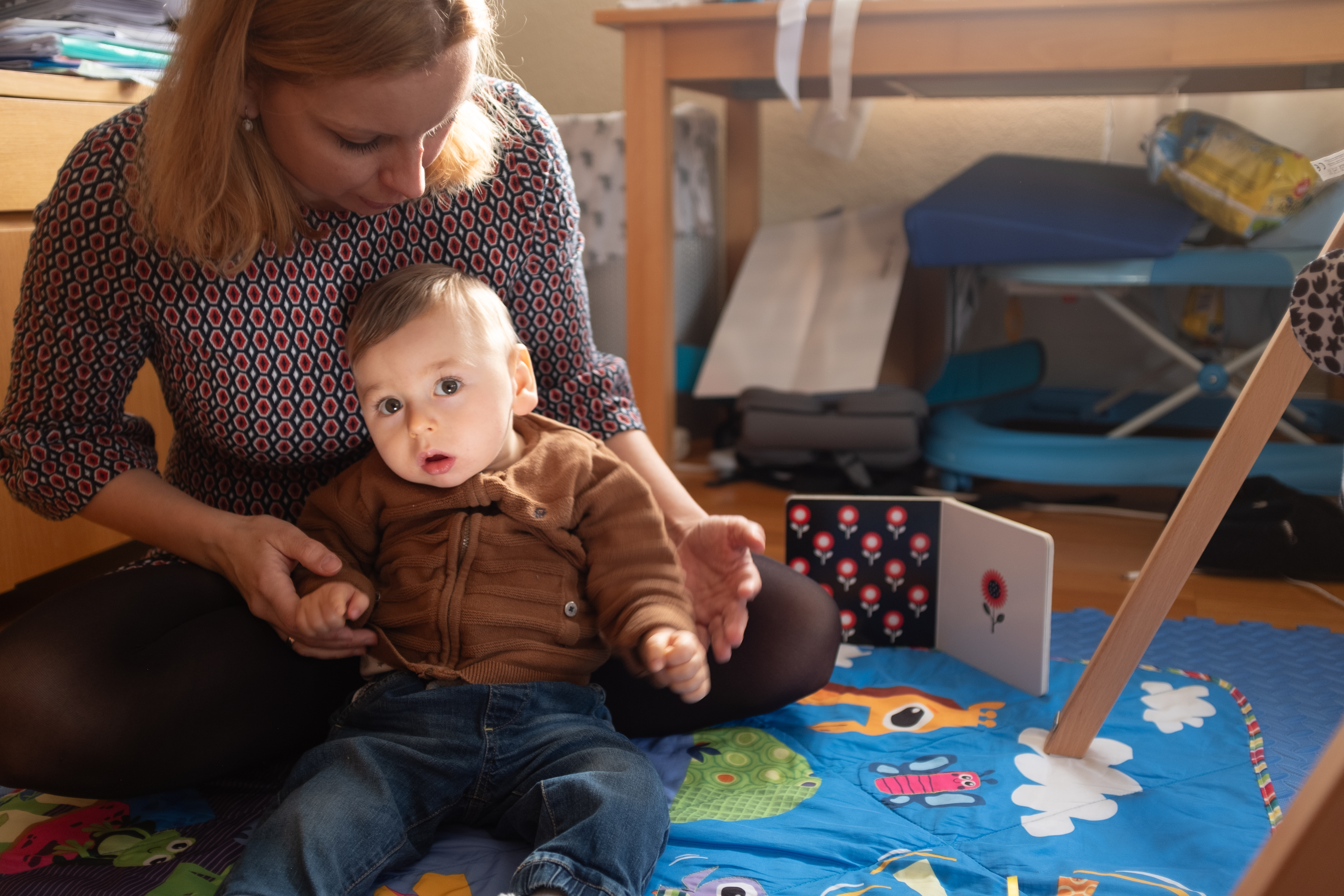
Ignored by the pharma industry, a growing number of parents are taking drug development for their children’s ultra-rare diseases into their own hands. One couple in Switzerland shares what it takes to keep hope alive.
Select your language
Generated with artificial intelligence.
Listening:
Desperate to save their children, parents become unexpected drug developers


February 2, 2025, was the most frightening day of Mariann Vegh’s life. She had just returned from a walk in her neighbourhood in Trélex, western Switzerland, with her five-month-old son Erik peacefully asleep in his pram. When he woke up, he started convulsing, struggling to breathe. By the time an ambulance arrived, the seizure was over, but Mariann will never forget the feeling of helplessness.
“It was only eight minutes before emergency services arrived, but it felt like an eternity,” Mariann, a marketing director at a consumer health company, told Swissinfo. “I can still hear my voice, desperately calling out for Erik.”
Erik experienced several more seizures over the following two weeks as he lay in hospital while doctors conducted a series of tests to identify the cause. Blood tests and MRIs didn’t show any abnormalities.
+ Global health leaders declare rare diseases a priority
The answer arrived two months later. Genetic testing revealed Erik had Asparagine synthetase deficiencyExternal link (ASNSD), a rare, inherited disorder caused by a mutation in the ASNS gene that leads to severe neurological problems. The disease is recessive, which means both Mariann and her husband Balázs Karancsi had to pass down the mutated gene.
There is no single global definition of a rare disease, but most use prevalence thresholds: The World Health OrganizationExternal link defines a rare disease as one that affects one in 2,000 people or fewer; in the US it is fewer than 200,000 people at one time.
Some 300 million people or one in 17 people in the world have a rare disease but taken individually, each disease has very few patients. In Switzerland, some 500,000 people in a population of nine million are said to have a rare disease.
There is growing use of the terms nano or ultra-rare diseases to refer to even less common diseases. In some cases, only a handful of people have the same genetic mutation, according to n-Lorem non-profit associationExternal link.
Doctors treating Erik had never come across ASNSD. The internet showed only 40 people in the world had ever been diagnosed with the disease – not a single one in Switzerland. The handful of published papersExternal link on ASNSD showed children dying before their first birthday.
There is no treatment. Doctors believe Erik, now 15 months old, has a milder form of the disease. He can take epilepsy medication to reduce the number of seizures, but the disease has a poor prognosis. It can lead to blindness, serious developmental delays and in severe cases, death.
But Mariann refused to give up.
“I felt like the doctors took away hope,” she said. “The doctors tell you there is nothing they or you can do because they can’t find any information about the disease. But that just isn’t true. I said I’m not accepting this.”
Mariann sent some 200 emails to doctors, parents of children with rare diseases, and anyone in her network who might be able to help.
The couple became convinced a treatment could be developed but equally certain they couldn’t wait for others to do it.

“You get to the point where you believe that you can actually find a way to develop a drug yourself,” she said.
The couple created the ASNSD Research AssociationExternal link to find more people with the disease, raise money, and centralise research. They found an ally in Roxane van Heurck, a geneticist at Geneva University Hospitals (HUG), who brought together experts to identify different research projects.
The couple attends drug development courses, meets with scientists, and connects with families online all while caring for Erik and their older son, Mark. On top of this, the couple faces mounting insurance paperwork and medical bills and is trying to raiseExternal link CHF500,000 ($630,000) just to get the research off the ground. Their ultimate goal is to develop a gene therapy that can correct or replace the faulty ASNS gene.

Parents in the driver’s seat
What Mariann and Balázs are undertaking, while common in the United States, is unusual in Switzerland and in many other parts of the world. Experts who spoke to Swissinfo said only a handful of patients or caregivers in Switzerland have ever tried to get a drug developed themselves for a rare disease. But there is growing interest amid increasing despair among parents over the lack of treatment, increased access to funding through platforms such as GoFundMe, and new medical breakthroughs.
There are more than 7,000 known rare diseases affecting at least 300 million people globally, but only 5% have an approved treatmentExternal link. Most of which are for more common rare diseases like cystic fibrosis.
Nano or ultra-rare diseases, which may affect fewer than 100 people, are for the most part ignored by pharmaceutical companies. There are at least 4,000 genes associated with rare diseases. “If your disease occurrence is only one in 100,000 or more people, which is the case for ASNSD, pharma companies aren’t interested,” said Mariann.
Gene therapy aims to fix a faulty gene or replace it with a healthy gene to treat a disease or make the body better able to fight it. In 2017, the US Food and Drug Administration approved the first gene therapy.
But with new technology like gene therapy coming on the market, parents have more hope that treatments and even cures are possible. One example is Zolgensma – a gene therapy for spinal muscular atrophy.
“Gene therapy is changing the paradigm,” said Bernard Schneider, the head of the Bertarelli Foundation Gene Therapy facility at the Federal Institute of Technology Lausanne (EPFL) who works with the couple. “These therapies were considered too risky, but in the past years we’ve gained confidence about their safety and learned that they can work.”
In 2016, Christine R.’s son was diagnosed with FOXG1 syndrome – a rare genetic neurodevelopmental disorder caused by a mutation in the FOXG1 gene. There were only 100 reported cases worldwide at the time.
Similar to Mariann, Christine’s response was to take action. “A small group of parents shared a deep understanding that no one was ever going to research this gene unless we initiated it ourselves,” Christine, who lives in western Switzerland, told Swissinfo.
She connected with Olivier Menzel, a Swiss molecular biologist, who created the BLACKSWAN FoundationExternal link in 2010 to advocate for rare diseases. He worked with Christine to create a framework for research into FOXG1, set up a scientific advisory council and a way to process funding, among other things.

Christine was joined by Anouk Brunschwiler, another Swiss mother navigating her son’s diagnosis. Together, they faced the daunting task of financing the research.
“Asking for money was a terrifying prospect,” said Christine. “But we are living in a country with considerable resources.”
With the help of Google Maps, she identified large estates along Swiss lakes and sent personal letters to owners. Several responded, including one individual who took a personal interest in her story and made a large donation.
Combined with Anouk’s fundraising effort and that of a father in France, they raised just over CHF800,000 to kickstart research. In 2017, mothers Nasha Fitter and Nicole Johnson founded the FOXG1 Research FoundationExternal link in the US, building on the initial research funded from Europe.
The foundation, which has raised more than $17 million (CHF13.5 million), is now a global, parent-led non-profit organisation developing the first gene therapy for FOXG1 syndrome. It funds a dedicated lab with 20 scientists and is on track to begin clinical trials in 2026.
It isn’t alone. Parent-led groups such as PACS2 Research FoundationExternal link and SCN8A International AllianceExternal link are attracting top researchers, co-authoring peer reviewed studies, and providing scientific guidance to parents and doctors on how to manage diseases. Some, such as Mila’s Miracle FoundationExternal link for Batten Disease in the US, have even had their therapies approved.
Research groups led by patients or parents are now legitimate actors in scientific research and drug development, said Menzel. “In rare diseases, there is no expertise. The expert is the patient, or the parents of the patient because they are living it day to day,” he added. “And no one is going to do this research if the parents aren’t driving it forward.”
Fundraising never ends
Despite parents’ enthusiasm and commitment and growing interest from researchers, the challenges of raising money are immense, especially for clinical trials to test drugs on patients.
Private companies, who would usually step in at this phase of drug development, have been abandoning gene therapy programmes because of poor sales and regulatory pushback against high prices.
+ Gene therapies moment of reckoning
The FOXG1 Foundation is now raisingExternal link $12 million to complete clinical trials on its own for its gene therapyExternal link after a US-based biotech stopped developing it, citing high costs and lack of profitability.
Parent-led groups can’t apply for grants from public funders like the US National Institutes of Health or the Swiss National Science Foundation because they aren’t scientists. They depend entirely on research institutes, which have their own priorities. “There’s no place to go except to private donors,” said van Heurck.

These organisations have more success in the US because established networks exist to connect them with big pots of money, and many philanthropists donate to science and innovation. In 2019, the Chan Zuckerberg Initiative, founded by Meta CEO Mark Zuckerberg and his wife Priscilla Chan, set up the Rare As One ProjectExternal link to support patient-led research into rare diseases. It has made grants totalling more than $30 million to some 94 organisations.
Groups in Europe find it harder. “In Europe, we really have to convince people that we are doing something real, that it isn’t a scam,” said Gosia Kosla, who set up the PACS2 Research Foundation in Poland when her daughter was diagnosed with PACS2 syndrome, a rare neurodevelopmental disorder.
In Switzerland, “people tend to give to organisations that they know and for emergencies, like a tsunami,” said Menzel. “There aren’t a lot of donations for research into rare diseases, especially drug development that takes a long time and carries risks.”
One exception is the annual AFM-TéléthonExternal link in France, which raises funds for research into muscular dystrophy and ultimately led to the development of the gene therapy Zolgensma, which was later acquired by Swiss giant Novartis. But this scale of funding has been difficult to replicate in other countries.
+ Zolgensma: Whatever happened to the most expensive therapy in the world?
Erik’s battle
Mariann and Balázs are fully aware of the daunting journey that lies ahead and that there is no guarantee a gene therapy will be developed in time to save their son’s life.
Erik’s seizures are currently under control with the help of anti-epilepsy medicine, but he isn’t reaching typical developmental milestones for his age. “We have a really good support team,” said Mariann. “But we really need to stop the disease from progressing.”

The family has a research plan that includes several projects including repurposing existing therapies, which could offer Erik some options in the near term, and progress is being made.
The ASNSD Association was accepted into the Genetic Therapy Accelerator Centre at University College London, which is exploring a gene therapy and another treatment technique called Antisense oligonucleotides (ASOs)External link.
The association is also collaborating with researchers in Switzerland – including van Heurck and Schneider as well as Théo Ribierre at the NeuroNA Human Cellular Neuroscience Platform in Geneva – who are using Erik’s cells to create a model of his brain to test different therapies.
The family has launched a crowd-funding campaignExternal link and raised 65% of the CHF500,000 for research that will hopefully provide the data to allow researchers to apply for bigger grants.
“The era has changed,” said van Heurck. “Five years ago, we couldn’t offer anything to those parents with children with ultra-rare diseases. But technology has changed. The field is moving.”
Edited by Nerys Avery/vm/ts
Correction: The Rare as One initiative has supported 94 patient communities not 50 as previously written.
Subscribe to
-
 Apple PodcastsExternal link
-
 SpotifyExternal link
-
 YouTubeExternal link
-
 Amazon MusicExternal link
-
 iHeartRadioExternal link
-
 Podcast IndexExternal link
-
 CastboxExternal link
-
 OvercastExternal link
-
 Pocket CastsExternal link
-
 Podcast AddictExternal link
-
 DeezerExternal link
-
 Listen NotesExternal link
-
 PodchaserExternal link
-
 Player FMExternal link
-
 CastroExternal link
-
 GoodpodsExternal link
-
 True FansExternal link
-
 PandoraExternal link
- Buzzsprout RSS Feed External link
External Content

In compliance with the JTI standards
More: SWI swissinfo.ch certified by the Journalism Trust Initiative

You can find an overview of ongoing debates with our journalists here . Please join us!
If you want to start a conversation about a topic raised in this article or want to report factual errors, email us at english@swissinfo.ch.