








Why Switzerland is struggling with its national defence
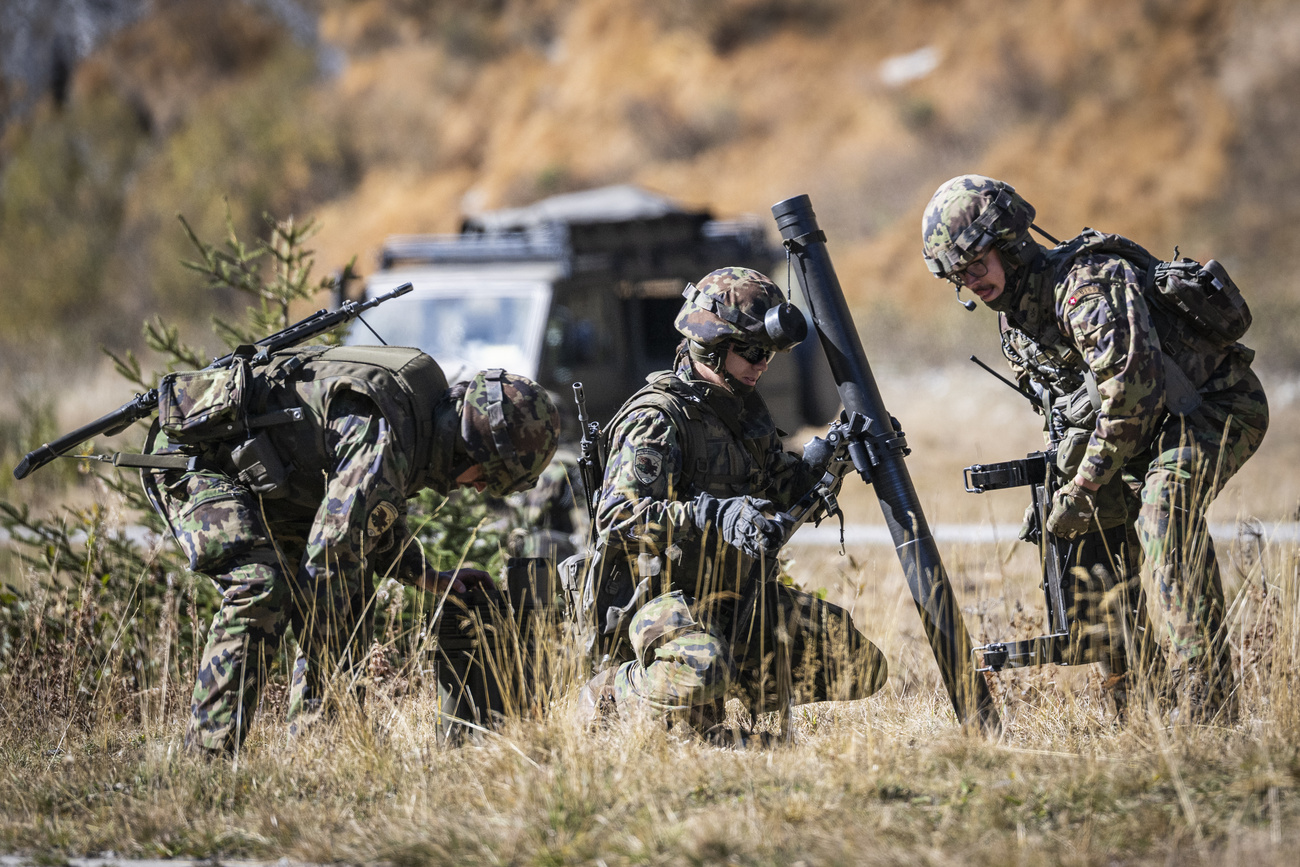
Switzerland’s neighbours increasingly see the country as a potential weak link in European security. But at home, defence is hardly a priority on the political agenda. As our analysis shows, financing has taken over the debate among lawmakers all while public trust in the armed forces is eroding.
Select your language
Generated with artificial intelligence.
Listening:
Why Switzerland is struggling with its national defence

Four years on from Russia’s full-scale invasion of Ukraine, the impact of this hybrid war is being felt in Switzerland. Although the government in Bern has stopped short of formally assigning blame, military experts are convinced that Russia has already carried out major cyberattacks against Swiss public infrastructure.
Since April 2025, Switzerland has kept official records of reported attacks on critical infrastructure, including hospitals, power plants, and banks. On average, one cyberattack is reported each day. Disinformation campaigns have also been uncoveredExternal link, most recently in the form of interference by the Kremlin-controlled media outlet Russia Today (RT) over the upcoming national vote on funding the Swiss Broadcasting Corporation, Swissinfo’s parent company.
‘The heart of Europe is vulnerable’
In October 2025, witnesses in canton Aargau, northern Switzerland reported seeing a large drone hovering above the centre of Europe’s high-voltage network, the so-called Star of Laufenburg. The incident barely registered with the wider public, but it set off alarm bells in security circles.

The Laufenburg substation is one of the most exposed sites in Switzerland. It also plays a key role in supplying power to neighbouring countries. “Switzerland is just as affected by Russia’s hybrid war as the rest of Europe,” the Neue Zürcher Zeitung newspaper pointed out. Swiss infrastructure, it added, forms the heart of Europe’s most economically powerful region.
‘Neutrality has led to isolation’
Speaking to Swissinfo, Neue Zürcher Zeitung’s Georg Häsler says the issue is no longer only about defending Swiss territory, but about protecting interconnected systems. In his view, Switzerland has a duty to safeguard transport and energy infrastructure because the rest of the continent depends on it.
“For the rest of Europe, our neutrality has become a security risk,” he says. “Switzerland’s bet that it could secure its safety by keeping its distance and turning a blind eye has not paid off.”
Marcel Berni, who teaches military strategy at the federal technology institute ETH Zurich, says Switzerland’s inability to defend critical infrastructure on its own territory has left neighbouring countries feeling deeply unsettled. Like Häsler, Berni refers to it as a crisis of neutrality. “Switzerland has convinced itself that it’s neutral. But neither Russia nor NATO see it that way.” In the meantime, Berni argues that Switzerland has effectively cut itself off through its isolationist interpretation of neutrality.
This is especially clear when set against a backdrop of increased defence spending in Europe. Governments across the continent have signalled their intention to allocate 5% of their GDP to defence as the prospect of a US withdrawal from NATO becomes more plausible.
In conversations with his European counterparts, Defence Minister Martin Pfister has repeatedly had to explain Switzerland’s comparatively low level of spending. Switzerland currently spends just 0.7% of its GDP on the military, with an aim of reaching 1% within six years. After the Munich Security Conference, Pfister told Swiss public television “there is a lack of understanding” among his European counterparts.
When asked by Swissinfo at a press conference if he senses pressure from Europe, Pfister said that expectations were high: “Europe expects Switzerland to be capable of defending itself without relying on support from others. If we wish to remain neutral, it is also an obligation on our part.”
To boost defence spending, Pfister is proposing a ten-year increase in the value added tax (VAT) of 0.8 percentage points – from 8.1% to 8.9% – which would bring CHF31 billion into federal coffers. While he has secured the support of his fellow ministers in the Federal Council, parliament has shown little appetite for the idea. So far, only Pfister’s Centre Party supports his proposal.
Among the public, scepticism is even more widespread. A representative pollExternal link in early February found that 76% of those surveyed opposed raising the VAT.
External Content
None of the alternative financing models for the army put forward in the poll found majority support either.
External Content
The implications are clear. Swiss voters are not willing to give more money to the armed forces. In a country governed by direct democracy, this means the military will not receive additional funding until a majority recognises its necessity.
Public disappointment builds
Swiss voters have developed a strong sense of detachment from their defence establishment as past failings come back to haunt it. A drone procurement process broke down. The purchase of the F-35 fighter jets spiralled out of control. A digital operating system is increasingly plagued by setbacks. Across the board, there are cost overruns and delays. These are only the most prominent irregularities that have prompted disappointment among voters.
“We are not prepared to give even more money to a department plagued by so many scandals and instances of mismanagement,” left-wing Social Democratic Party parliamentarian Samira Marti told Swiss public television SRF. The Social Democrats describe the situation at the defence ministry as a “crisis of confidence” and insist that it must be resolved before any more funding is approved. “Right now, more money for this army does not translate into greater security,” Marti said.
A sobering assessment
This is the dilemma in which Pfister finds himself. When he joined the government in March 2025, he promised greater transparency and better communication from his department. He enlisted the most rigorous financial auditor to overhaul the procurement process, sort out the situation, and rebuild trust.
Pfister has been releasing quarterly updates, each time with fresh bad news. Many legacy projects have become financially or structurally irreversible and now must be either scrapped at considerable cost or dragged across the finish line with additional funding. The attempt to rebuild trust has, for now, only deepened disillusionment.
Mistrust and open questions
Meanwhile, the clock is ticking. Protracted procurement deals are being dragged out as several countries want weapons and Switzerland, a lone player in a tightly interconnected market, is not given priority. Take the case of the US Patriot air defence system. Despite putting a CHF700 million ($904 million) down payment, Washington is giving preference to other countries. “We can ask seven times, but if there is no response …” the head of the air defence programme recently told the press.
The technological upheavals on display in the war in Ukraine are also causing uncertainty among Swiss voters. Could their country fight in a drone war? Would a new fighter jet even make sense in this scenario? Conventional weapons such as tanks seem obsolete. US weapons systems inspire mistrust. The Swiss Armed Forces are only just beginning to develop drone capabilities, and they have yet to show how extra billions would significantly strengthen cyber defence. Nearly every piece of equipment is now debatable.

All of this reinforces mistrust and further alienates the public from the army.
“There’s little recognition that this is our military safeguarding our security,” says Christian Brändli, editor-in-chief of the Swiss defence policy journal Allgemeine Schweizer Militärzeitung. “Nor does the public fully understand how vulnerable we are.”
In his view, the responsibility lies with the Federal Council. “The government must clearly communicate how delicate the situation has become,” he says.
‘We need a great deal of money very quickly’
Werner Salzmann, a senator from the right-wing Swiss People’s Party and security policy specialist, sees it much the same way. He has called on the government to conduct a comprehensive assessment of the security situation. Salzmann recommends that the government then present a united front and clearly outline the risks to the public. In his view, this is a core responsibility of government leadership. “If politicians do not acknowledge the danger, why should the public?”
Generally, Salzmann believes the armed forces can be financed through the ordinary budget, without additional funds or new borrowing. “The problem is that we now need a great deal of money very quickly, because we must place urgent orders and make advance payments,” he says. In a parliamentary motionExternal link, he explored the possibility of special financing, including a dedicated defence bond. He says he is surprised that the government cited the “tight federal budget” in its response, as if these were normal times.
Centre Party senator Marianne Binder-Keller is calling for the creation of a fundExternal link that would enable the government to circumvent its strict debt brake, a constitutional rule limiting federal borrowing. She argues that Russia’s use of hybrid warfare in Europe amounts to an extraordinary situation that would warrant this kind of financing. “Right now, it is fiscal policymakers who set the tone,” says Binder-Keller, “and this leads to inaction.”
In her view, the greatest threat to Switzerland stems from the “hybrid attacks coming from Russia”. That is how wars have always started, she says: “The second greatest threat is our typically Swiss way of thinking – the belief that none of this really affects us.”
Among concerned security policymakers, Binder-Keller says, a wry joke is circulating: Switzerland can be handed over debt-free to Russian President Vladimir Putin.
Edited by Samuel Jaberg. Adapted from German by David Kelso Kaufher/gw
More


In compliance with the JTI standards
More: SWI swissinfo.ch certified by the Journalism Trust Initiative

You can find an overview of ongoing debates with our journalists here . Please join us!
If you want to start a conversation about a topic raised in this article or want to report factual errors, email us at english@swissinfo.ch.