








Climate change in the Alps: five ways Swiss ski resorts are fighting for survival

Switzerland is a popular winter sports destination, but the days of guaranteed snow are over. Ski resorts and winter sports destinations are being forced to rethink their strategies to survive.
Select your language
Generated with artificial intelligence.
Listening:
Climate change in the Alps: five ways Swiss ski resorts are fighting for survival

1. Ski resorts are changing ownership
Swiss ski resorts are mainly owned by cable car and lift companies, in which local communities often hold a stake but do not have majority control. In autumn 2025, the municipalities of Flims, Laax and Falera, in canton Graubünden, made headlines when they banded together to buy their ski area, “Weisse Arena”. The citizens and local assemblies voted overwhelmingly to take over the entire area at a cost of CHF94.5 million ($123 million). The overriding aim was to prevent it from falling into the hands of foreign investors. The latter had promised to invest millionsExternal link, but local stakeholders would have lost their say.
Vail Resorts from the United States, the world’s largest ski resort operator, has set its sights on the Alps. It has already acquired the ski lifts of Crans-Montana and Andermatt-Sedrun. The company often focuses on sites with development potential where lifts, accommodation and leisure facilities can be combined into one huge resort. The presence of these new investors is changing the character of the mountain regions. Thus, in Andermatt, Egyptian businessman Samih Sawiris is shaping touristic development and has even created a new village centre. In Saas Fee, the Austrian Schröcknadel familyExternal link holds a majority stake in the ski resort, as well as several properties.
Like “Weisse Arena”, other Swiss ski resorts are also rallying to prevent foreign takeover. The cable car and lift company in Lenzerheide, canton Graubünden, has adopted a structure with over 3,500 shareholders, in which the municipality holds almost half of the shares.
2. Higher-altitude resorts are expanding their infrastructure
As a rule of thumb, a slope must have 30cm of snow cover for 100 days for it to be worth grooming and operating. A new tool, known as Snow Compass, helps ski resorts determine whether they will still have such snow cover in the future. The tool, which was developed by the Swiss Cable Car Association and Switzerland Tourism together with the Institute for Snow and Avalanche Research, the federal technology institute ETH Zurich and MeteoSwiss, uses scientific methods to generate forecasts for the future of the slopes. It is evident from the data that the winter season will be significantly shorter in certain locations.
The tool also clearly shows that cable car companies and the associated winter sports resorts still depend heavily on winter business. The colder months continue to attract guests reliably and are therefore by far the most profitable. As a result, places that know they will still have snow in the future are investing. High-altitude ski resorts are replacing old lifts with modern facilities and renovating restaurants. Thus, Saas Fee has renovated the world’s highest funicular railway to the Mittelallalin at almost 3,500 metres above sea level; the cable car to Mürren in the Bernese Oberland has been modernised, at a cost of CHF130 million; and CHF80 million has been invested in new gondolas in the Flims Laax Falera ski area. The Berner Zeitung newspaper writes of an “arms race in the mountainsExternal link.”
>>A short video that looks at how Swiss mountain resorts are being assisted by the “Snow Compass” forecasting tool:
3. Ski resorts are joining forces
Where possible, Swiss ski resorts are banding together to shoulder the investments. Larger, interconnected ski areas offer winter sports enthusiasts more kilometres of slopes, more restaurant facilities and more different activities. The operators can share the costs and organise their marketing and ticketing jointly. Well-known interconnected ski regions include Arosa-Lenzerheide in canton Graubünden and Les Portes du Soleil in canton Valais. In the latter, skiers can even glide across the border and keep skiing in France.
The most recent merger involved ski resorts in three different valleys across two cantons. The Andermatt-Sedrun ski area was completed External linkin autumn 2018, with Disentis joining six months later. New cable cars and restaurants were built at high altitude to connect the resorts via the Oberalp Pass. Huge sums were also invested in snow farming and snowmaking. The US operators promise a seven-month ski season.
More

4. Ski resorts are focusing on activities that require less snow
“Everyone goes skiing,” went the popular Swiss song in the 1960sExternal link. Switzerland remains a skiing nation to this day. According to one analysisExternal link, 62% of Swiss between the ages of 14 and 70 practise winter sports. This percentage has remained constant in recent years. Clearly, though, it is better for ski resorts if people come not only for the slopes.
Especially at lower altitudes, ski regions are trying to create offerings beyond Alpine winter sportsExternal link that require less snow and less costly maintenance. Some ski resorts have specialised in snowshoeing or winter hiking. The Stockhornbahn near Thun has turned its back on ski tourism entirely. The same goes for Monte Tamaro in Ticino and the Les Paccots region in canton Fribourg. With a more sustainable approach to tourism, these regions are seeking to attract those who want to travel off the beaten path, as well as groups such as older people, foreign visitors and those without skiing experience.
Although winter is the most lucrative season, mountain destinations and tourism associations are trying to entice tourists all year round. They are offering yoga retreats, mountain bike holidays and culinary hotspots. Climate change may be a curse for winter, but autumn has received an upgrade. Switzerland Tourism is promotingExternal link the country’s many delights in autumn through advertising spots with celebrities such as Roger Federer and Halle Berry. Hiking holidays are now possible well into November, after which the ski season kicks off seamlessly. This does mean, however, that hotels and cable cars must forego the traditional between-season breakExternal link if they want to be able to welcome guests in the autumn.
Another solution is to juggle around the seasons. Because of lack of snow, the Atzmännig ski resort in canton St Gallen has switched to summer modeExternal link in winter. Unfortunately, however, this is not financially viable.
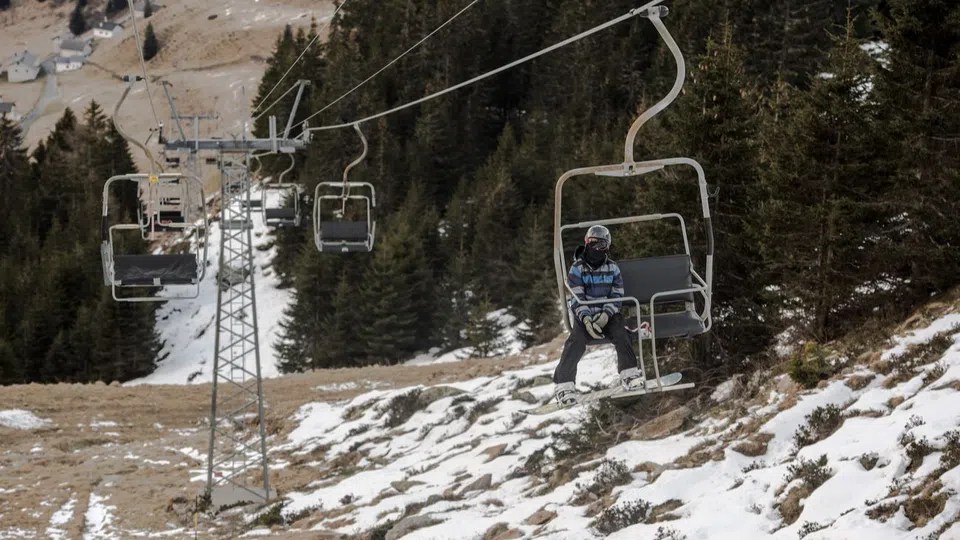
>>A look at resorts in southern Switzerland, which have been particularly hit hard by the lack of snow.
More
Can Ticino’s ski resorts survive a warming climate?
5. Ski resorts are closing
Most of the ski resorts mentioned in this article are large and extend well above the critical altitude of 1,600 metres above sea level. In such places, it is clearly worth investing in the future. Lower down the situation is different.
Owing to chronic lack of snow, dozens of ski resorts in Switzerland have ceased operations, while others are on the verge of doing so. Many of these are village lifts that used to operate regularly, but now mostly stand on a big patch of grass. The online news portal Watson counts 167 ski resortsExternal link that have shut down.
After closure comes the problem of dismantling the infrastructure. This usually costs huge sums of money, which in many cases no one is able or willing to pay. Dozens of abandoned ski liftsExternal link are thus rusting away across the country.
Even on the central Swiss Plateau, however, there are still a few ski lifts that can quickly provide a few hours of skiing fun when it snows. Like here in Seon in canton Aargau, where a ski race was even heldExternal link in January 2026, for the first time in 30 years.
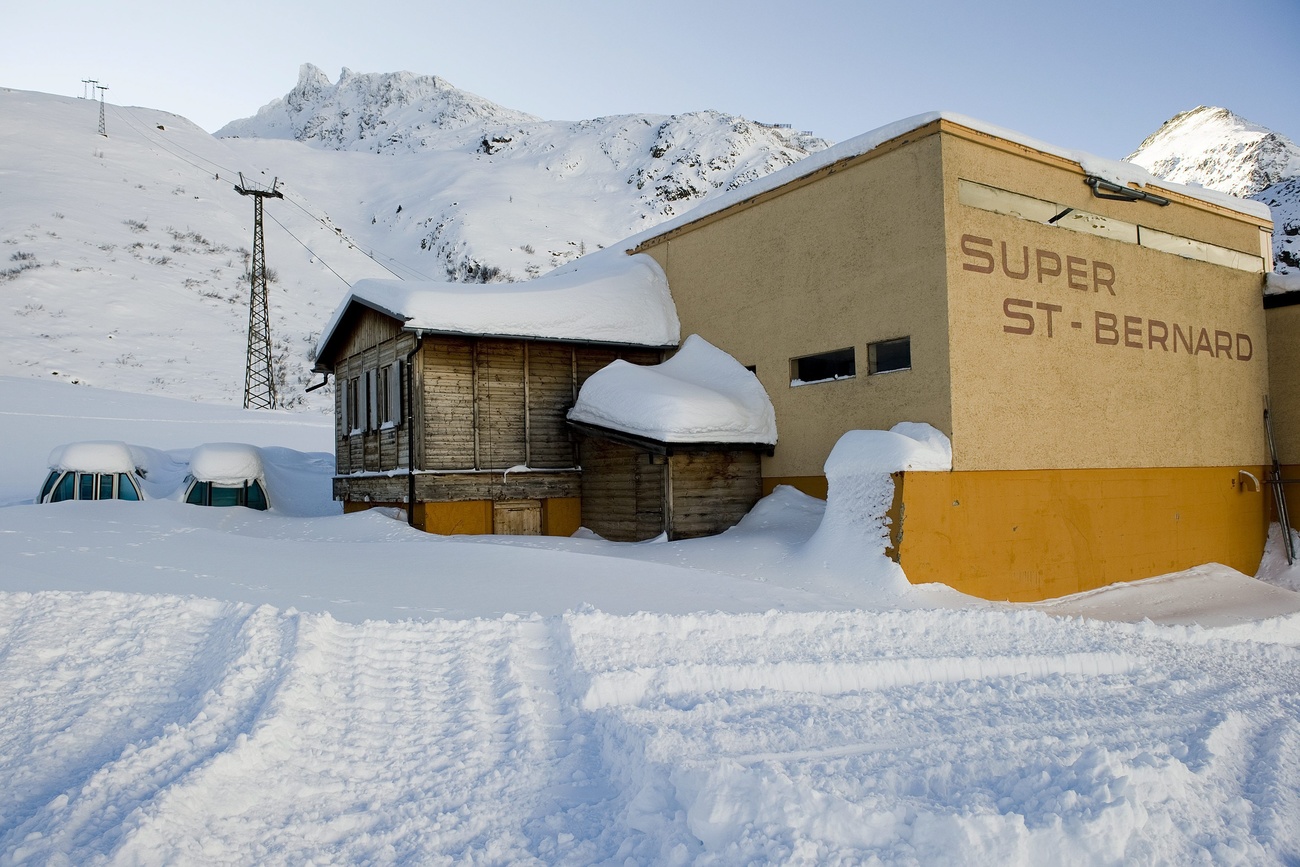
>>An article on the former Swiss ski resort of Super St-Bernard, which remains popular:
More
The lure of the ghost resort
Edited by Balz Rigendinger/Adapted from German by Julia Bassam/sb

In compliance with the JTI standards
More: SWI swissinfo.ch certified by the Journalism Trust Initiative

You can find an overview of ongoing debates with our journalists here . Please join us!
If you want to start a conversation about a topic raised in this article or want to report factual errors, email us at english@swissinfo.ch.