








Cycling in Switzerland twice as dangerous as in Netherlands
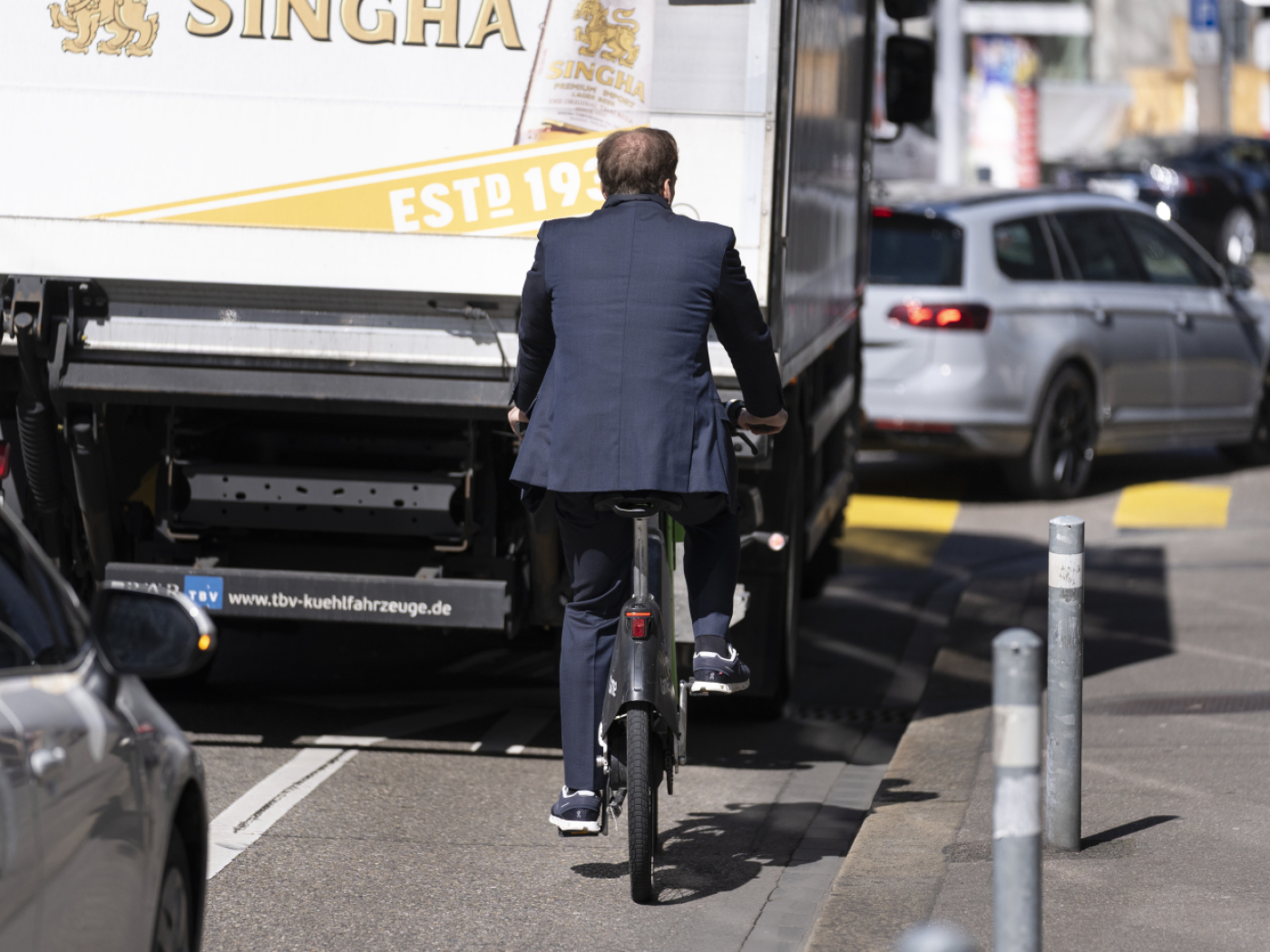
The accident rate in Switzerland is twice as high as in the Netherlands when measured in terms of kilometres cycled, according to a new study.
Between 2019 and 2022, an average of 0.19 cycling accidents were recorded per 100,000 kilometres cycled in Switzerland – compared with 0.09 in the Netherlands, as shown by the analysis published in the specialist journal Journal of Safety Research.
For the study, researchers from the University of Twente in the Netherlands and the federal technology institute ETH Zurich analysed more than 86,000 police-recorded cycling accidents from 2019 to 2022 in Switzerland and the Netherlands.
The findings revealed that locations in Switzerland where cyclists encounter other road users are particularly problematic. For instance, the risk of accidents for cyclists at public transport stops in Switzerland is significantly higher than in the Netherlands, and tram tracks also prove to be accident blackspots. The risk is also significantly higher at junctions in Switzerland.

More
Cycling accidents in Switzerland rise by 50% in ten years
More cycling infrastructure, less risk
The researchers cite differences in infrastructure as a possible explanation for the higher risk of accidents in Switzerland.
According to lead author Georgios Kapousizis, bus and tram stops are a clear example of this. While in Swiss cities bicycles often ride directly past waiting buses or pedestrians, in the Netherlands cycle paths usually run behind the stops, Kapousizis explained to the Swiss News Agency Keystone-SDA. This means they do not get in the way of cars on the road or passengers getting on and off, and vice versa.
To improve road safety for cyclists, Kapousizis suggests that Switzerland could focus on the three problem areas identified in the study: public transport stops, tram tracks and junctions.
“Switzerland and many other countries do not need to reinvent the wheel,” he said. At stops, it could adopt the Dutch model; at junctions, protected cycle lanes and dedicated cycle traffic lights could help. Where tram tracks are concerned, structural solutions are needed to prevent bicycle wheels from getting caught in the rails.
Where physical separation is not possible, Kapousizis recommends lower speed limits. The study shows that on roads with a 50km/h speed limit, the probability of an accident was almost three times higher than on those with a 30km/h limit.
More
Mandatory bike helmet advocates face uphill battle
+ How we produce news in English
Translated from German, reviewed by an English Department journalist.

In compliance with the JTI standards
More: SWI swissinfo.ch certified by the Journalism Trust Initiative

You can find an overview of ongoing debates with our journalists here . Please join us!
If you want to start a conversation about a topic raised in this article or want to report factual errors, email us at english@swissinfo.ch.