








China’s pharma companies turn to Europe for growth

China has emerged as a powerhouse of biotech innovation, but local firms still face a steep climb toward financial stability and global growth. Swissinfo spoke with three Chinese companies navigating these hurdles as they set their sights on Europe.
Select your language
Generated with artificial intelligence.
Listening:
China’s pharma companies turn to Europe for growth

At this year’s Swiss Biotech Day in Basel in May, 12 Chinese companies – nearly double last year’s number – attended with the support of the China hub of Swiss Global Enterprise, the official government export and investment organisation. At least another 15 Chinese firms took part at their own initiative.
This surge comes as Western giants like Roche and Novartis sign a record number of deals to license drug candidates from Chinese biotechs. Once known for copy-cat drugs, Chinese companies now account for 30% of clinical trial starts – up from 1% in 2009, according to healthcare analytics firm IQVIAExternal link.

More
The numbers behind China’s pharma rise
However, with dwindling domestic venture capitalExternal link, intense local competition, and rising US scrutinyExternal link, many Chinese companies are looking at opportunities in Europe. Many came to Basel to burnish their credentials outside China and prove they can be trusted partners.
Here, three executives share their journey to the global stage.
Canton Biologics – standing out from domestic competitors
For Xiao Shen, the next three years will be critical for his company’s international growth. Some 40% of its total revenue now comes from overseas, but Shen’s goal is to bring that closer to 80% by 2028.
To get there, he and his management team are actively looking for global partners. Swiss Biotech Day is one of more than ten conferences they are attending in Europe and the United States in a span of six months.
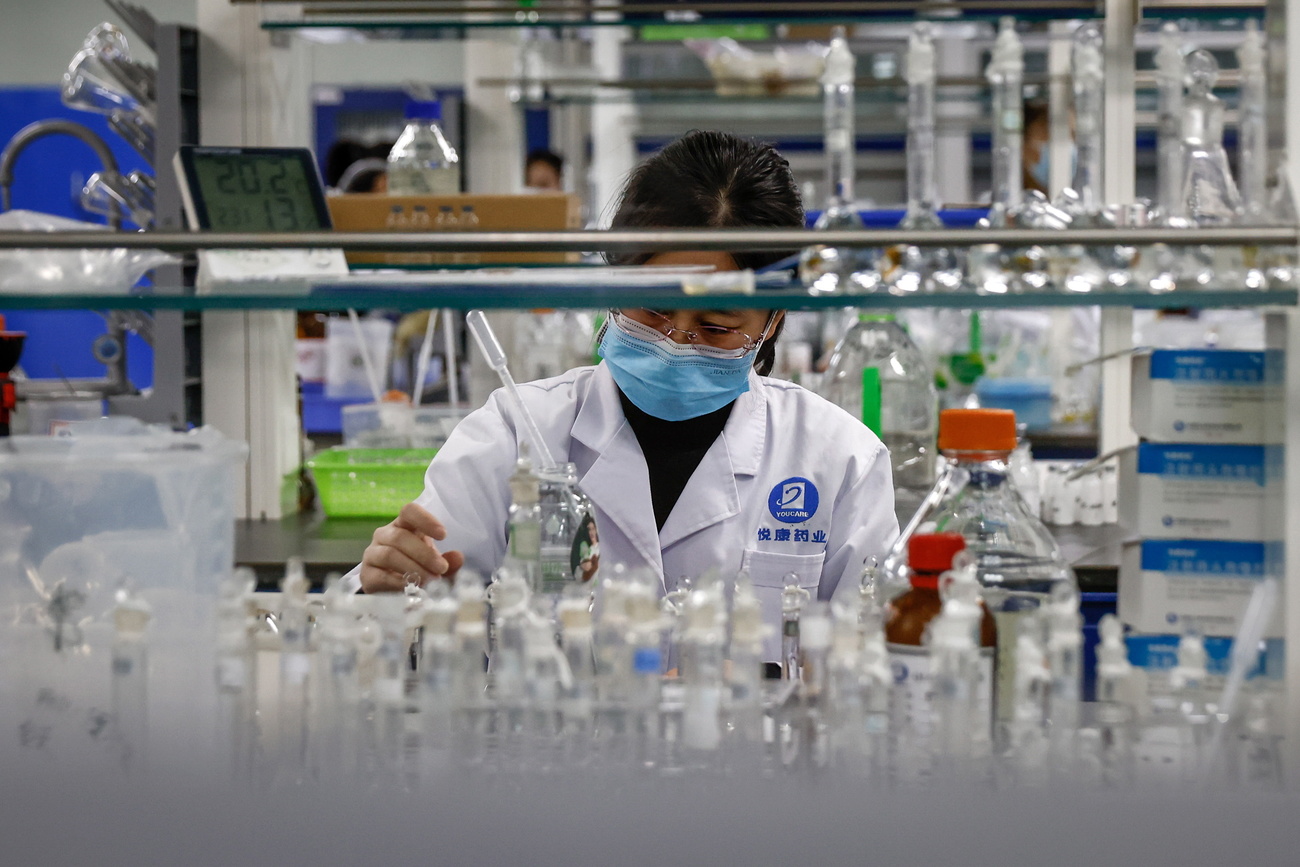
Shen is the founder and CEO of Canton Biologics, a Contract Development and Manufacturing Organisation (CDMO) in southern China. CDMOs serve an essential role in the pharma supply chain. Drug companies often hire them before clinical trials to handle design, formulation, laboratory development, and manufacturing.
Switzerland is home to Lonza, the world’s largest CDMO in the world by revenue, founded over 125 years ago. China is now teeming with CDMOs, such as WuXi AppTec, that have been built on the country’s industrial strength. A 2024 surveyExternal link of 124 biopharma firms found that 79% of them have at least one contract or product with a China-based or -owned CDMO.

Policy changes in the Asian country starting in 2015 that allow drug developers to outsource manufacturing helped to fuel the rise of CDMOs. That’s when Shen started Canton Biologics, which specialises in complex biological products that Shen says he can deliver with “speed, quality, flexibility, and cost competitiveness”.
Chinese investors gave Shen seed funding in 2016 to start the company. Since then, he has raised over $40 million (CHF32 million) in three rounds through 2023.
But domestic venture capital for biotech fellExternal link 73% to $4.2 billion in 2024, down from a peak of $15 billion in 2021, amid slowing economic growth. Meanwhile competition from home-grown companies has intensified.
“There’s huge competition everywhere in almost every industry in China,” said Shen. “This puts people under pressure.”
Expanding the company’s global client base is essential for growth. Just under half of Canton Biologics’ more than 100 clients are domestic.
While most Chinese CDMOs target the US, this strategy is becoming increasingly risky as the US imposes more restrictionsExternal link on contracts with Chinese biotech companies over national security concerns.
Shen aims to carve out a niche with European clients, which is why he is in Basel. He feels well positioned to build trust in Europe and stand out from other Chinese companies because of his experience on the continent.
More
Chinese biotechs eye Swiss collaboration as relations with US sour
As a child, Shen, who was born in Jiangsu province, lived in Lower Saxony, Germany while his father earned his doctoral degree. He later returned to Germany to study biological pharmacology and then spent four years at the Swiss Federal Institute of Technology Lausanne (EPFL), where he received a PhD. His academic experience at EPFL helped shape the scientific and entrepreneurial vision behind Canton Biologics.
“I always say I learned science in Germany and biotech in Switzerland,” said Shen.
Canton expanded from a ten-person team and a 400m² R&D centre to 300 employees with 16,000 m² at four sites, including a German subsidiary set up in 2022.
Shen hopes to build an international company that can compete with CDMO heavyweights, but the long-term goal, he said, is to go beyond being a service provider and become a “biotech innovator with global influence”.
“We are still young, but we are on the right track,” he said. “It takes time for European clients to get to know us and accept us.”
CoJourney – pitching speed and affordability
CoJourney is trying to solve one of biotech’s toughest manufacturing problems – producing safer, more effective and affordable gene therapies.
Founder LiJun Wang has a similar career trajectory as many Chinese CEOs in the headlines today. She was raised in China, pursued her graduate education overseas in the US, then spent 13 years working at biotech companies in Florida and California.
In 2019, she co-founded with two US-trained Chinese scientists a biotech firm, Exegenesis Bio, operating out of Hangzhou and Pennsylvania. The company develops gene therapies for wet age-related macular degeneration – a serious eye condition – and the rare disease spinal muscular atrophy (SMA). Swiss firm Novartis sells the only gene therapy for SMA on the market.
In 2023, Exegenesis spun off the manufacturing business as CoJourney, a CDMO producing viral vectors, mRNA and other products that help transport modified genes into cells. The aim was to let Exegenesis focus on drug development while CoJourney, headed by Wang, pursued market opportunities with Chinese start-ups and global clients.

Wang came to Basel to explore the European market. A key part of her sales pitch to international clients is speed, quality and cost efficiency. According to CoJourney’s website, its Zero-Chrom platform produces purified plasmid DNA – a fundamental building block of gene therapies – in 60% less time and at 70% lower cost than widely used methods. This could dramatically lower the cost of gene therapies, which often carry price tags in the millions per dose.
Wang also emphasised another key advantage of CoJourney as a bridge. It helps clients navigate special regulatory pathways, such as Investigator-Initiated Trials (IITs). This route allows a hospital’s own scientific and ethics committees to greenlight first-in-human trials of therapies without going through the standard experimental drug application process.
“China is fast-tracking drug development to improve affordability,” said Wang. “Focus on drug development efficiency speeds up market access, which is key for rare, progressive diseases that start in childhood.”
China’s expedited approach has raised global concernsExternal link regarding possible compromises in patient safety, data reliability, and disclosure. Notably, following Swissinfo’s meeting with Wang, news broke of three fatalitiesExternal link in recent IITs, each a highly innovative, first-in-human trial.
Wang later communicated via email that she doesn’t believe these deaths will cast a long shadow over China’s gene therapy field. While advocating for greater transparency, she told Swissinfo that “new regulations [in China] will help manage risks and provide clear reporting channels for serious side effects, including fatalities”.
She pointed to Decree 818, effective May 1, 2026, which limits IITs to certain hospitals and licensed physicians with high ethical standards, proven research integrity, and relevant clinical expertise. The regulation also enforces rigorous quality requirements for manufacturers.
“The scientific community’s goal is to learn from these events to advance research, not to stall it,” said Wang.
Eyebright Medical – convincing quality sceptics
When German executive Thomas Zimmer first came across Eyebright Medical Technology at an eye surgeons’ conference in Copenhagen in 2016, he was sceptical. Zimmer, who ran OphthalmoPro, a German firm specialising in surgical eye products, had never heard of high-quality intraocular lenses (artificial lenses implanted in the eye) made in China.
But a trial in a German operating room changed his mind. While US and European delivery tools struggled with precision, Eyebright’s preloaded system allowed the surgeon to enter the eye seamlessly.
Zimmer’s experience highlights the challenge Chinese life-sciences firms face as they expand internationally: overcoming deep-seated Western scepticism about product quality.

“The biggest hurdle was convincing surgeons to use the lenses,” said Zimmer. But as more patients came back with improved vision, it became clear that the product spoke for itself. The margins were also much better for him.
Zimmer’s company started to work more closely with Eyebright, expanding the business to other parts of Europe and Asia. In 2025, Eyebright bought the German firm and opened a Swiss subsidiary as a marketing base for the European market. Zimmer was appointed to the board of Eyebright Switzerland.
“Eyebright is the market leader in China. It’s not a backyard company,” said Zimmer. “It can achieve much more than we can as a mid-sized company in Germany.”
The Swiss Biotech Day was a chance to build awareness of Eyebright and the new Swiss unit among industry peers. A core strategy is to use mergers and acquisitions to strengthen the company’s position outside China. It faces fierce competition, though: US and European companies like Alcon and Johnson & Johnson have a tight grip on the European market for intraocular lenses.
Although OphthalmoPro is now owned by a Chinese company, its name remains on products sold in Europe, at least for now. Zimmer acknowledges there are still worries about Chinese products being of poorer quality.
“We still use our name in Europe and on all the studies,” said Zimmer. “It is more trusted to have European naming.”
Additional reporting by Jie Guo Zehnder. Edited by Nerys Avery/vm/gw

In compliance with the JTI standards
More: SWI swissinfo.ch certified by the Journalism Trust Initiative

You can find an overview of ongoing debates with our journalists here . Please join us!
If you want to start a conversation about a topic raised in this article or want to report factual errors, email us at english@swissinfo.ch.