








Swiss health authorities defend Covid strategy

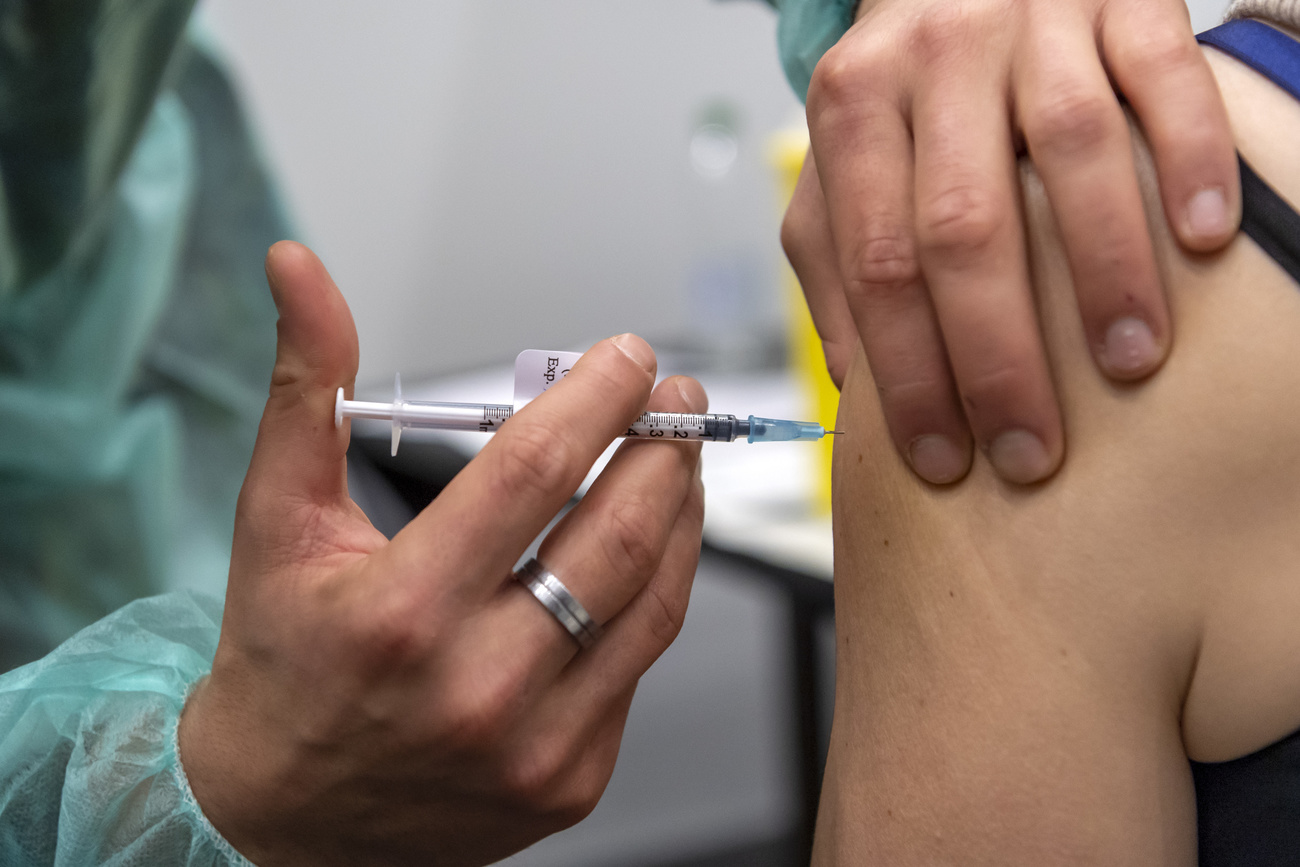
Anne Lévy, the director of the Federal Office of Public Health (FOPH), has defended the order of 61 million doses of Covid-19 vaccine during the pandemic.
Select your language
Generated with artificial intelligence.
Listening:
Swiss health authorities defend Covid strategy
+Get the most important news from Switzerland in your inbox
“At the start of the pandemic, competition for supplies was fierce,” Lévy said in an interview with the SonntagsBlick. “It wasn’t clear which company had the best vaccines – imagine if we had bet on the wrong product or ordered too few doses,” she added.
Switzerland administered 17 million vaccine doses on its territory and sent eight million to other countries. The rest was partly either destroyed or not delivered, yet paid for.
SonntagsBlick pointed out that over 70% of the vaccine doses paid for by Switzerland were not used. Lévy responded that Switzerland followed a strategy “based on safety”. Parliamentary oversight also found the measures to be justified. In a pandemic, it is better to order too much than too little, she said.
Meanwhile by the start of 2026, Swiss authorities had logged 408 claims for compensation for vaccine-related damages. According to Lévy, 300 of these have been rejected after initial examination, two accepted and two refused, while others are still pending.
More
Too many Covid doses: Switzerland’s vaccine conundrum
Patrick Fischer and quarantine
The majority of the Swiss population supports vaccination efforts. During the pandemic, almost 70% got a jab; the figure even exceeded 90% among over-65-year-olds.
Asked about Patrick Fischer, the ex-coach of the Swiss men’s hockey team who was sacked this week, Lévy said that it is a “personal decision” whether one gets vaccinated or not.
In 2022, Fischer travelled to the Beijing Winter Olympics with a forged Covid certificate. For Lévy, “he could have taken part in the Games even without vaccination; this would have been possible by entering quarantine. Other athletes have done so.”
Adapted from French by AI/dos
We select the most relevant news for an international audience and use automatic translation tools to translate them into English. A journalist then reviews the translation for clarity and accuracy before publication.
Providing you with automatically translated news gives us the time to write more in-depth articles. The news stories we select have been written and carefully fact-checked by an external editorial team from news agencies such as Bloomberg or Keystone.
If you have any questions about how we work, write to us at english@swissinfo.ch
External Content

In compliance with the JTI standards
More: SWI swissinfo.ch certified by the Journalism Trust Initiative

You can find an overview of ongoing debates with our journalists here . Please join us!
If you want to start a conversation about a topic raised in this article or want to report factual errors, email us at english@swissinfo.ch.