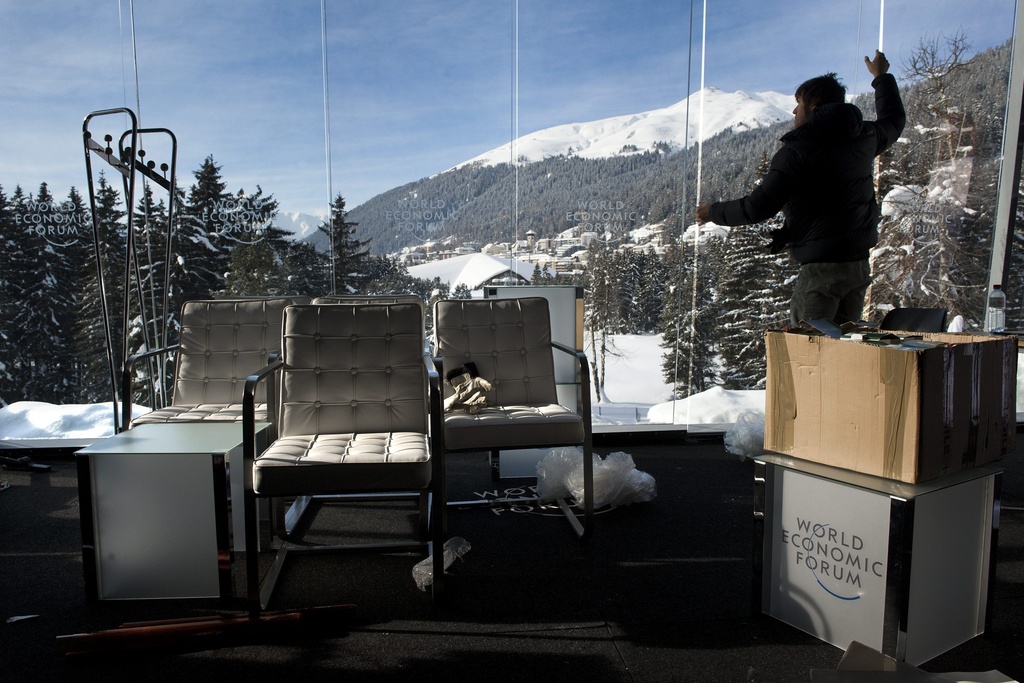
swissinfo’s business correspondent Matthew Allen takes a look behind the scenes at the 42nd WEF annual meeting to bring you the inside story at Davos.
The World Economic Forum (WEF) started life as the European Management Forum in 1971.
Formed by German-born businessman Klaus Schwab, it was designed to connect European business leaders to their counterparts in the United States to find ways of boosting connections and solving problems.
It is a non-profit organisation with headquarters in Geneva and is funded by the varying subscription fees of its members.
The forum took its current name in 1987 as it broadened its horizons to provide a platform for finding solutions to international disputes.
As the forum grew in size and status in the 1990s, it attracted rising criticism from anti-globalisation groups, complaining of elitism and self-interest among participants.
This year’s meeting will see 2,600 leaders in politics, business and civil society gather in Davos.
More
More
Goodbye, adieu, ciao etc
This content was published on
It’s always the same every year: a nervous, dynamic buzz of activity to start with followed by an exhausted, out of body experience when you leave. Day one in Davos is all about queues, impatience, jostling and journalists sticking down bits of paper to lay claim to their section of desk. The open plan media…
This content was published on
To be fair, Ferguson is not the only one to champion the transformation of the EU into a more complete federation. Many others are questioning how monetary union can exist without member states ceding more control of budgets, spending and borrowing to a central authority. “Is it possible for Europe’s diverse people to live in…
This content was published on
Star economist Nouriel Roubini has likened global social unrest to undernourished people wanting a larger slice of the pie. The trouble is, the pie is shrinking in the face of a severe economic slowdown. The world’s leadership is remarkably chaotic, he opines. “It doesn’t look like a G20 world, it looks like a G0 world.”…
This content was published on
But I predict that most WEF delegates will scarcely bat an eyelid at the fate of Switzerland’s oldest private bank, which has been driven into the arms of the Raiffeisen group. Wegelin is no Merrill Lynch and its current travails won’t cause a domino effect among the wider banking community – nor will they do…
This content was published on
I sat in on a key debate this morning looking at the weighty issue of European debt. When asked by an audience member how the EU could find a resolution to the crisis without unity, German Finance Minister Wolfgang Schäuble quipped: “I would like to give you the mobile telephone number of [British Prime Minister]…
This content was published on
Delegates at the WEF meeting spent Wednesday prodding at the wheezing body of the barely conscious eurozone like a team of doctors, only to shake their heads ruefully and wistfully hope for a miracle cure. While it may be difficult to find a pulse in the sick man of the global economy (Europe), China’s only…
This content was published on
Why not? For one thing, the billionaire wheeler dealer who made his name by breaking the British pound in 1992, has retired from the hedge fund industry. Soros was speaking on day one of the WEF meeting. But he also advises the current crop of financial whizz kids against staking their shirts on the SNB…
This content was published on
But the air is also thick with dire warnings of impending economic and social collapse. The WEF’s risk report identifies myriad interconnecting problems that threaten to plunge the world into a dystopian nightmare of riots and revolution. Christine Lagarde, head of the International Monetary Fund, says the world is on the brink of a 1930s-style…












You can find an overview of ongoing debates with our journalists here . Please join us!
If you want to start a conversation about a topic raised in this article or want to report factual errors, email us at english@swissinfo.ch.