








Africa’s heritage in Switzerland: what should the mandate of museums be?

Restitution takes time and represents a major opportunity, particularly for museums. It can play a central role in relations with African partners, says Samuel Bachmann, curator of the African collections at the Bern Historical Museum.

During the colonisation of Africa, hundreds of thousands of everyday objects, works of art and documents, as well as minerals and rocks, plants and other organisms, but also animal skins, skeletons and human remains, were appropriated and transferred to Europe.
Often justified on the grounds of scientific necessity, they were subsequently numbered and catalogued as “objects” in museums. The six largest ethnographic collections in Switzerland alone now hold more than 100,000 items of African cultural heritage.
Not all of these objects originate from a colonial context in the strict sense. Yet their provenance histories constitute a vast body of sources for researching Switzerland’s involvement in the colonisation of Africa. Seen in this light, cultural and natural history museums become colonial archives of a country without a formal colonial policy. They are therefore key reference points for writing the history of Switzerland’s global entanglements.
More
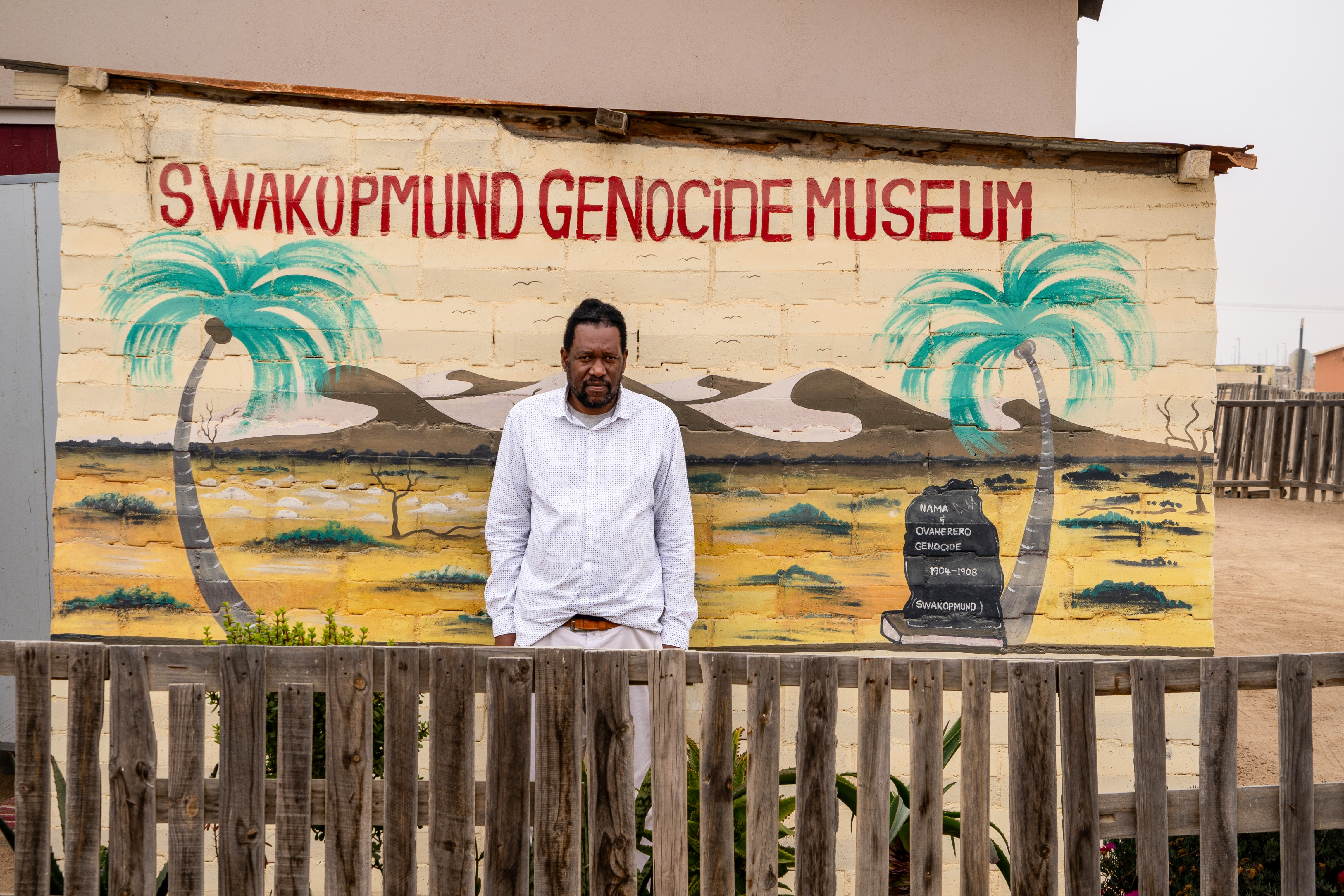
An artefact returns to Namibia from Switzerland
How are museums addressing this?
In recent years, several Swiss museums have taken action and made clear that they intend to take responsibility for the colonial heritage in their care. Museums in particular have launched a range of welcome initiatives that have helped turn Switzerland’s colonial past into a long-overdue public debate. Most recently, in 2024, the Swiss National Museum in ZurichExternal link addressed the country’s colonial past in the exhibition “colonial. Switzerland’s Global Entanglements”.
Alongside exhibitions, provenance research – the investigation of the ownership and acquisition history of collection items – is central to addressing the colonial legacy. The reality in museum archives, however, is that there is often little reliable information on the precise origins of objects from colonial contexts.
Museums generally know who donated what, and when and how. But the crucial question of when items were acquired locally is documented only in very rare cases. Even with extensive research, it is seldom possible to reconstruct a complete chain of ownership – understood as a sequence of transfers – for colonial-era objects. On the one hand, African actors were systematically not documented. On the other, collectors rarely recorded in writing the moments of appropriation – which were, at best, opportunistic and dubious, and at worst violent.
More
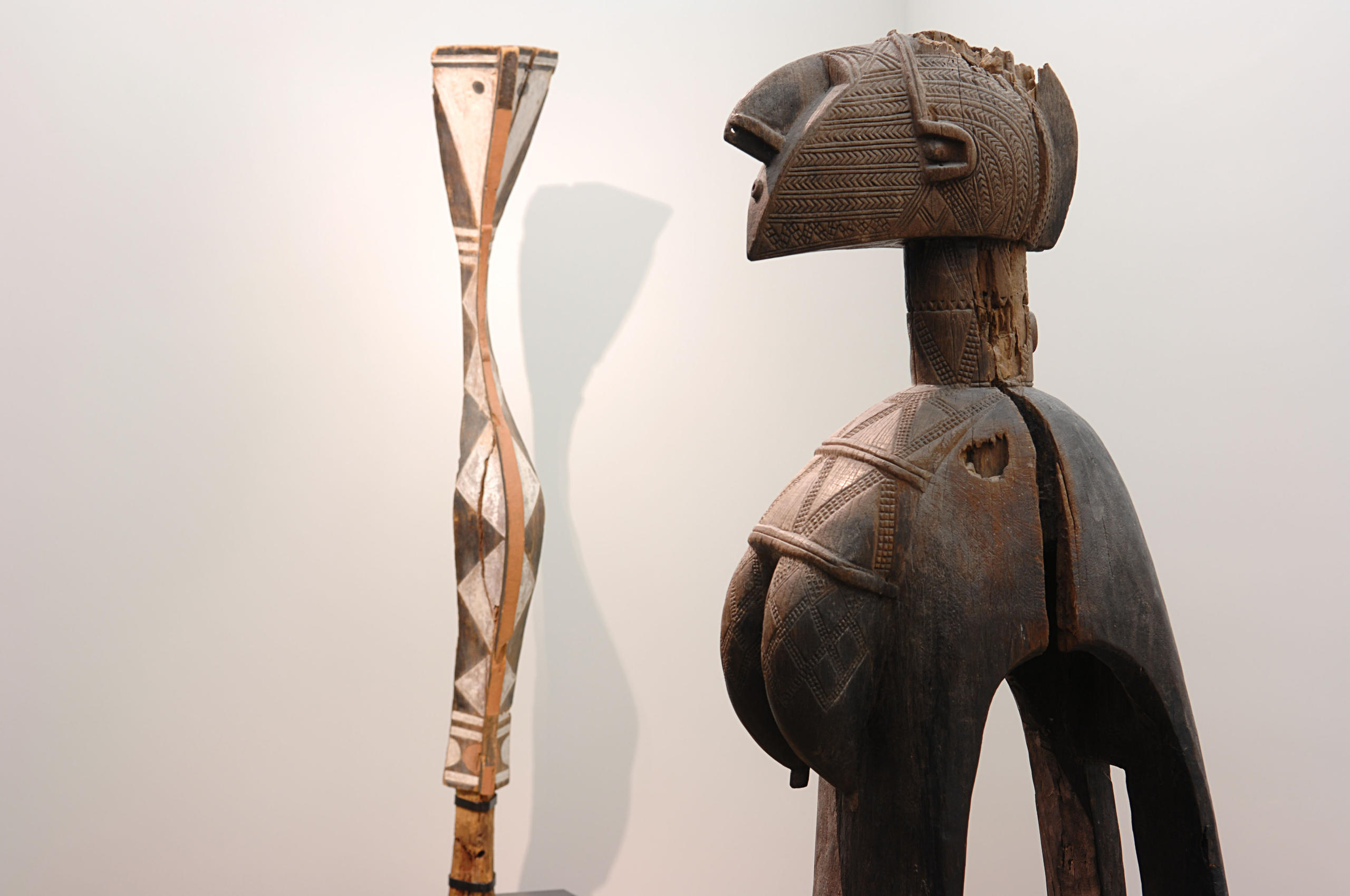
Systematically looted? The complex paths of non-Western art
Many of these museum projects also tend to be inward-looking. The way research findings are communicated suggests a form of accountability that primarily serves the museum’s audience, its funders or local political stakeholders. Research projects that do not necessarily benefit the museum – and might even harm it – stand little chance. By contrast, a carefully presented strategy can be expected to enhance a museum’s public image.
In other words, museums are already doing a great deal, provided it also serves their own interests. There is nothing inherently wrong with this. Preserving, researching and presenting collections is the core mission of museums. Without a change in mandate, one cannot expect them to suddenly regard, for example, African publics as their primary audience. Within this self-referential logic, the obvious is often overlooked: these collections represent the missing cultural heritage of the places from which they were taken. Even an object in a Swiss museum that bears witness to colonial entanglements is absent as part of cultural heritage elsewhere.
What is Switzerland doing about it?
Unlike museums, the Swiss authorities see little need for action. That said, Interior Minister Elisabeth Baume-Schneider acknowledged in her opening speech at the National Museum’s exhibition on colonialism that it has become clear how deeply Switzerland was entangled in the colonial system. She noted that the country had been involved “a little bit everywhere”, which, taken together, amounted to quite a lot. However, she argued that responsibility for this colonial legacy lies with everyone, rather than with the state. In doing so, she shifted responsibility away from the authorities.

More
Africa’s relevance is growing – and everyone wants in
One encouraging development is the newly established independent commission on contested cultural heritage. From the perspective of African claimants to colonial collections, however, it offers no real avenue for action. To bring a case before it, a certain level of prior research must already have been demonstrated – something that is often impossible, or achievable only with great effort, in the context of colonial heritage. Moreover, the commission may consider only applications submitted jointly with the other party, which will usually be the Swiss museum holding the disputed object.
A key state instrument is the funding scheme for provenance research in museums attached to the Federal Office of Culture, which is arguably the most important source of funding in this field nationwide. In the most recent round, for the first time, the majority of the 34 applications submitted concerned objects from colonial or archaeological contexts, whereas applications relating to Nazi-looted art had previously dominated. In 2023, Basel City became the first Swiss canton to enshrine provenance research in law, allocating CHF4 million ($5.1 million) over four years for this purpose. However, these examples represent only temporary, project-based funding. Structural change continues to be postponed.
Hardly any museum in Switzerland has a permanent budget for research into colonial provenance, and none of the funding schemes or strategies mentioned allows for long-term planning. One cannot escape the impression that both in politics and, at times, within museums, the prevailing view is that collections can simply be reviewed, irregularities addressed on a project-by-project basis, and then normal museum operations resumed.
What use is all this to Africa?
The issue cannot simply be treated as a box-ticking exercise. If Switzerland is serious about addressing its responsibility towards the hundreds of thousands of non-European artefacts in its museums, it will not be enough to examine each item for possible colonial provenance. At the end of every provenance trail, there are people waiting – people without access to their cultural heritage, and people calling for equal partnerships and restitution. African partners will no longer accept the fundamentally colonial assumption that Europe is the appropriate place to preserve the cultural heritage of humankind – especially not when it comes to their own.
Restitution is a process, not a one-off event. It must be reconsidered and renegotiated on a case-by-case basis. It takes time and represents a significant opportunity, particularly for museums, giving them a new diplomatic and civil society role. For this reason, the challenge extends beyond museums themselves. If museums are to confront their – and Switzerland’s – coloniality, they require a new mandate: one that questions their interpretive authority and addresses fundamental questions about why, and for whom, cultural heritage is preserved, researched and communicated.
Edited by Benjamin von Wyl/Adapted from German by Patrick Huwyler/ts
The views expressed by the author do not necessarily reflect those of Swissinfo.

More
Our newsletter on geopolitics

In compliance with the JTI standards
More: SWI swissinfo.ch certified by the Journalism Trust Initiative

You can find an overview of ongoing debates with our journalists here . Please join us!
If you want to start a conversation about a topic raised in this article or want to report factual errors, email us at english@swissinfo.ch.