








Swiss Army combines horses and high-tech drones
Horses have always been used by the Swiss Army. Now the animals are being combined with the latest technology – drones.
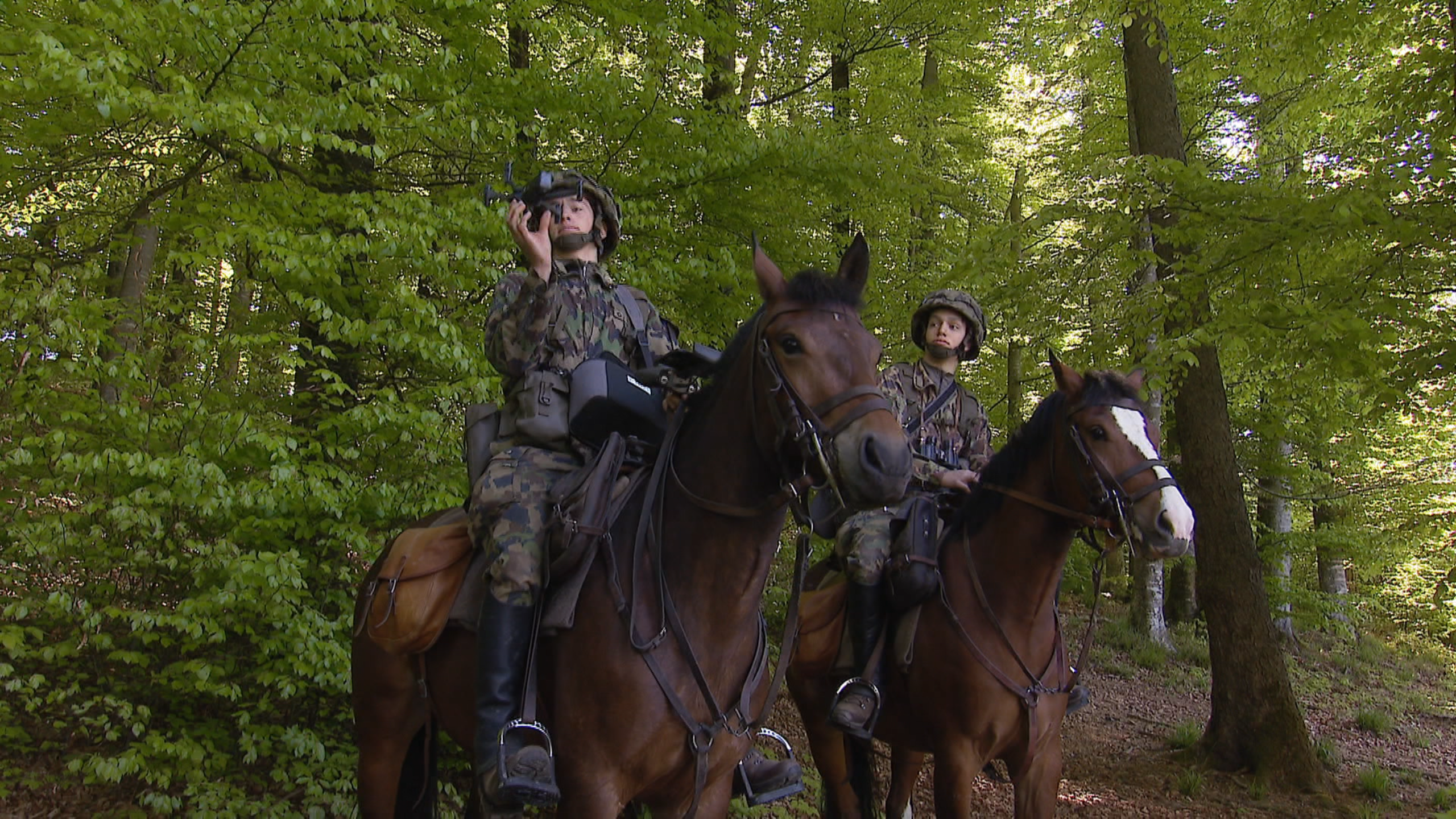
Today, drones – like horses in the past – are part of warfare. A small group of recruits is now learning to use both in a special training programme by the Swiss army. Their job: to monitor terrain as mounted patrols.
The interaction between animal and drone has to be practised. All new things are initially frightening for a horse, so it must first get used to the drone, says a young recruit who is simulating a reconnaissance mission with a colleague at the edge of a forest.

The Swiss army has long used horses. At the highpoint a century ago, it had tens of thousands of them. Today, the number is only 300, and they are mainly used for monitoring purposes, such as at large sites which host critical infrastructure. Zurich airport, where there are few paths around the runway, is one such example.

“The horse can move faster than a foot patrol,” says Commander Kim Schätti, who is responsible for the army’s animals. Horses can react quickly and relatively silently in difficult and rough terrain.
More
Why Switzerland is struggling with its national defence
Drones, by contrast, are a relatively new technology. They allow soldiers to monitor terrain at night. The drones are equipped with thermal imaging cameras, making it possible to detect people and animals – who are warmer than their surroundings – in the dark.
Around half of the army’s horses are housed in the Bern area, including in Schönbühl, where riders and horses are trained.

“Horses can provide a service that no one else can,” says Schätti. The drone is an ideal addition – the combination is better than a helicopter. It makes operations more flexible and allows several locations to be monitored at the same time. Mounted patrols can therefore be deployed over a wide area.
Around 16 young soldiers are trained as mounted patrols during each Swiss recruit school.
The Swiss Army needs money – but this is proving hard to come by. We discussed why in our Let’s Talk podcast:
Translated from German using AI/amva/dos
This article by Swiss public broadcaster SRF was originally published on May 15, 2026, and has been updated with a new video produced by Swissinfo.
How we translate with AI
We use automatic translation tools, such as DeepL and Google Translate, for some content.
Each translated article is carefully reviewed by a journalist for accuracy. Using translation tools gives us the time for more in-depth articles.
Learn more here about how we work with AI.
External Content

You can find an overview of ongoing debates with our journalists here . Please join us!
If you want to start a conversation about a topic raised in this article or want to report factual errors, email us at english@swissinfo.ch.