








Switzerland’s new energy challenge: keeping cool in a warming climate
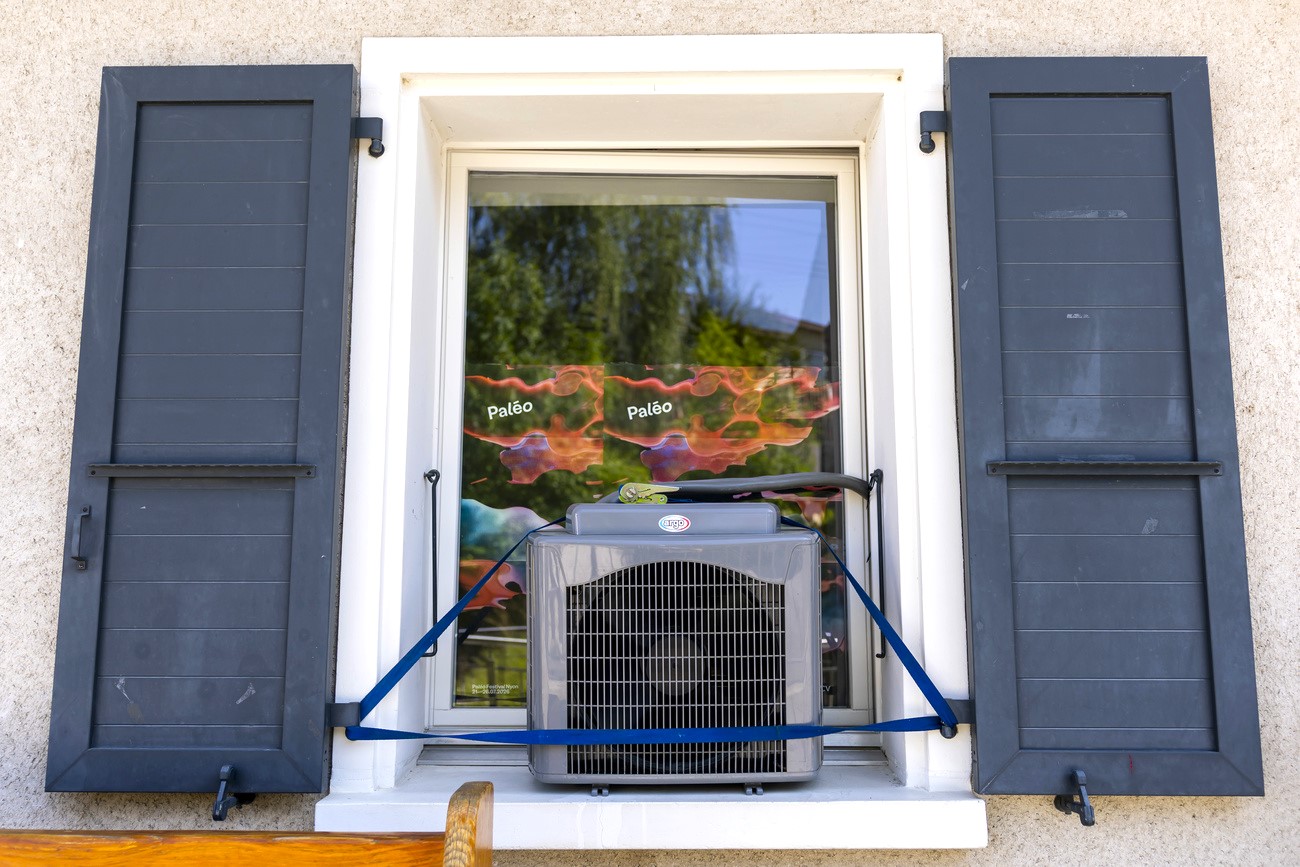
Homes and cities in Switzerland were designed to cope with winter. Today, scorching summers are driving up the use of air conditioning and raising energy demands for cooling down. What does this mean for the electricity grid?
Select your language
Generated with artificial intelligence.
Listening:
Switzerland’s new energy challenge: keeping cool in a warming climate


Switzerland is built for winter. Almost all buildings are equipped with heating systems and were designed to maximise exposure to the sun’s rays in colder months.
However, due to climate change, winters are getting milder and heatwaves are growing more frequent and intense. Switzerland is meanwhile among the countries where temperatures are rising fastest. Together with the United Kingdom, it could be set to experience one of the sharpest relative increases in the number of days of uncomfortably high temperatures.
As temperatures rise, the use air conditioning is also on the increase. This summer, sales of portable air conditioners and fans reached record levels in SwitzerlandExternal link. Cooling technologies improve comfort and reduce heat-related deathsExternal link, but can also increase pressure on electricity grids, contribute to the urban heat island effect, and raise greenhouse gas emissions.
“Cooling is becoming an increasingly important challenge for both buildings and the electricity system,” Urs-Peter Menti, professor and co-director of the Institute of Building Technology and Energy at the Lucerne University of Applied Sciences and Arts, told Swissinfo.
This trend extends well beyond Switzerland. Electricity demand for cooling is rising sharply worldwide. In European Union countries, energy consumption for cooling doubled between 2018 and 2024External link. There has also been significant growth in the US and across Asia and the Middle East.
“Access to cooling has to be treated as essential infrastructure, alongside water, energy and sanitation, because heat is now a leading cause of climate-related deaths”, Clara Camarasa, senior advisor at the United Nations Environment Program Copenhagen Climate Center (UNEP CCC) and former policy analyst at the International Energy Agency (IEA), told Swissinfo.
>> Air conditioning can save lives, but it’s far from a subject of cozy consensus:

More
Luxury or necessity? Five questions about air conditioning in Switzerland and around the world
Boom in portable air conditioners
It is estimated that fewer than one in ten homes in Switzerland has fixed air-conditioning (called a split-unit system). Regulations in some cantons and high installation costs have contributed to the popularity of portable air conditioners; at an average price of CHF452 ($559) and ready to use straight out of the box, they can also be a simple solution. In June, sales of these devices by Swiss online retailer Galaxus rose by 38%External link over the previous year.
Portable units, however, are less effective and have a relatively high electricity consumption. A 1,000-watt unit uses roughly as much electricity as ten refrigerators.
One increasingly popular alternative to air conditioning comes in the form of reversible heat pumps, which use electricity to transfer heat from one place to another. The devices, which can heat indoor spaces in winter and cool them in summer, are common in new and renovated buildings.
Besides still requiring energy, however, heat pumps – as well as both fixed and portable air conditioners – contain refrigerant gases which, if released into the atmosphere, contribute to the greenhouse effect and the climate crisis.

Energy consumption for cooling is increasing
According to the Federal Office of Energy, electricity demand for cooling (air conditioning, ventilation and technical installation) in Switzerland is similar to the energy demand for heating. In 2024, cooling accounted for 10.9% of electricity consumption, compared to heating’s 10.5%.
But this comparison is imperfect: it only refers to electricity, which is almost entirely behind cooling, whereas heating relies on a broader mix of energy, including heating oil and natural gas. When all energy carriers are taken into account, space heating remains by far the dominant end use of energy in households.External link
Nevertheless, the trend is clear: energy use for space heating in Switzerland has fallen sharply (dropping 19.5% between 2000 and 2024), while energy for cooling has increased (climbing 14.3%).
External Content
Researchers at the Swiss Federal Laboratories for Materials Science and Technology (Empa) have estimatedExternal link that, in an extreme scenario characterised by strong warming, high population growth, and widespread adoption of air conditioning, Swiss households could require comparable amounts of thermal energy for cooling and heating by 2050.
Air conditioning behind 10% of global electricity consumption
Cooling residential and commercial buildings is now the fastest-growing segment of energy consumption worldwide, according to the IEA.
Global electricity demand for indoor cooling more than doubled between 2000 and 2022, reaching about 2,900 TWhExternal link today. This represents roughly 10% of global electricity consumption, a share that can exceed 50% during the summer months in the hottest countries.
External Content
By 2035, electricity consumption related to cooling is projected to increase by a further 1,600 TWh – equivalent to the current annual electricity demand of Japan and South Korea combined.
The biggest increases are expected in India, China, Southeast Asia, and the Middle East – all densely populated regions with hot climates and rapidly growing economies. In addition to global warming, rising incomes are also driving demand, as more people can afford to buy air-conditioning systems.
Europe, meanwhile, is the fastest-warming continent, heating up at roughly twice the global average rate. It has recorded the largest increase in “cooling degree days” (CDD) – an estimate of the demand for air conditioning and cooling energy – with a rise of 115% between 1990 and 2025.
In Geneva, one of the warmest cities in Switzerland, the number of CDDs per year could more than double under a 3°C global warming scenario, according to the CH2025External link Climate Scenarios for Switzerland.
External Content
Reversible heat pumps instead of portable air conditioners
Not taking steps to cool buildings isn’t an option in most places. Heat is often underestimated as a health hazard, warns Reto Knutti, a climate physicist at the federal technology institute ETH Zurich. To reduce heat-related deaths, “we also need to deploy air-conditioning systems strategically,” Knutti recently said in an interviewExternal link. Air conditioning, for example, should be installed in schools and nursing homes, he reckons.
As air conditioning expands, annual electricity demand will rise moderately, buildings expert Menti says. “The more significant challenge is the increase in summer peak loads.”
Currently, air conditioning systems are responsible for around 3% of global greenhouse gas emissionsExternal link. Fortunately, cooling demand often coincides with high solar power generation. “If designed appropriately, energy systems can therefore provide cooling largely powered by renewable energy sources,” Menti says.
Heat pumps, along with seasonal ground-based thermal storage, can provide highly efficient cooling, says Robin Mutschler of Empa. If their electricity comes from low-carbon renewable sources, their operational greenhouse-gas emissions can also remain very low.
The gradual replacement of fossil-fuel heating systems with these technologies could make portable air conditioners largely unnecessary, Mutschler says. According to data from the Federal Statistical Office, more than 23% of residential buildings in Switzerland were equipped with a heat pump in 2024, five times as many as in 2000.
Rethinking buildings
Menti says construction needs to take the new climate reality into account. “For decades, Swiss buildings were primarily optimised to reduce heating demand. Today, adapting to climate change must become an equally important design objective,” he says.
This does not simply mean more air conditioning systems, but rather placing the priority on passive cooling solutions. External shading such as shutters and awnings prevent heat from sunlight entering buildings, while construction materials with high thermal mass – such as clay – slow down indoor overheating.
“We cannot air condition our way out of the heat crisis”, says Clara Camarasa. The solutions that protect most people at the lowest cost are largely passive and nature-based, she adds, pointing to urban greening, cool surfaces and traditional building practices of southern Europe such as thick walls, light colors, shading and night ventilation.
“Protection from extreme heat begins with the building, the neighborhood and the health system, not with the appliance”, Camarasa says.
According to the IEA, measures such as proper thermal insulation and external solar shading can reduce a building’s cooling requirements by up to 80%.
Having built homes and cities to protect itself from the cold, Switzerland must now learn to live with the heat. How it designs its buildings and energy system in the years ahead will determine whether cooling becomes a new climate problem or part of the solution.
Join the debate:
External Content
This article was first published on July 29 and updated on July 30 to add comments from Clara Camarasa of UNEP CCC.
Edited by Gabe Bullard/dos

In compliance with the JTI standards
More: SWI swissinfo.ch certified by the Journalism Trust Initiative

You can find an overview of ongoing debates with our journalists here . Please join us!
If you want to start a conversation about a topic raised in this article or want to report factual errors, email us at english@swissinfo.ch.