








How to prevent wildfires in Switzerland and Europe
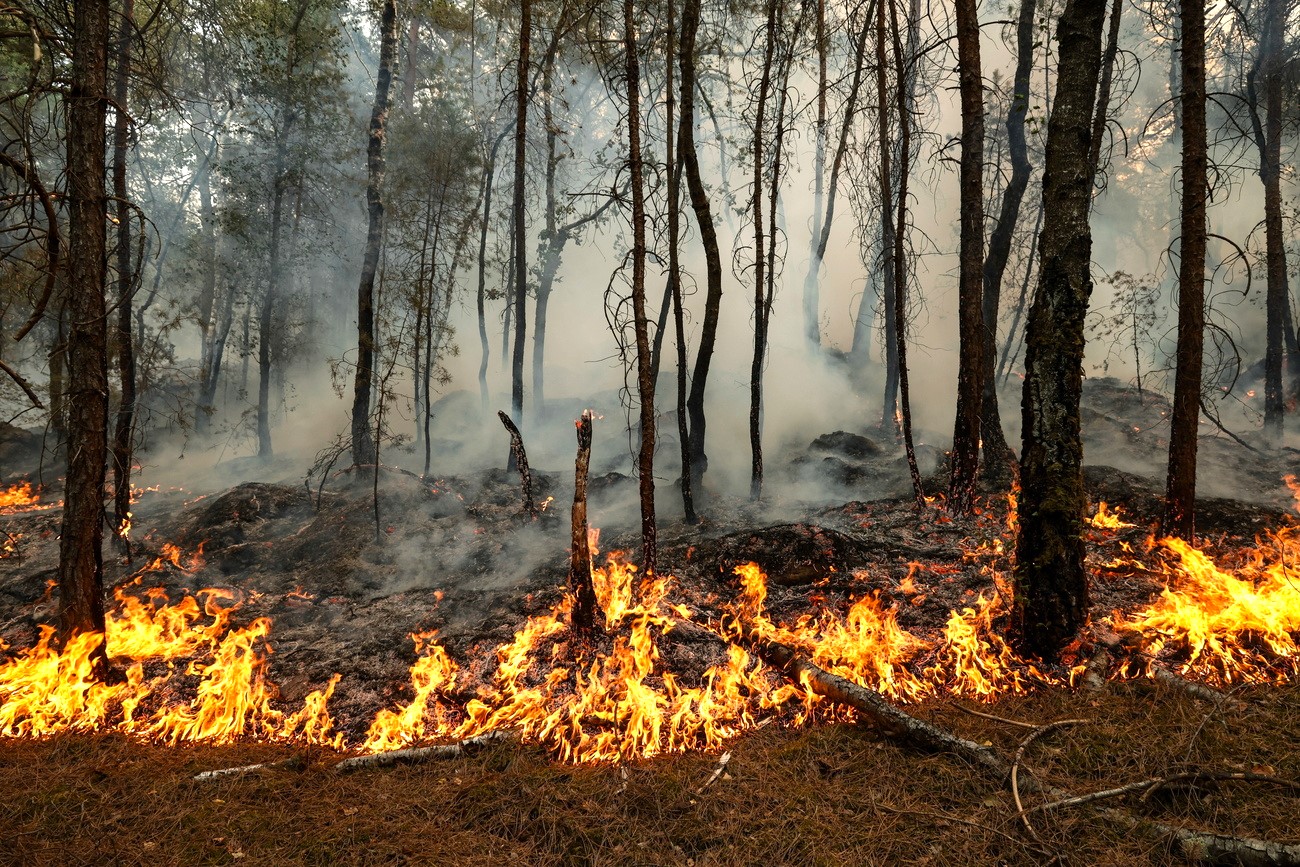
With risk levels high across much of Switzerland, an expert explains why the wildfire season started early in Europe this year and what can help the situation.
Select your language
Generated with artificial intelligence.
Listening:
How to prevent wildfires in Switzerland and Europe

From Canada and Russia to southern Europe, wildfires have been affecting vast areas of the planet. In Spain, Italy and France, huge blazes – fuelled by high temperatures and drought – have destroyed swathes of forest and farmland and forced thousands out of their homes. Numerous fatalities have also been recorded.
The fires which have been seen across Europe and beyond are linked to a specific weather pattern that has been observed since the beginning of the year, says Julia Miller, a wildfire expert at the WSL Institute for Snow and Avalanche Research (SLF) in Davos. A stable high-pressure system over Europe has blocked much of the rainfall that would normally reach the continent, she explains. Combined with extreme heat, this has intensified drought conditions, making 2026 “an exceptional year”.
>> Despite all its rivers, lakes and glaciers, Switzerland is not immune to drought:

More
Sparse rainfall and heatwaves have put Switzerland on drought alert
In January and February, Spain and France experienced heavy rainfall, while in the Alps there were drought-like conditions and a marked lack of snow. In May, a severe heatwave came immediately after the start of the growing season, Miller says.
A second heatwave followed and led to June becoming the hottest ever recorded in western Europe and the third hottest in Switzerland since records began in 1864. As a result, Miller adds, vegetation is now extremely dry, and many parts of Europe are experiencing increased wildfire activity.
“The wildfire season started early,” she says. The peak will likely occur in August, typically the hottest month, but September and October could also remain dry and conducive to fires.
Area the size of Luxembourg
Since the start of the year, 1,254 wildfires have been recorded in European Union countries, according to data updated on July 22 by the European Forest Fire Information SystemExternal link (EFFIS). This is fewer than during the same period last year (1,329 fires), but more than twice the historical average of 569.
Meanwhile a total of 254,388 hectares have burned, roughly equivalent to the size of Luxembourg. Last year, the worst since records began, 270,449 hectares were destroyed.
The danger in Switzerland
So far in 2026, Switzerland has not experienced any large-scale fires. But the country is suffering from severe drought, and almost all cantons face a high to very high risk of forest firesExternal link.
All 26 cantons have issued restrictions or bans on outdoor fires. In Fribourg, barbecues are prohibited even in designated public grilling areas, while Winterthur in canton Zurich has banned all forms of open fire, including private charcoal barbecues. The traditional fireworks displays for Switzerland’s National Day on August 1 are also under careful scrutiny.
For Miller, the current situation is worrying. “A very high danger warning means that, if a spark ignites, wildfires are likely to spread rapidly,” she says.
Experts in Switzerland assess the danger via an information system based on the Fire Weather IndexExternal link, developed in Canada and then adapted to the Alpine environment. The system relies on just four meteorological parameters: temperature, humidity, precipitation and wind speed.

Over 100 wildfires per year
Most wildfires in Switzerland happen in spring. According to the Federal Office for the Environment (FOEN), humans cause 90% of them, mainly via carelessness or negligence – a discarded cigarette butt here, a campfire not properly extinguished there. In summer, lightning can also spark forest fires.
From 2000 to 2023, Switzerland saw an average of 118 wildfires per year, according to data by the Swiss Federal Institute for Forest, Snow and Landscape Research. On average, the fires affected 157 hectares, the equivalent of 220 football pitches. Most incidents are limited in size, with large-scale and catastrophic fires rare and mainly occurring on the southern side of the Alps.
Among the most significant fires in recent years were registered in Gambarogno, Ticino, in 2022 and Bitsch, Valais, in 2023. In both cases, blazes caused damage worth several million Swiss francs and destroyed respectively 100 and 200 hectares of forest, farmland and meadows.
In the EU, for context, the annual cost of wildfires is estimated at up to €3 billion (CHF2.8 billion).
External Content
Rising risk in summer and winter
The FOEN expects that more frequent droughts and heatwaves are set to increase the risk of wildfires in Switzerland, not only in summer but also in winter and early spring.
During these periods, vegetation has not yet fully resumed growth. And when snow is absent, sunlight hits the forest floor directly, drying grasses and leaves accumulated from the previous year. The risk is also intensified by the “Föhn” – a warm, dry wind common in many Alpine valleys that can accelerate the spread of flames.
According to Miller, the most effective prevention measures are to “reduce the likelihood of human-caused ignitions and to strengthen preparedness”. This includes raising public awareness, improving the early detection of fires and ensuring rapid initial intervention. Forest management aimed at structurally diverse and climate-adapted forests is also important, she adds.
As global warming increases the risk of wildfires, a key part of the solution ultimately remains in human hands. Responsible behavior and effective prevention measures can help ensure that a single spark does not become a disaster.
More

Edited by Balz Rigendinger; translated from Italian, sub-edited by Domhnall O’Sullivan


See more Swissinfo articles in your Google results. Learn more

In compliance with the JTI standards
More: SWI swissinfo.ch certified by the Journalism Trust Initiative

You can find an overview of ongoing debates with our journalists here . Please join us!
If you want to start a conversation about a topic raised in this article or want to report factual errors, email us at english@swissinfo.ch.