








High Swiss trust in government sparks little interest abroad

Public trust in government and public institutions has stabilised across much of the world, according to a new survey covering 38 countries. But in most democracies, people still do not feel their voices are heard. Switzerland stands out as the exception, with high levels of both trust and political participation, according to a Swissinfo analysis.
Select your language
Generated with artificial intelligence.
Listening:
High Swiss trust in government sparks little interest abroad

Although Switzerland records some of the highest levels of trust in public institutions in the world, it barely featured when the Organisation for Economic Co-operation and Development (OECD) presented its latest international survey covering 38 countries. Nor did any representative of the Swiss government attend the online launch.
Instead, Spanish Prime Minister Pedro Sánchez highlighted the rise in confidence in Spain’s government, where more than 40% of respondents now report high or moderate trust. Mexico’s anti-corruption minister, Raquel Buenrostro Sánchez, also addressed the event after Mexico recorded trust levels of 53%, well above the international average.
Australia’s assistant minister Patrick Gorman welcomed the finding that 51% of Australians trust their government. He argued that this vindicated the government’s decision to ban social media for minors: parents had demanded action, he said, and the government had listened, despite opposition from major technology companies.
Two-thirds of Swiss feel they have a political voice
Yet even in Australia, fewer than half of respondents believe that the political system gives “people like them” a meaningful say in what government does, according to the OECD report.
Across all 38 countries, only around one-third of respondents feel they have such influence. The OECD says this reflects “growing and unmet” expectations among citizens to participate in political decision-making beyond elections.
Switzerland is the only country where a clear majority feels politically heard. Some 65% of respondents believe the political system gives people like them a voice.
External Content
Switzerland also ranks first internationally in trust in government. Sixty-two per cent of respondents expressed high or moderate trust in the government, a level that has remained stable.
Confidence in the police, media and political parties
These findings are unsurprising. Switzerland has traditionally enjoyed relatively high levels of social trust, as confirmed in the annual SecurityExternal link study published by the Federal Technology Institute ETH Zurich.
Compared with the previous OECD survey in 2023, confidence increased further in 2025 across a range of institutions, including the police, the judiciary, the media and cantonal governments.
The OECD reaches a positive conclusion: on average, confidence is “robust”. The loss of trust in previous years has stabilised, or even in some countries, reversed. Four in ten people in OECD countries reported high or moderate trust in their government in 2025, although slightly more – 43% – said they had little or no trust.
Positive levels of trust were recorded in Iceland (59%), Norway (57%) and Luxembourg (55%). Low levels were found in Bulgaria (16%), Peru (20%) and France (22%).
Anyone familiar with Switzerland’s often bitter referendum campaigns might find another result surprising: almost half of respondents trust political parties.
By international standards, this is exceptional. In neighbouring France, only 15% trust political parties. The figure is 22% in Italy and 25% in Germany.
External Content
Optimism about tackling climate change and regulating AI
Swiss confidence extends beyond public institutions. More than half of respondents believe Switzerland can successfully reduce carbon emissions. Besides Switzerland, only Brazil and Finland recorded majority optimism on this question. Across all countries surveyed, the average was just 38%.
Majorities in Switzerland also believe the country will succeed in balancing the interests of current and future generations, revising unpopular legislation when necessary and regulating new technologies such as artificial intelligence appropriately.
More than half also believe elected politicians would respond meaningfully if contacted by citizens. No other country surveyed recorded majority confidence on this measure.
Why is trust so high?
Are Swiss people simply naive, or is that trust well founded?
Trust always involves surrendering a degree of control. In Switzerland, however, citizens give up less control than voters in many other democracies. If they are dissatisfied with government policy, they do not have to wait several years until the next election to express their discontent.
It is likely that Switzerland’s democratic optimism has to do with direct democracy. They can be reasonably sure that unpopular legislation will be rejected in a referendum. Because all the major parties send representatives to the consensus-based Swiss government, Swiss voters know that it is very likely someone in it will broadly share their values.
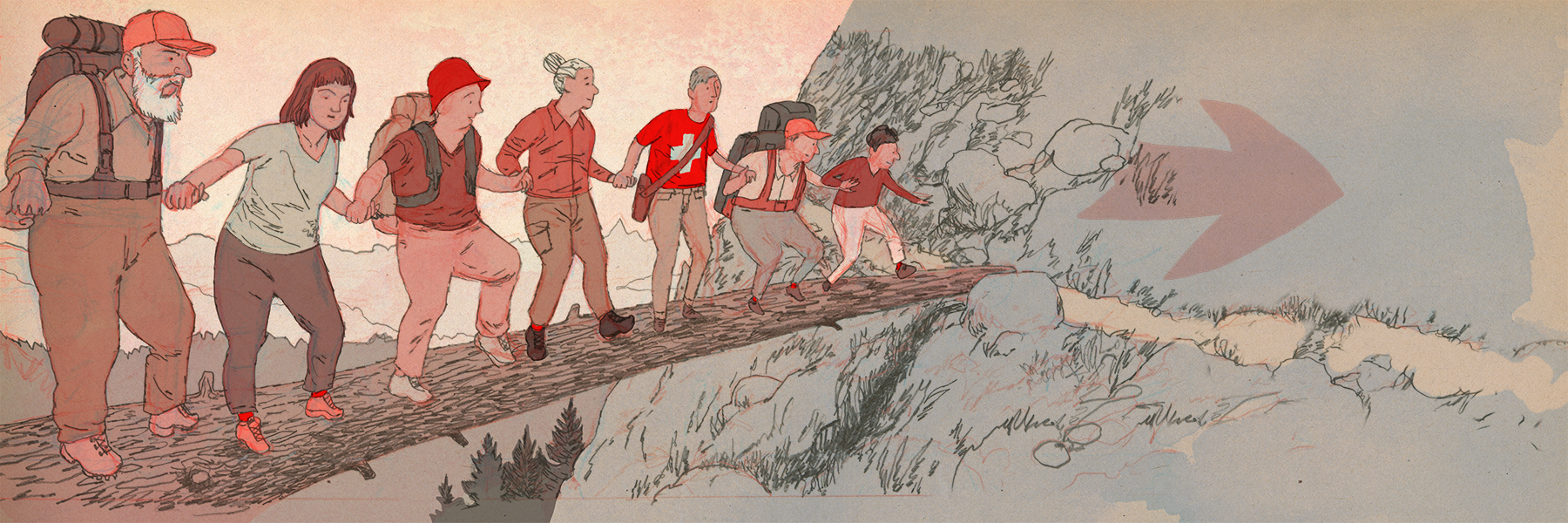
More
Why people in Switzerland trust the state
The rift in Swiss society
While a majority in Switzerland feels its voice is heard, that is not true for everyone. On one issue, Switzerland stands out in a negative sense. Around four out of five people with higher education qualifications trust the government, compared with only around 45% of those with vocational training or no post-compulsory education.
For Switzerland, this presents a challenge. A country that values volunteer work and civic participation and takes pride in the quality of its vocational training cannot afford a situation in which non-university graduates feel politically left behind. People experiencing serious financial difficulties also report lower levels of trust than those without money worries. Women likewise express slightly less trust than men, although these differences are smaller than those associated with education.
Cautious optimism
Trust is a cornerstone of democratic systems. Many democracies have experienced growing populism and democratic backsliding in recent years. Political scientists often link these developments to declining trust: people who lose confidence in democratic institutions may become more willing to accept restrictions on political participation or civil rights because they no longer believe those rights are meaningful.
Against that backdrop, the OECD struck a cautiously optimistic tone. While only 40% of respondents across the participating countries expressed high or moderate trust in government, the decline observed in previous years appears to have levelled off.
That figure can be viewed as low, but the OECD study looked at who has trust and who does not. Low trust should not automatically be equated with distrust. People who report little confidence in government are not necessarily angry or drawn to conspiracy theories. A healthy democracy also depends on citizens maintaining a critical attitude towards those in power.
External Content
More troubling than declining trust, however, is the finding that nowhere outside Switzerland does a majority of people feel they have a genuine voice in political decision-making.
At the report’s launch, OECD Director Elsa Pilichowski said the survey was intended not only to inform public debate but also to serve as “an important tool for governments”.
That raises an obvious question: why is so little international attention paid to the country that consistently records the world’s highest levels of political trust?
Should foreign governments visit to study the Swiss model? Whether they would also be willing to embrace its combination of federalism, power-sharing and direct democracy is another question altogether. That may help explain why Switzerland’s exceptional levels of trust attract less international attention than they deserve.
More

Edited by Reto Gysi von Wartburg and Giannis Mavris. Translated from German by Catherine Hickley/ac

In compliance with the JTI standards
More: SWI swissinfo.ch certified by the Journalism Trust Initiative

You can find an overview of ongoing debates with our journalists here . Please join us!
If you want to start a conversation about a topic raised in this article or want to report factual errors, email us at english@swissinfo.ch.