








Contaminated baby formula: how Nestlé organised ‘discreet’ recalls from shop shelves

Radio France’s investigative unit, together with RTS and RTBF, has investigated the circumstances under which Nestlé organised ‘discreet’ product recalls in Austria and Germany. The matter has been referred to the French courts due to a delayed alert.
Select your language
Generated with artificial intelligence.
Listening:
Contaminated baby formula: how Nestlé organised ‘discreet’ recalls from shop shelves
External Content
How is it that infant formula contaminated with a toxin capable of causing serious poisoning in infants, or even death, was identified as early as the end of November 2025 by the multinational Nestlé, yet a global recall was not triggered until 5 January? Why were there such delays in the recalls? And why did Nestlé hold products back in its factories without immediately alerting the authorities, even though some batches had already been sold?
As French MPs prepare to present the findings of a rapid fact-finding mission into this case on Tuesday 19 May, Radio France’s investigative unit, in partnership with RTS (Swiss Radio and Television) and RTBF (Belgian Radio and Television of the French Community), has pieced together a series of failings that led to infant formula posing a health risk being allowed to remain on the market.

More
Infant formula recall: Is trying to copy breastmilk increasing risk of contamination?
At the centre of this case is the Nestlé group, which initiated the very first recall of products contaminated with the toxin on 11 December – more than two weeks after the detection, in late November, of the toxin cereulide in infant formula produced at its factory in the Netherlands, as revealed by the newspaper Le Monde.
Legal action taken following delays deemed unusual in alerting the authorities
The French-language public media have sought to understand what happened between 11 December, the date of that initial recall, and 5 January, when a global recall was finally issued. According to our information, the multinational Nestlé did indeed delay in alerting the European authorities to the presence of contaminated products still on the shelves and already distributed to consumers.
The local Departmental Directorate for the Protection of the Population (DDPP), which is responsible for inspections at the Nestlé factory in Boué where the group’s infant formula is manufactured, has, according to our information, referred the matter to the courts on the basis of Article 40 of the Code of Criminal Procedure. This move has been confirmed by the Laon Public Prosecutor’s Office, which states that it referred the case to the Paris Public Prosecutor’s Office on 16 March, without, however, specifying either the date or the content of the report.
However, as Radio France’s investigative unit had already revealed, the Nestlé group did indeed halt all production of infant formula at its factory in the Aisne (North of France) as early as 26 December, following confirmation of the presence in these products of ARA oil contaminated with very high concentrations of cereulide, a toxin produced by the bacterium Bacillus cereus, which, according to our information, was found in phenomenal concentrations, in the region of 700 micrograms per kilogram of ‘encapsulated’ oil – that is, oil processed into powder form for incorporation into infant formula.
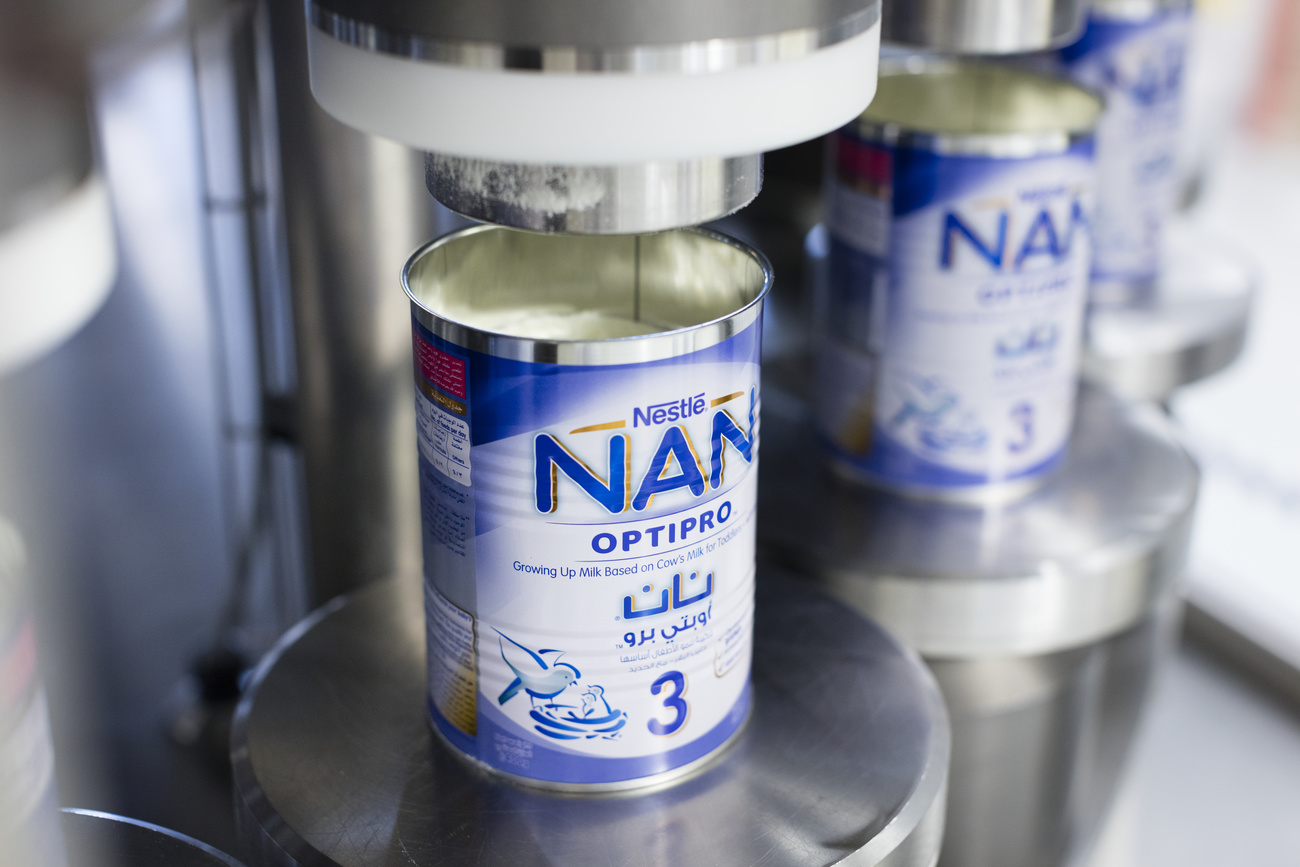
In total, 838,000 tins of infant formula were then held up at the French factory, as well as at all the multinational’s other production sites.
However, products already on the market remain in the distribution channels or in consumers’ homes, with no official recall or immediate notification from the European authorities, even though the regulations require immediate notification as soon as a health risk is identified.
In France in particular, food business operators are required to “immediately inform the administrative authority designated by decree whenever they consider, or have reason to believe, on the basis of any self-monitoring results, that a foodstuff is likely to pose a risk to human health”. Failure to comply with this obligation is punishable by six months’ imprisonment and a fine of 150,000 euros.
More
Nestlé struggles to win over baby formula critics
However, it was not until 5 January that countries such as France, Switzerland and Belgium were officially informed by Nestlé.
Products quietly withdrawn in Austria
This discrepancy is all the more problematic given that, at the same time, elsewhere in Europe, the multinational is already carrying out discreet product recalls from factories other than the one in the Netherlands. The NGO Foodwatch had already raised the alarm back in December about these ‘silent’ recalls. Our investigation now enables us to document the scale of the issue.
Indeed, according to our information, on 16 December 2025, the Austrian authorities instructed the public health safety agency to take samples from several batches of infant formula sold in the country, notably BEBA (Nestlé) and Aptamil (Danone) products. On 24 December, the results were released: the presence of cereulide was confirmed in samples of Nestlé products, with concentrations of 0.7 and 0.5 micrograms per kilogram of powder – levels exceeding the reference values currently adopted by the European Food Safety Authority (EFSA) as ‘maximum reference doses’, i.e. levels likely to pose a health risk.
However, no public recall procedure was initiated. The products were simply withdrawn discreetly from the shelves of the main Austrian retail chains – BILLA, BILLA Plus, BILLA Kaufleute, BIPA and Sutterlüty – without directly informing families who had already purchased the products, and without issuing a wider alert to other Member States. Only Germany was informed at the time, as the factory in Biessenhofen (Bavaria), which manufactures the affected batches, supplies the Austrian market directly.
When contacted, the Austrian and German authorities confirmed the existence of these “silent” recalls. The Austrian Ministry of Health acknowledges that “the samples tested were deemed unfit for human consumption” and therefore “unsafe” within the meaning of European regulations, but surprisingly adds that no public recall was necessary, on the grounds that “the health risk had not been established”.
A duty to inform the public
In Germany, it’s much the same story. The federal authorities point out that “where there are grounds for believing that a food product is unsafe, operators are required to inform the competent authorities immediately and take appropriate measures”, whilst shifting responsibility for silent recalls to the Länder, and in particular to the Hessian Ministry of Agriculture, where Nestlé’s German headquarters are located.
When contacted by the investigative unit of Radio France, RTS and RTBF, the ministry confirmed that “as early as 24 December 2025, certain products manufactured in Biessenhofen had already been withdrawn from sale as part of a discreet recall, in close coordination with Nestlé”. Once again, no public recall was issued, as the German authorities considered at the time that “the assessment of these products did not reveal any acute health risk”.
For its part, the European Commission confirms that the practice of a “silent recall” simply has no basis in European law: the obligation to inform the public applies “as soon as a product that may be unsafe is likely to have reached the consumer”. Regarding the discreet recalls organised in Austria and Germany, Brussels states that “it is up to the Member States to officially confirm whether any such recalls took place, as the Commission does not wish to comment on hypothetical scenarios”.
Other manufacturers have been alerted
Whilst Nestlé is currently in the spotlight, questions are also being raised about how other players in the sector will respond. According to our information, the Swiss group had in fact alerted all manufacturers as early as 30 December 2025 to the presence of a toxin in an oil used in the manufacture of virtually all infant formula sold in Europe.
This oil, produced by the Chinese company CABIO Biotech, had been supplied to infant formula manufacturers by the multinational Cargill, which has confirmed to our consortium that it acted as a “logistics distributor”. However, at both Lactalis and Danone, the first product recalls did not take place until the very end of January – several weeks later.
In this case, five criminal investigations were launched on 30 January by the public health unit of the Paris Public Prosecutor’s Office, notably on charges of endangering the lives of others, following the deaths or hospitalisations of infants. Whilst the public prosecutors’ offices in Bordeaux and Angers ultimately ruled out a link between two child deaths and the consumption of contaminated milk, the investigative unit of Radio France, RTS and RTBF has revealed that another investigation was opened by the Meaux public prosecutor’s office following the death, in October 2025, of an infant fed with Danone’s Gallia milk. The Meaux public prosecutor’s office has confirmed that it has since handed the case over to Paris.
A link between the consumption of contaminated infant formula and the presence of toxins in the stools of a 24-day-old infant, who was hospitalised in early February in Montpellier, had also been confirmed, as revealed by Radio France’s investigative unit.
More
WHO slams baby milk industry for rampant ‘manipulative’ marketing
According to Nathalie Goutaland, a solicitor representing dozens of families in this case, “these silent recalls are not compatible with European law”: “A product that may be dangerous must be treated in the same way as a product that is known to be dangerous. Nestlé should have immediately notified the European authorities and recalled the contaminated products as soon as the first suspicions arose”.
The implementation of a “strict procedure”, according to Nestlé
When asked about these recalls, which have been described as “quiet”, Nestlé states that it followed a “strict procedure”, involving an assessment phase, followed by traceability work – both upstream, to determine the source of the contamination, and downstream, to identify products already on the market – before notifying the authorities and launching a public recall. The Swiss group “strongly denies” having “marketed contaminated milk and carried out ‘discreet’ recalls without informing consumers or the authorities”. It maintains that it has “acted with complete transparency”.
Nestlé adds that the group halted production after cereulide was detected in late November 2025 at a factory in the Netherlands. “On 30 December, we alerted the entire sector via trade associations. From 2 January onwards, Nestlé notified the authorities on a country-by-country basis. Public recalls were rolled out in close collaboration with them from 5 January, in accordance with the regulations in each country.”
The group believes that “taking action without having consolidated data would have led to an incomplete or incorrect recall” and emphasises that, as infant formula is a “essential product”, it was “imperative to strictly limit the recall to the affected batches alone in order to ensure both the safety of babies and the availability of the products for families”.
Regarding the criminal investigation launched by the Meaux Public Prosecutor’s Office following the death of an infant who had consumed Gallia-brand milk in October, Danone states that it is not aware of this case.
The Department of Health states that “the health authorities are still recording three infant deaths, which occurred between 16 January 2026 and 10 February 2026, among children who were reported to have consumed the infant formulae subject to the recalls. This figure has not changed since then.”
This article was first published by Radio France on May 19, 2026. Translated from French by EBU/Alice Kouri.

More
Our science newsletter

In compliance with the JTI standards
More: SWI swissinfo.ch certified by the Journalism Trust Initiative

You can find an overview of ongoing debates with our journalists here . Please join us!
If you want to start a conversation about a topic raised in this article or want to report factual errors, email us at english@swissinfo.ch.