








Switzerland orders freezing of Maduro assets

The Swiss government has decided to freeze Venezuelan President Nicolás Maduro's suspected assets in Switzerland with immediate effect. It had previously sent a cautious warning to Washington.
Select your language
Generated with artificial intelligence.
Listening:
Switzerland orders freezing of Maduro assets

Switzerland reacted quickly: after Maduro was arrested by US intervention forces in Caracas on Saturday and brought to the United States, it called for de-escalation, moderation and compliance with international law on the same day. It recalled the ban on the use of force and the principle of respect for territorial integrity.
+ Venezuela: Switzerland calls for respect for international law
Following these cautiously critical tones towards Washington, the government decided on Monday to freeze the suspected assets of Maduro and other people associated with him in Switzerland as a precautionary measure to prevent an outflow of capital.
The government points out that no member of the current Venezuelan government is affected by this measure, which is taken in accordance with the Federal Act on the Freezing and the Restitution of Illicit Assets held by Foreign Politically Exposed Persons.
Legality is irrelevant
In a statement, the Swiss government explained that the reasons for Maduro’s loss of power are not decisive for ordering a freeze under the aforementioned law. This means that it is not decisive whether Maduro’s removal was legal or contrary to international law.
The decisive factor is that the loss of power has occurred and there is now the possibility that the state of origin can initiate legal assistance proceedings in relation to illegally acquired assets.
The freezing opens the way for this. Should it be proven in subsequent court proceedings that the funds are of illicit origin, Switzerland will ensure that they are returned in favour of the Venezuelan people, the Swiss government explained. The ordinance is valid for four years until further notice.
Multilateralism put to the test
The freezing of the accounts is a preventive measure and, in the government’s view, is independent of Switzerland’s foreign policy role. This focuses on efforts to achieve peace, the defence of international law and good offices, which it has repeatedly offered to all parties involved in the case of Venezuela.
In addition, as an active member of multilateral organisations, Switzerland strives to ensure coherence in the application of international norms, particularly in its role as Chair of the Organization for Security and Co-operation in Europe (OSCE) this year, the world’s largest regional security organisation, of which the United States is also a member.
The military operation carried out by the US in the early hours of January 3, during which Venezuelan President Nicolás Maduro and his wife were arrested, has left many unanswered questions. According to various experts, Washington’s stance, like that of Moscow, is hampering the work of multilateral institutions such as the OSCE.
More
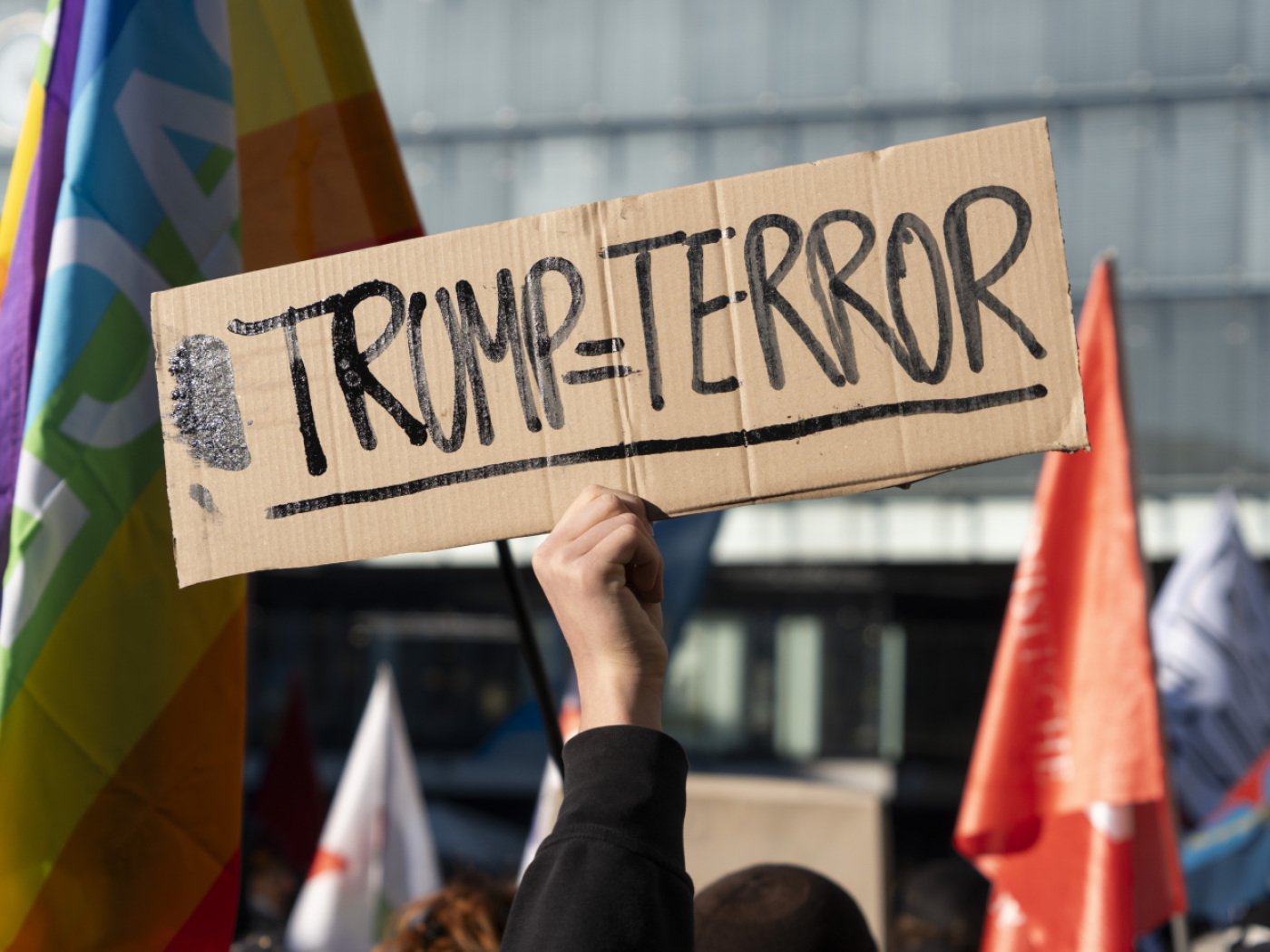
Some 200 demonstrate in Bern against US intervention in Venezuela
Imperialism reawakened
Many observers, including those from Switzerland, have questioned the legality of the US military action from the outset. From Geneva, António Guterres, Secretary-General of the United Nations, stated that he was “deeply concerned” and warned that the US action could set a dangerous precedent, as the rules of international law were not observed.
Article 2.4 of the United Nations Charter, which was signed in October 1945 and whose purpose is to prevent another conflict on the scale of the Second World War, states: “The Members of the Organisation shall refrain in their international relations from the threat or use of force against the territorial integrity or political independence of any State or in any other manner inconsistent with the Purposes of the United Nations.”
Since the Russian invasion of Ukraine, nobody needs to be told what a violation of international law means. But actors such as Russia and the US systematically evade sanctions in court by not recognising the authority of the International Criminal Court (ICC), the only permanent authority to prosecute the crime of aggression by military force.
A new world order?
When a power like the US acts outside the international legal framework, a dangerous precedent is set. “International law is universal, otherwise it is meaningless,” declared the Swiss Secretary General of the Council of Europe, Alain Berset, in a public statement.
“The news from Venezuela is a time of great uncertainty for the Venezuelan people and for international stability and security,” he said. “This situation cannot be reduced to an either-or decision between condemnation and support. It points to a deeper change in an emerging world order in which violence is becoming the norm and the law is being instrumentalised.”
Berset stated that a transition in Venezuela must be peaceful, democratic and respectful of the will of the Venezuelan people and recalled that the Council of Europe knew from its involvement in Ukraine “how fragile international law becomes when the use of force becomes the norm”.
‘Drifting along without a leader’
In Venezuela itself, the intervention is perceived ambivalently. Speaking to Swissinfo from Caracas, historian and political analyst Margarita López Maya explains that the US president’s operation may seem irresponsible from a foreign perspective.
“But from my point of view, the prevailing conviction in Venezuela was that Maduro would not leave without the use of force. And that it was impossible for the population to take the necessary steps for a transition on their own, given the decay, fragmentation and total repression they were experiencing.” Politically speaking, this intervention was perhaps the only way out. “We’re not happy, but we’re relieved that Maduro is in custody.”
López emphasises that Washington’s strategy focused on portraying Maduro as the head of a drug cartel in order to remove him. The other members of the government have been left untouched. Currently, she says, Venezuela is “drifting along without a leader”.
More

Edited by Marc Leutenegger. Translated by AI/ts

More
Our newsletter on geopolitics

In compliance with the JTI standards
More: SWI swissinfo.ch certified by the Journalism Trust Initiative

You can find an overview of ongoing debates with our journalists here . Please join us!
If you want to start a conversation about a topic raised in this article or want to report factual errors, email us at english@swissinfo.ch.