





Venezuela’s new interim leader Delcy Rodríguez faces Swiss sanctions

Select your language
Generated with artificial intelligence.
Listening:
Venezuela’s new interim leader Delcy Rodríguez faces Swiss sanctions
Delcy Rodríguez, named interim president by Venezuela’s Supreme Court following the recent US capture of Nicolás Maduro, has featured on a Swiss sanctions list since 2018.

Delcy Aloina Rodríguez Gómez, a 56-year-old lawyer who has been acting as Venezuela’s interim leader since January 3, is among top political figures sanctioned by Switzerland since 2018. Rodríguez and 53 of her colleagues – including Interior Minister Diosdado Cabello – are subject to an asset freeze and a travel ban to Switzerland.
“Her actions within the Presidential Commission, and later as president of the illegitimate Constituent Assembly, undermined democracy and the rule of law in Venezuela, notably by usurping the powers of the National Assembly and using them to target the opposition and prevent it from participating in the political process,” Swiss authorities wrote in a decree dated March 28, 2018.External link
Since that date, the Swiss government has also imposed an embargo on Venezuelan military equipment and goods that could be used for repressive purposes.
SwitzerlandExternal link thus joined sanctions imposed by the European Union after the regime of Nicolas Maduro and Delcy Rodríguez dismantled the National Assembly, elected two years earlier and dominated by the opposition, as well as following the demonstrations that ensued, which left more than 100 dead in 2017.
On January 5, 2026, the Swiss government also decided to freeze, with immediate effect, any assets in Switzerland belonging to Nicolás Maduro and 36 other peopleExternal link who are linked to him.
>> Learn more about the freezing of assets belonging to Nicolas Maduro and his associates:

More
Switzerland orders freezing of Maduro assets
State of emergency
In Venezuela, fears of repression and human rights violations have increased in recent days. Since the US attack and the spectacular capture of Maduro on January 3, Venezuelan authorities have declared a “state of external unrest” in the country.
“The state of emergency is causing concern because it authorises restrictions on the free movement of people, the confiscation of assets necessary for national defence, and the suspension of the right to assembly and demonstration, among other measures,” Ravina Shamdasani, a spokesperson for the Office of the United Nations High Commissioner for Human Rights warned on TuesdayExternal link, speaking from Geneva.
“National, state and municipal police forces are instructed to immediately proceed throughout the national territory to search for and arrest any person involved in promoting or supporting the armed attack waged by the United States of America against the territory of the Republic,” a Venezuelan government decree statesExternal link.
People rarely speak in the streets in Venezuela, and when they do, it’s in hushed tones and with suspicion. The fear of being thrown into prison for opposing the regime is growing. “There’s no rule of law here. It’s quite a severe form of authoritarianism,” a young woman from Caracas told Swissinfo, who prefers to remain anonymous. She believes the crisis will worsen, and with it, the repression.
Switzerland warns its citizens
The Swiss foreign ministry also warns of the consequences of the entry into force of the emergency law. “This decree authorises, in particular, public authorities to control public services and strategic installations and to close borders and airspace,” it states on its websiteExternal link dedicated to travellers and the Swiss community in Venezuela, which has some 800 members.
It is uncertain whether security can be guaranteed throughout the country following the military operations conducted on January 3. The situation is very tense and its evolution remains uncertain, the ministry says. Demonstrations with violent clashes are possible, and violence linked to political tensions has resulted in deaths and injuries on several occasions.
More

Furthermore, there is a risk that foreign travellers may be arrested, interrogated, and detained. Consular assistance cannot be guaranteed in the event of detention.
“To Swiss citizens currently in the country: stay informed about the evolving situation. Avoid crowds and demonstrations of any kind and comply with the directives of local authorities. Limit your travel within the country to the bare minimum and check the security conditions beforehand,” the ministry warns.
Offer of good offices maintained
The Swiss authorities have repeatedly offered their good offices services to help mediate, but the regime has so far rejected them. Under the current circumstances, the offer remains valid, but Bern knows that discretion is paramount in this type of crisis.
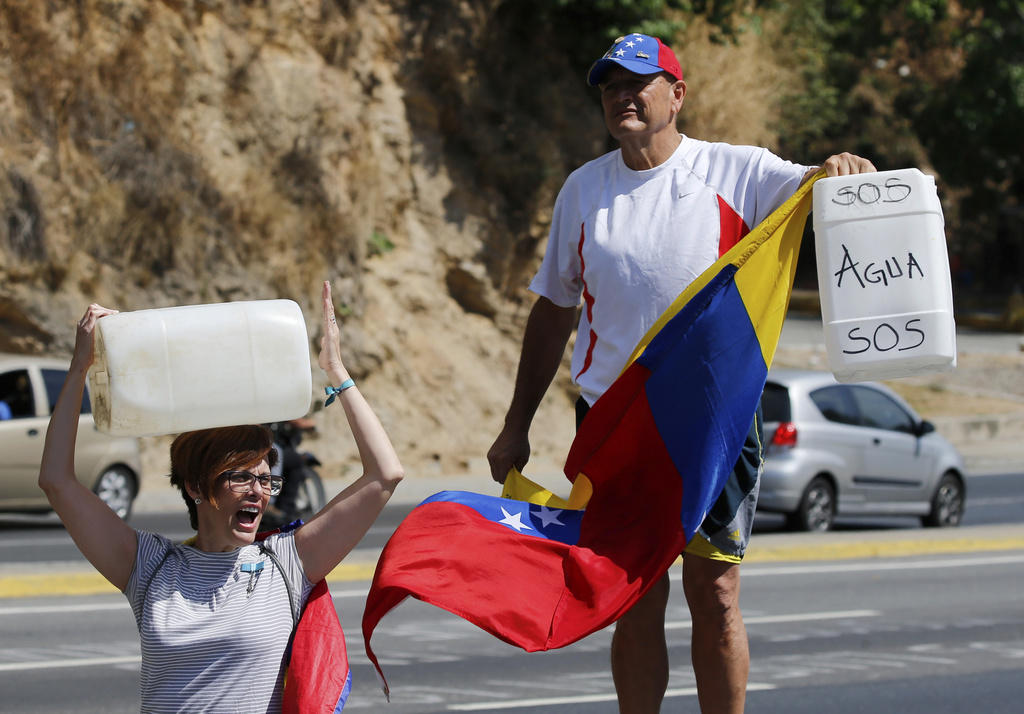
>>>Nicolás Maduro, the former president overthrown by force, did not accept in 2019 that Switzerland represent Washington’s interests in Caracas:
More
Messenger, not mediator: Switzerland in Venezuela
The Spanish government of Pedro Sánchez, for its part, has been much more proactive, publicly offering its assistance to create the conditions for possible mediation and a resolution to the conflict.
Switzerland has forged a reputation as a protecting power with eight ongoing mandates, including five of which are linked to the Americas: it defends the interests of Iran in Egypt and Canada, those of the United States in Iran, those of Russia in Georgia, and vice-versa, those of Ecuador in Mexico, and vice-versa, as well as those of Ecuador in Venezuela.
>>>Switzerland’s oil traders are paying close attention to developments in Venezuela – read more below:

More
Swiss oil traders weigh opportunities following US intervention in Venezuela
Edited by Samuel Jaberg/adapted from French with AI/sb
More
Need a diplomatic messenger? Switzerland is eager to help

In compliance with the JTI standards
More: SWI swissinfo.ch certified by the Journalism Trust Initiative

You can find an overview of ongoing debates with our journalists here . Please join us!
If you want to start a conversation about a topic raised in this article or want to report factual errors, email us at english@swissinfo.ch.