








What it takes for a referendum to be fair

Popular votes are held not only in democracies such as Switzerland, but also in semi-democratic and authoritarian countries. Can such referendums ever be fair?

What does Switzerland have in common with dictatorships around the world? Above all, a fondness for popular votes.
“Nowadays, almost every dictator holds elections,” says Robin Gut, a political scientist at the Centre for Democracy Studies Aarau. They create an appearance of democratic legitimacy. But sham elections are costly and need lots of people: an opposition which poses no real threat, a party structure, candidates. Involving large numbers of people creates unpredictable risks.
“You don’t have all these problems with a referendum,” says Gut, who researches how non-democratic and semi-democratic states use plebiscites.
Referendums are popular with dictators because they can easily determine the topic, the wording of the question and the timing – unlike elections, which are held at regular intervals. At the same time, referendums can legitimise a dictatorship or its policies in a similar way.
External Content
Authoritarian rulers can also call a referendum at very short notice, catching everyone off guard. The Council of Europe’s Venice Commission states in its Code of Good Practice on ReferendumsExternal link that one month between the announcement and the vote is the “absolute minimum” period necessary for voters to form an opinion.
“The fairness of a vote is not measured solely by whether ballots are cast freely on voting day,” says Regina Kiener, a legal scholar who helped draft the Code of Good Practice. The state must recognise and safeguard the freedom to form an opinion, she says. This includes ensuring that both sides can “express themselves equally” ahead of the vote and are “adequately represented in public media”. The Code of Good Practice, Kiener says, can serve “as a benchmark for assessing whether a state can be regarded as a constitutional democracy governed by the rule of law”.
The key points:
1. Universal suffrage: all groups in society, especially minorities, must have equal access to the process.
2. Freedom to form an opinion and equal treatment of both sides during the campaign.
3. Secret ballots: there must be no coercion or intimidation.
4. A rules-based framework.
5. A clear and balanced referendum question.
6. The organisation and oversight of the referendum must be impartial and independent.
7. International and domestic observers from all camps must have broad access to monitor the vote and the count.
8. Effective legal remedies in the event of irregularities.
A tool for authoritarian rulers
Since the time of Napoleon, authoritarian rulers around the world have repeatedly turned to referendums. In the 21st century this includes Morocco’s monarchy, Turkish President Recep Tayyip Erdoğan and Russia’s Vladimir Putin. Observers have often criticised these votes as undemocratic.
Even in democracies, referendums are sometimes accused of being unfair. In Switzerland, allegedly one-sided official information brochures frequently end up before the courts.
In the UK, some critics of the 2016 Brexit referendum argued that the outcome was unfair and did not reflect “the will of the people”External link.
How do referendums and direct democracy actually work in Switzerland? Read more in our explainer:

More
How Swiss direct democracy works
Can referendums in dictatorships bring democracy?
Votes in democracies are not automatically fair – but referendums in dictatorships cannot be fair.
“There will always be problems with referendums in non-democratic countries,” Gut says. Fair votes require democracy, the rule of law and civil liberties. Freedom of assembly, expression and the press are essential. “Without these conditions, a free process of opinion formation is impossible.”

In their researchExternal link, Spanish political scientists Sergio Velasco and Alberto Penadés describe top-down referendums, which they refer to as plebiscites, as a “tool for dictatorships”External link. They do, however, cite examples where votes held under authoritarian regimes triggered democratisation: for example in Spain in 1976, when a plebiscite following the death of dictator Francisco Franco initiated the transition to democracy. The best-known example is Chile in 1988, when a majority voted to end Augusto Pinochet’s rule – despite years of brutal repression of the opposition.
But such cases of what Velasco and Penadés call “institutional suicide” are exceptions. Their conclusion is that dictators often remain in power longer thanks to popular votes. After such a ballot, they face less resistance within their own power structures, and the opposition’s ability to mobilise is weakened.
Votes in Thailand and Bangladesh
In 2026, referendums were held in two countries with systems between dictatorship and liberal democracy: Thailand and Bangladesh. Thailand’s previous referendum in 2016 was later criticised by scholarsExternal link for the poor quality of official information and the fact that it was not even delivered to all citizens. Gut also points to intimidation and disinformation as problems at the time.
The 2026 question in Thailand was simple: Are you in favour of adopting a new constitution? According to Gut, such a question is appropriate for a referendum. He is more critical of the vote in Bangladesh, where citizens were asked to approve a package of multiple reforms in a single ballot. According to Gut, bundling proposals makes it unclear what voters actually support.
Clear rules matter
For a referendum to be fair, the rules of the game must be clear from the outset. Supporters and opponents alike must trust the rule of law, including the procedures governing the vote.
“It is important that a referendum follows clear rules, set out in the constitution or in legislation,” Gut says. Switzerland is “relatively regulated” in this regard, but internationally – and not only in dictatorships – there are many examples where this is not the case.
External Content
Gut is sceptical of non-binding referendums. “If I go to the ballot box, I must be able to assume that my vote will have an effect,” he says. When the result of a consultative vote does not suit politicians, it can be ignored. If it does suit them, it may be interpreted as backing for a pre-existing plan. Neither outcome reflects the purpose of direct democracy.
Gut points to Ireland as a positive example. There, citizens’ assemblies first examined sensitive issues such as the legalisation of abortion, with the national vote only held after these debates, which also resulted in a public recommendation.
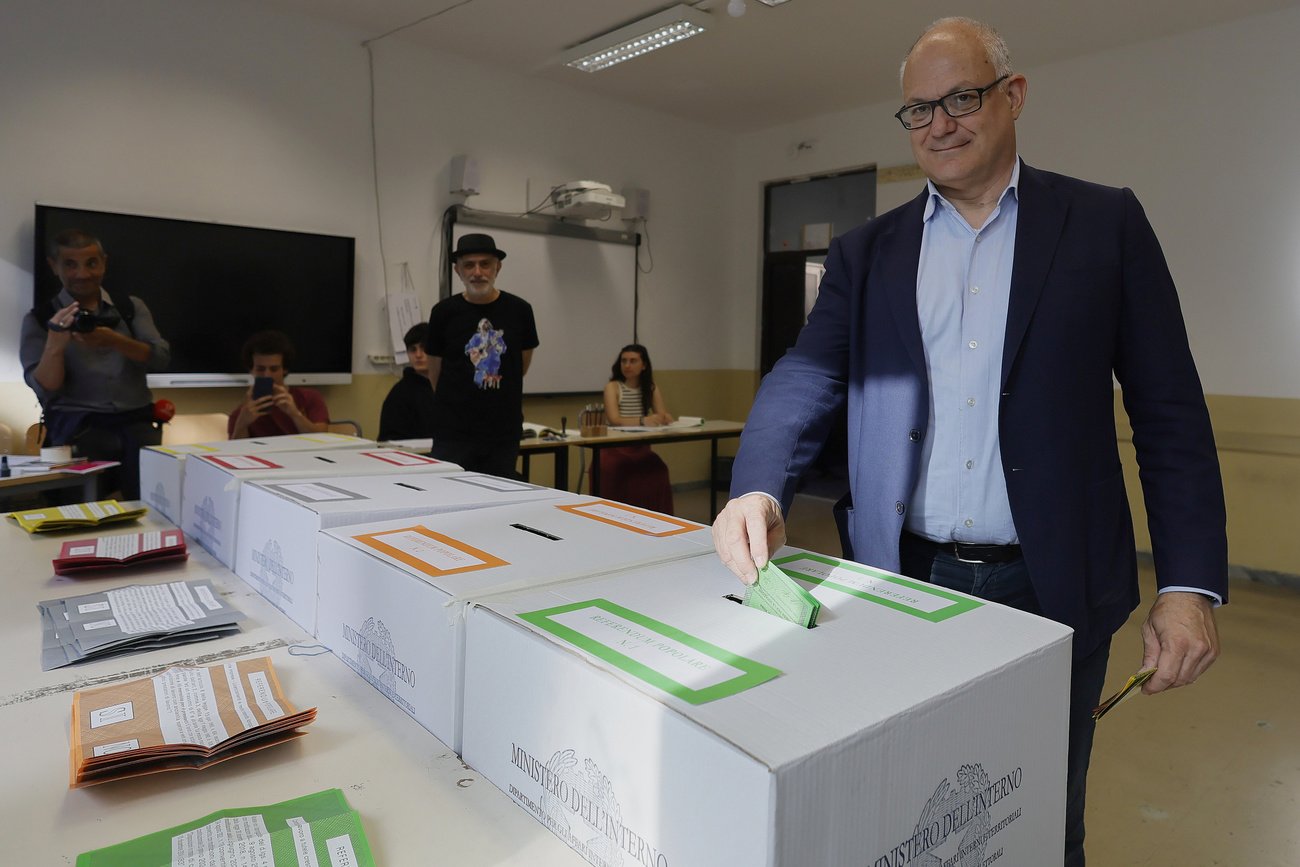
He is more critical of Italy, where there referendums require high turnout thresholds to be valid. Constitutional referendums, such as the vote in March 2026, are an exception, in that they don’t need such quorums; in other cases, however, referendums rarely manage to have an effect.
Low participation rates also raise questions: when many citizens stay home, it is unclear whether they oppose the proposal or are simply indifferent.
Read our article about the 2025 referendum in Italy:
More
Italy’s referendum flop sends a warning to the left
International law and implementation
In Switzerland, referendums must not violate mandatory international law. Otherwise, a majority could vote to disenfranchise a minority. “You cannot hold a vote on whether to introduce slavery,” Gut says. However, international law can complicate the implementation of Swiss popular decisions. Although parliament reviews initiative texts, Gut says it takes a “liberal approach to what is allowed on the ballot”. As a result, political authorities sometimes face difficulties in implementing initiatives, such as a ban on building minarets, or an initiative on the non-applicability of statutes of limitations for certain crimes.
Gut notes that even in democracies, many politicians find referendums cumbersome, as they complicate their work. But fairness requires that political authorities implement decisions without distortion.
At the same time, referendums in democracies are not the opposite of representative politics. As Alice el-Wakil, assistant professor at the University of Copenhagen, has shownExternal link, referendums and popular initiatives interact continuously with the work of government and parliament.
“In a democracy, no institutional actor ever has the final word,” el-Wakil says. “Decisions are made, but the discussion always continues.”
After voting day comes the next step. Everyone must always have the opportunity to participate. Democracy is a process.
Edited by Balz Rigendinger/dos
Have you also had any experiences with referendums outside Switzerland?
More


In compliance with the JTI standards
More: SWI swissinfo.ch certified by the Journalism Trust Initiative

You can find an overview of ongoing debates with our journalists here . Please join us!
If you want to start a conversation about a topic raised in this article or want to report factual errors, email us at english@swissinfo.ch.