








Myanmar – bringing justice to women

Select your language
Generated with artificial intelligence.

Listening:
Myanmar – bringing justice to women
Almost a decade ago, Myanmar’s military launched a brutal assault on the Rohingya population.

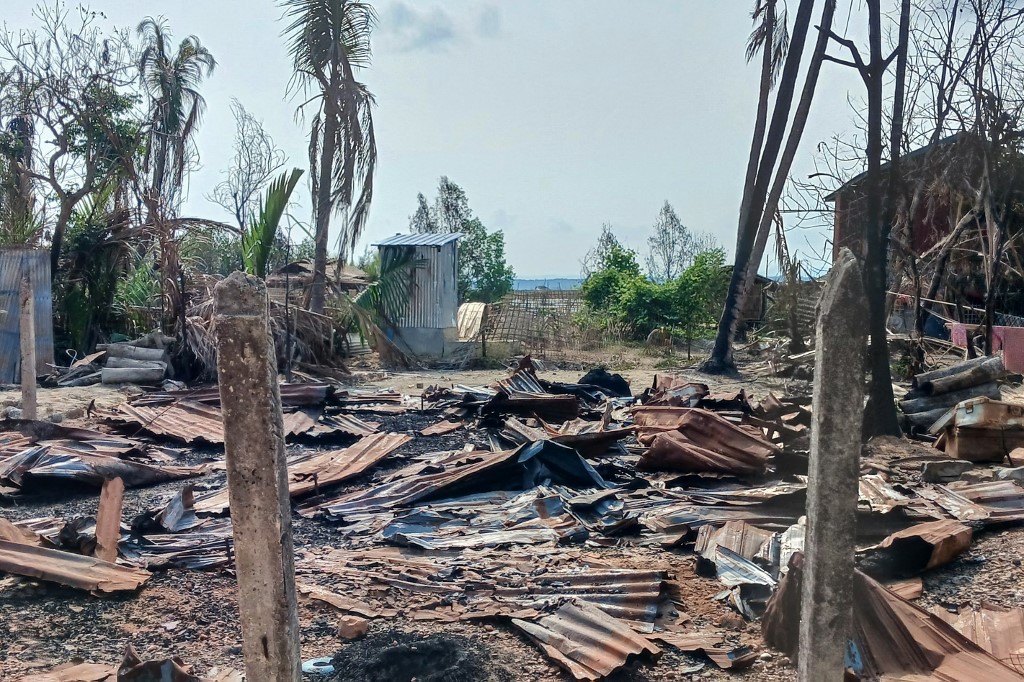
Almost a million people were driven from their homes, villages were burned and those arriving as refugees in neighbouring Bangladesh brought with them horrific reports of atrocities: rape, and murder, even of babies.
United Nations human rights investigators on the fact-finding mission for Myanmar were, despite their long experience of documenting violations, shocked by what they heard. In 2022, I interviewed two of them, Chris Sidoti and Ilaria Ciarla, for an earlier episode of Inside Geneva looking at why people turn to UN human rights for justice.
Ciarla told me of taking the testimony of a woman whose baby was snatched from her arms and burned alive. The mother was then gang raped. “I thought, can this be possible?” she told Inside Geneva.
More
Inside Geneva: Myanmar, women and justice
Sidoti remembered hearing the testimony of children, and thinking of his own children and grandchildren. He found purpose in his conviction that “the evidence that they give to us will contribute to presenting the entire picture of what occurred… and we hope that in addition there will be possibilities of international justice.”
Antonia Mulvey was on that fact-finding mission too. She remembers taking the testimony of women who had waited hours to see her, and who asked her for precisely that: justice. “At that time I really thought it would not be possible for justice to come,” she tells Inside Geneva.
But Mulvey was wrong, and, in an in-depth interview on Inside Geneva this week, she tells us of the journey from the refugee camps in Bangladesh to the International Court of Justice (ICJ) in The Hague. A lawyer herself, she is accompanying Rohingya women who are testifying.
Myanmar accused of genocide
In a case brought by the Gambia, Myanmar stands accused at the ICJ (the court which hears complaints by one state against another) of genocide. Mulvey believes it is a landmark case that could set precedents for future cases, such as the one South Africa has brought against Israel over Gaza.
But first and foremost, it is the chance almost a decade later for those who endured such atrocities to testify in a court of law. Giving evidence to human rights investigators is important of course, but a court is required for the perpetrators of atrocities, including states, to be brought to justice. Mulvey describes the start of the case as “a legally powerful moment in time.”
It is especially powerful when we remember that many of the women Mulvey has been supporting have been living in refugee camps in Bangladesh since 2017, and before that had never left their villages. “They’ve never got on a plane before,” says Mulvey. “They’ve never put a seatbelt on in a car before. Every single element that we take for granted is new for them.”
Many are survivors of sexual violence, but they have also told Mulvey they are testifying not just for themselves, but on behalf of their families; children, mothers, sisters, who were killed. “Their bravery and courage is quite inspirational,” says Mulvey. “And I think we need that inspiration right now in the world that we are in.”
More
How digital evidence is reshaping UN investigations in Myanmar
Can the court bring justice?
Myanmar has denied the charges of genocide; the case is expected to last at least until the end of 2026. Meanwhile, some of the world’s most powerful countries, notably the United States, seem to be backing away from international law. Washington, which never signed up to the International Criminal Court, has now sanctioned judges at the ICC because, the White House says, the ICC has undertaken “baseless actions targeting America and our close ally Israel.”
The US is also reportedly trying to prevent any UN action which might uphold last year’s landmark ICJ ruling that states have a legal obligation to act on the “existential threat” of climate change.
Nevertheless Sidoti is, like Mulvey, inspired by the Myanmar case. He says: “To see action in the International Court of Justice, I still know how many years it’s going to take. I still know that the Myanmar butchers who are responsible for what happened may never individually be brought to justice. But I certainly live in hope that one day they will.”
If the ICJ finds Myanmar as a state guilty of genocide, it can order Myanmar to pay reparations, to restore land and property to the displaced Rohingya, and to start prosecuting individuals who committed atrocities. UN member states would be expected to cut ties, and to sanction Myanmar. Would Myanmar comply? Would it make any difference? Mulvey thinks the very fact of the world’s highest court ruling that a state has committed genocide should have “an impact.”
For Sidoti and Mulvey, who spent months collecting harrowing testimonies from the Rohingya community, the case shows that, despite all the current headwinds, international law can still function and can bring justice even to those who, as Mulvey thought back in 2017, were never likely to get to court.
“Sometimes in life it’s really good to be wrong,” Mulvey told Inside Geneva. “And I was definitely wrong.”
“I remember sitting in those camps thinking, I just can’t think that they’re going to get justice. They’re not going to get the justice that they deserve, there’s no foreseeable legal pathway for them.”
But when Mulvey, with the Rohingya women she is supporting, arrived in the grand chamber of the ICJ, she realised how wrong she had been. “If you were in that court, I can assure you international law is alive and it is fighting very hard.”
Listen to this episode of Inside Geneva for the entire, inspiring conversation.
Edited by vm/sb

In compliance with the JTI standards
More: SWI swissinfo.ch certified by the Journalism Trust Initiative

You can find an overview of ongoing debates with our journalists here . Please join us!
If you want to start a conversation about a topic raised in this article or want to report factual errors, email us at english@swissinfo.ch.