








Why Switzerland stopped short of formally sanctioning Ukraine

Swiss neutrality is often misunderstood. An analysis shows how Switzerland’s response to the war against Ukraine divides the Swiss and puzzles outsiders.
Select your language
Generated with artificial intelligence.
Listening:
Why Switzerland stopped short of formally sanctioning Ukraine

Laws reveal much about how a nation sees itself. So too can the laws that do not get passed.
When Russia launched its full-scale invasion of Ukraine in February 2022, the EU and the US imposed sweeping sanctions on Russian organisations and individuals, and Switzerland followed suitExternal link. Less widely known is that Switzerland also imposed restrictions on Ukraine, treating it as a party to the conflict. Under Swiss neutrality lawExternal link, no side in a war can receive military support, irrespective of who the aggressor is.
The Swiss government invoked emergency powers to block exports to Ukraine of goods that could have a military use. Because these powers expired after four years, a formal law would now be required. This means Switzerland would have had to enact a law imposing formal sanctions against Ukraine.
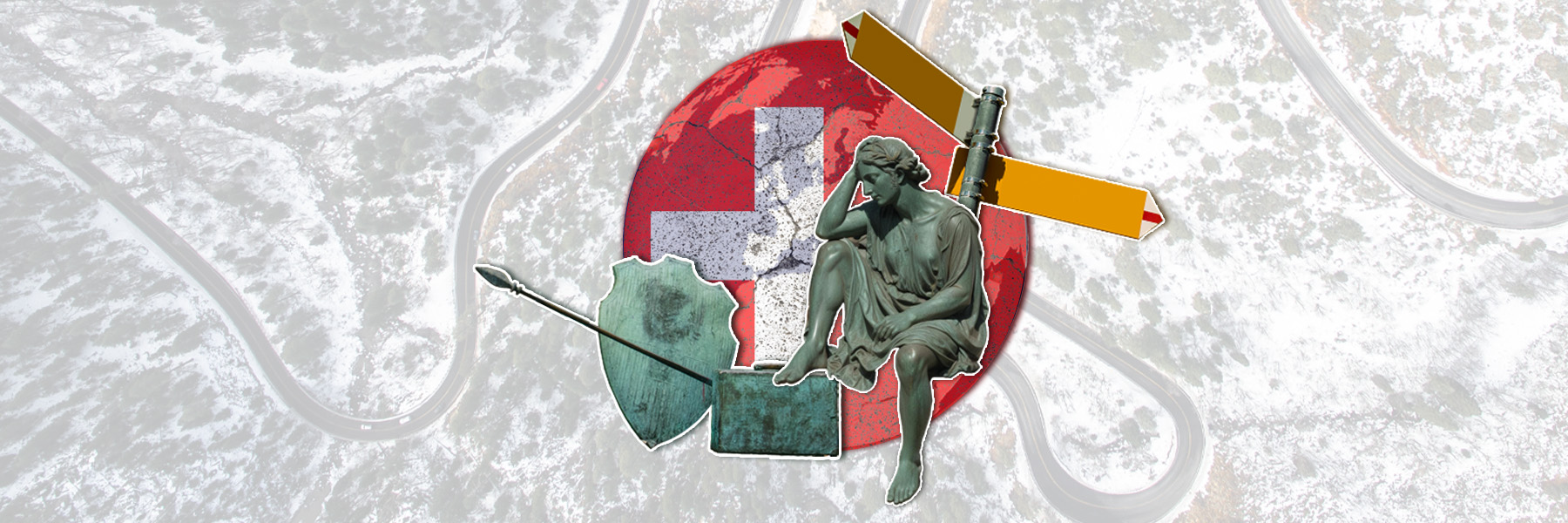
After much back and forth, the bill has been dropped. In practical terms, nothing changes. Yet the debate reveals a great deal about the constraints neutrality places on Switzerland’s foreign policy and the internal divisions over how to interpret it.
Read our in-depth coverage of Swiss neutrality here:
More
What does the future hold for Swiss neutrality?
Switzerland’s unique approach
The proposal was shelved after most political parties and business groups opposed it. The government saysExternal link it will not change how export licences are handled: “Export and transit restrictions linked to neutrality law will continue to be governed by existing legislation on war materiel and controlled goods.”
In other words, the sanctions stay in place. What Switzerland avoids is the signal that a special law would send. It would certainly have raised eyebrows among international partners. In recent years, Bern has repeatedly faced accusations of opportunism from its neighbours.
Historian and Liberal Green politician Marco Jorio sharply criticised the proposal. He described it as “probably the only anti-Ukraine law in the world”. He added: “Just imagine Switzerland invoking supposed neutrality rules to impose sanctions with a special law penalising Ukraine, a country which is under attack. It is absurd.”
Under the Embargo ActExternal link, Switzerland can independently decide whether and how to adopt sanctions imposed by the UN, the OSCE or its “most important trading partners”. Sanctions mandated by the UN Security Council, by contrast, must be implemented.
The War Materiel ActExternal link governs the manufacture and transfer of military equipment. It stipulates that Swiss-made war materiel may not be exported to countries engaged in internal or international conflicts.
The Goods Control ActExternal link regulates the handling of “special military goods”. This category also includes items such as body armour, helmets and camouflage nets. All of these are currently barred from export to Ukraine.
Criticism of the policy persists even though no formal law was passed. Franziska Roth of the Social Democratic Party said: “Anyone who stays completely ‘neutral’ and refuses to distinguish between the aggressor and the country under attack declares moral bankruptcy.” She is pleased that the bill has been dropped. At the same time, she said the government was pressing ahead with a policy targeting Ukraine that rests on “precarious legal footing”.
The right-wing Swiss People’s Party disagrees. It is the country’s biggest party and has long been sceptical of sanctions on Russia. Back in 2022, it arguedExternal link that sanctions would erode “the credibility of neutrality”. That stance was recently echoed by its parliamentarian Jean-Luc Addor in an interviewExternal link with the pro-Kremlin newspaper Izvestia. The party did not respond to Swissinfo’s requests for comment.
Before the proposal collapsed, the centre-right Radical-Liberal Party stood alone in backing it. Since its rejection, neither the People’s Party nor the Radical-Liberals have publicly set out their positions.
These domestic political debates run counter to Switzerland’s diplomatic efforts. Bern has already hosted multiple international conferences on the war and facilitated talks between the parties in Geneva. The foreign ministry continues to stress its willingness to mediate in negotiations.

More
Our newsletter on geopolitics
Why words matter
At the heart of the debate is one of the defining legal foundations of Swiss neutrality: the 1907 Hague Convention. Much of the government’s legal reasoning for neutrality rests on it, including the principle of equal treatment, which Switzerland enforces strictly.
Some international law experts contend that the UN Charter effectively overrides equal treatment when one side is the aggressor. Under international law, Ukraine is entitled to defend itself against Russia’s attack, which the UN has deemed a clear violation of the ban on the use of force. In this view, assisting the attacked country is compatible with neutrality.
Switzerland’s stance in the war has repeatedly drawn criticism from other European countries. One example was when Swiss-made war materiel could not be re-exported to Ukraine.
Read our article on these exports here:

More
European nations snub Swiss-made weapons over Ukraine restrictions
Foreign Minister Ignazio Cassis recently stirred controversy with his suggestion that Switzerland should “muddle through” this turbulent world, meaning it should find a pragmatic way to protect its interests. Responding to the backlash, he insistedExternal link that “muddling through” is not a weakness but “a principle of smart politics”.
The strong reaction to Cassis’s comment was due less to his choice of words than to the fact that it describes how Switzerland’s foreign policy really functions. For progressives, it lacks principle. For isolationists, it goes too far.
The same pattern can be seen in Switzerland’s approach to Ukraine. The balancing act is clearest in the wording. The government refers to its actions against Russia as imposing sanctions. For Ukraine, it opts for the softer phrasing of “measures linked to the situation”.
Russia maintains that Switzerland has forfeited its neutrality by adopting sanctions. Yet Bern participates in roughly 30 different sanction regimesExternal link, some of them for decades.
Swiss public opinion offers no clear answers. In a survey published in early 2026, 80% supported neutrality, and 56% favoured supplying weapons to Ukraine. For many, there appears to be no contradiction in this.
Later this year, Swiss voters will decide on the “neutrality initiative”, which would enshrine sweeping limits on sanctions into the constitution.The debate over how Switzerland interprets neutrality is far from over.
Read more about the neutrality initiative here:

More
How the neutrality initiative could affect Swiss policy
Edited by Benjamin von Wyl. Adapted from German by David Kelso Kaufher/ds

In compliance with the JTI standards
More: SWI swissinfo.ch certified by the Journalism Trust Initiative

You can find an overview of ongoing debates with our journalists here . Please join us!
If you want to start a conversation about a topic raised in this article or want to report factual errors, email us at english@swissinfo.ch.