








Expats struggle to explain Swiss neutrality abroad
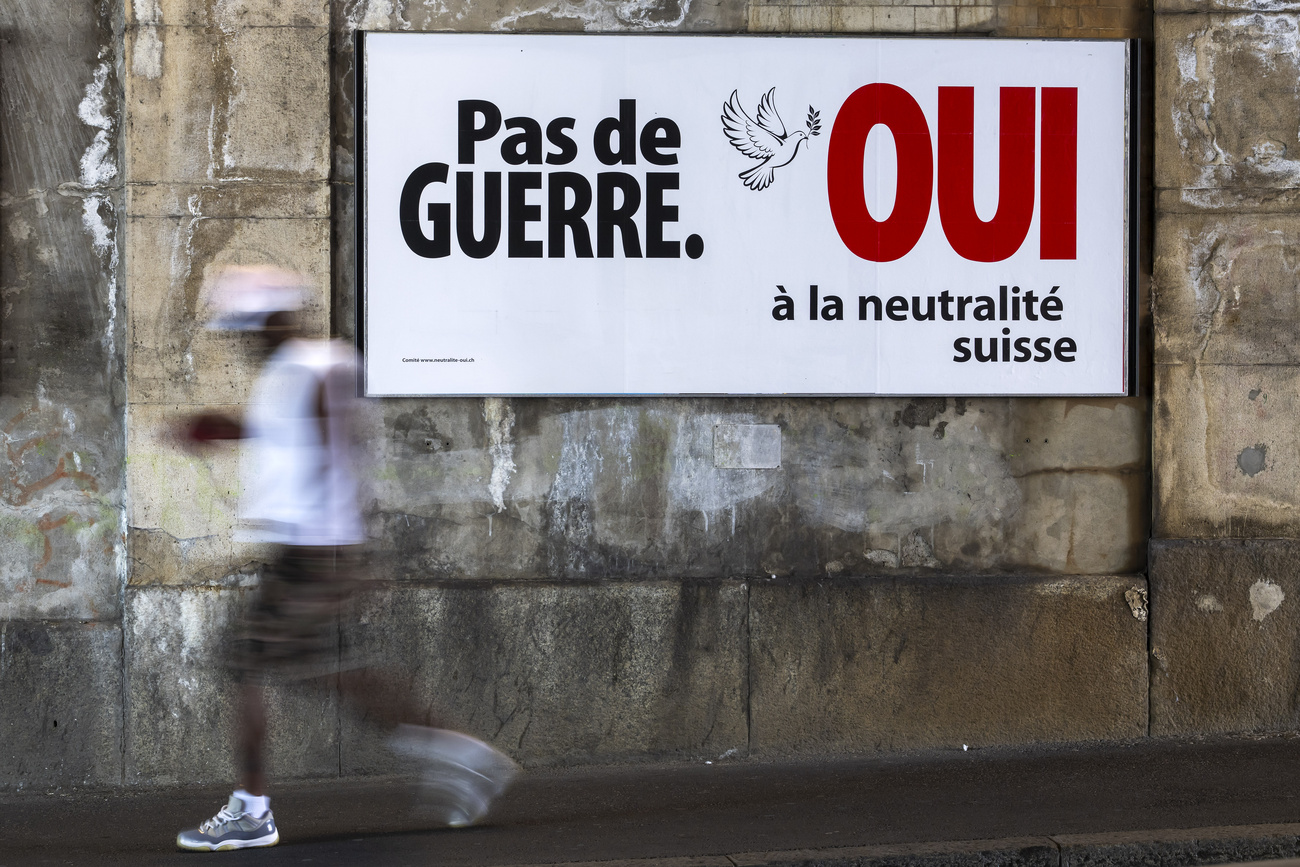
Switzerland’s neutrality is not always easy to explain, especially abroad. Many Swiss expats have to grapple with preconceived notions.
Select your language
Generated with artificial intelligence.
Listening:
Expats struggle to explain Swiss neutrality abroad

Swiss neutrality is a hallmark of Switzerland. Abroad, however, it is sometimes criticised. Swiss citizens living abroad are regularly asked about it and have to explain what neutrality means for Switzerland. Several Swiss Abroad have shared their experiences with Swissinfo.
“I’m Switzerland” is an idiom in the US. “Here in the US, you often hear that when someone doesn’t want to take a stance on an issue,” says Ruth Härri, a Swiss expat living in Florida. She too has found herself saying “I’m Switzerland” quite often lately, especially when the topic turns to US politics.
“I don’t want to discuss such topics with certain friends and neighbours, as our opinions rarely match,” she says.
Peter Schärer, who lives in Frankfurt, is also familiar with this stereotype that sticks to the Swiss Abroad. When discussions in his circle become more heated, he often hears the refrain “You’re Swiss, after all; you’re neutral.”
Criticism from Germany to Chile
In recent years, however, he has also been approached on several occasions in Germany with criticism of Swiss neutrality. The trigger was the Russian invasion of Ukraine and the issue of the transfer of Swiss weapons. “People here in Germany didn’t understand this sticking to principles,” he explains.
Patrick Reolon, who has emigrated to Chile, also hears criticism of Swiss neutrality. “Here, and in South America in general, Swiss neutrality is seen as economically opportunistic,” he says. The stereotype is that Switzerland doesn’t fall out with anyone and can do business with everyone. “Depending on who you ask, this is seen as cowardly or clever,” says the Swiss expatriate.
Peter Špari, who is based in Croatia, has a different experience. “Here, neutrality is seen as the cornerstone of Swiss prosperity, rather than as cowardice or a lack of solidarity.”
Correcting prejudices
Certain perceptions are also widespread in Spain. “Here, neutrality is often misunderstood as indifference,” says Sandra Carrasco, who lives in northern Spain. “That’s the prejudice I come across most often.”
However, the Swiss national does not let this view go unchallenged. “I always explain that neutrality is not the same as indifference. Looking back at history in particular, I can say that it is all about stability and impartiality, and that Switzerland is certainly capable of imposing sanctionsExternal link,” she says.
For Carrasco, it is also clear that Switzerland’s neutrality has brought many benefits. “When it comes to peace negotiations and international diplomacy, Switzerland is still right at the forefront,” she says.
Schärer agrees. “Neutrality has served Switzerland well,” he says. However, he adds that economic interests are sometimes more important than defending one’s own values. “Russia’s attack on Ukraine was ultimately also an attack on our values. Other traditionally neutral states such as Austria and Sweden took a stand. We did not,” he says.
Is neutrality still appropriate?
For Schärer, it is therefore no surprise that Switzerland is currently debating its neutrality. “In times of peace, neutrality is always a good thing, and everyone thinks it’s brilliant. But when things get really serious – even involving armed conflicts – it becomes more difficult.”
Ivo Dürr lives in Austria, a country that also adheres to neutrality. He believes Switzerland handles neutrality well as a tool.
“Here in Austria, too, neutrality is firmly rooted in the population,” observes Dürr. The difference? The tradition of neutrality in Switzerland is significantly older than that of Austria. “In Austria, people don’t discuss it much – perhaps they don’t dare,” he says.
It is therefore hard to imagine Austria actually holding a referendum on the form that its neutrality should take.
“In today’s world, we have to redefine many things. In that respect, the neutrality initiative isn’t all that far off the mark. It forces us to talk about it and consider: does it still fit the times, or do we need to adapt it?,” he says in response to the debate in Switzerland.
Edited by Samuel Jaberg. Translated from German, sub-edited by Anand Chandrasekhar.
More


In compliance with the JTI standards
More: SWI swissinfo.ch certified by the Journalism Trust Initiative

You can find an overview of ongoing debates with our journalists here . Please join us!
If you want to start a conversation about a topic raised in this article or want to report factual errors, email us at english@swissinfo.ch.