








Edna shares her humanitarian vision with TED
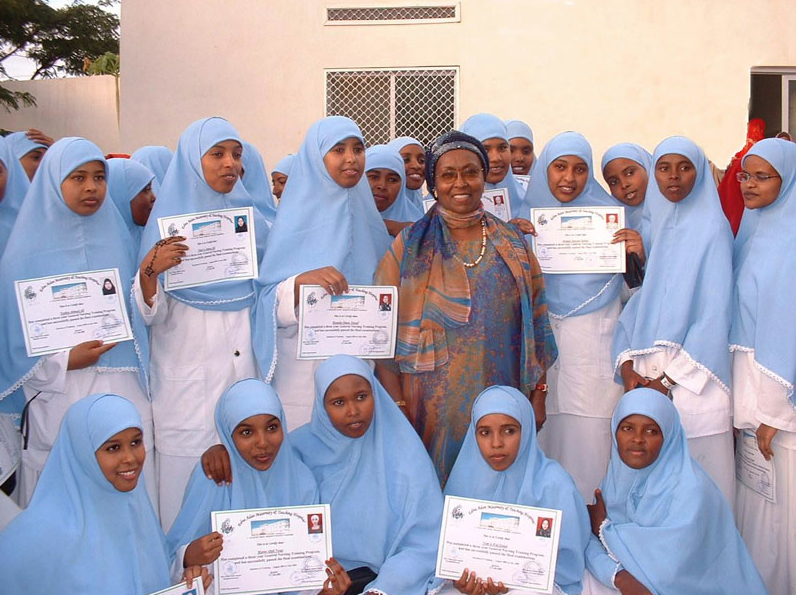
If an elderly woman can build a hospital, everyone has the potential to move humanitarian mountains if they put their mind to it, says Edna Adan Ismail.

Ismail is a former foreign minister of Somaliland, an autonomous region of Somalia. swissinfo.ch talked to the 74-year-old director and founder of Somaliland’s first teaching hospital following her talk on Sunday at the TEDxRC² event in Geneva.
The TEDx talks were held ahead of the four-day International Conference of Red Cross and Red Crescent Societies, which opened in the western Swiss city on Monday. The meeting takes place every four years aimed at strengthening international humanitarian law and humanitarian action.
TED is a global non-profit organisation devoted to “Ideas Worth Spreading”. Leading thinkers and personalities are filmed giving a 15-minute talk which is broadcast free on the internet. TEDx is a programme of local, self-organised events.
swissinfo.ch: At the age of 60 why did you decide to build a hospital at Hargeisa in Somaliland using your life savings and pension?
Edna Adan Ismail: Health and hospitals has been my business all my life. The biggest motivation came from my father, who was the first Somali doctor and the father of healthcare in my country – I refer to him as the African Albert Schweitzer. From a young age I wanted to build the kind of hospital my father would have liked to have worked in.
At 60 you are fit, healthy and your whole life and career are behind you and there is a big need – a whole lot of suffering around you. So I just said, ‘I’m going to roll up my sleeves and see what I can do about it’.
Of course, I underestimated the challenge. It’s not just about building a hospital but to run it, equip it, replace what’s broken, train health workers and set standards.
But I love it. If I had to do it all over again, I wouldn’t hesitate. I feel that whatever it is I’ve given was material, while what I get in return, one life saved, has no measure, no size. It’s something far bigger than anything I’ve given.
The hospital has also given me life. I work seven days a week and still deliver babies. I used to live there when I was foreign minister. I’m a hard-headed woman.
swissinfo.ch: What impact has the hospital had?
E.A.I.: We’ll be ten years old in March and it’s given life to an entire country. Every midwife in Somaliland has had to do a refresher course with us. We’ve developed a nursing training curriculum which is used nationally and a midwife training programme which has been replicated and used in neighbouring Somalia. It’s become a curiosity; people want to come and see what an old woman has done.
swissinfo.ch: TED conferences are about presenting great ideas to peacefully change the world for the better. What are your next big plans?
E.A.I.: I have two burning ambitions. One is to multiply the number of community midwives working in my country to about 1,000. Of course we need doctors but we can’t wait eight or nine years, and when we get doctors they don’t like going to villages.
The other is to start a school health programme, as we have 250,000 children going to school and there is no scheme. If I had ten arms I would use six dealing with the midwives and four with the school programme.
swissinfo.ch: Education is extremely important to you, isn’t it?
E.A.I.: The hospital may get run down and a window may fall out, but what will always remain behind is the knowledge we leave with the midwives, lab technicians, pharmacists and university students.
I was 16 and a half when I won a scholarship to go to England [to train as a nurse] and it is that knowledge at a young age and that training which is helping me today. Without that I might have been just another nomad woman and wouldn’t have been able to encourage or inspire other women.
swissinfo.ch: In your speech you said, ‘If I can build a hospital at 60, any of you can do it’. Is that realistic?
E.A.I.: People come to me and say they want to do something, but can’t build a hospital. I tell them size has nothing to do with it.
I tell them, ‘Go to where your grandparents were born or parents met. Find a school near there that maybe has a leaky roof and fix that. Or maybe the school doesn’t have a toilet for girls – so go and build them’. These are just small things. You then learn about your potential; and then maybe next time you can do something bigger.
But we don’t all need to start with hospitals. Try and measure your potential against the challenges and say this is a big problem but if I take a small hammer and chisel there will come a time when we can overcome this problem. Don’t try to move a mountain, just try to make it a little bit smaller.
Edna Adan Ismail is a nurse, midwife, United Nations diplomat, French Legion of Honour holder and former foreign minister of Somaliland. She is also a founding member of the Somali Red Crescent back in 1963.
She started building a hospital in Mogadishu, Somalia, in the mid-1980s but was forced to leave the country due to the civil war.
She also worked as the World Health Organization (WHO) regional nursing adviser and regional technical officer, retiring in 1997.
The Edna Adan University Hospital was opened on March 9, 2002 in Hargeisa, the capital of the autonomous region of Somaliland. The population suffers from one of the highest maternal and infant mortality rates in the world – a situation that’s been exacerbated by Somalia’s long civil war, which led to the death or departure of nearly all of the country’s health care workers.
The 31st International Conference of the Red Cross and Red Crescent is meeting in Geneva from November 28 to December 1, 2011.
The most important gathering of Red Cross and Red Crescent officials takes place every four years.
This year’s agenda will focus on strengthening legal protection for victims of armed conflicts, strengthening disaster law, reinforcing local humanitarian action and addressing barriers to health care.

In compliance with the JTI standards
More: SWI swissinfo.ch certified by the Journalism Trust Initiative

You can find an overview of ongoing debates with our journalists here . Please join us!
If you want to start a conversation about a topic raised in this article or want to report factual errors, email us at english@swissinfo.ch.