








A Swiss initiative wants flyers to fund trains
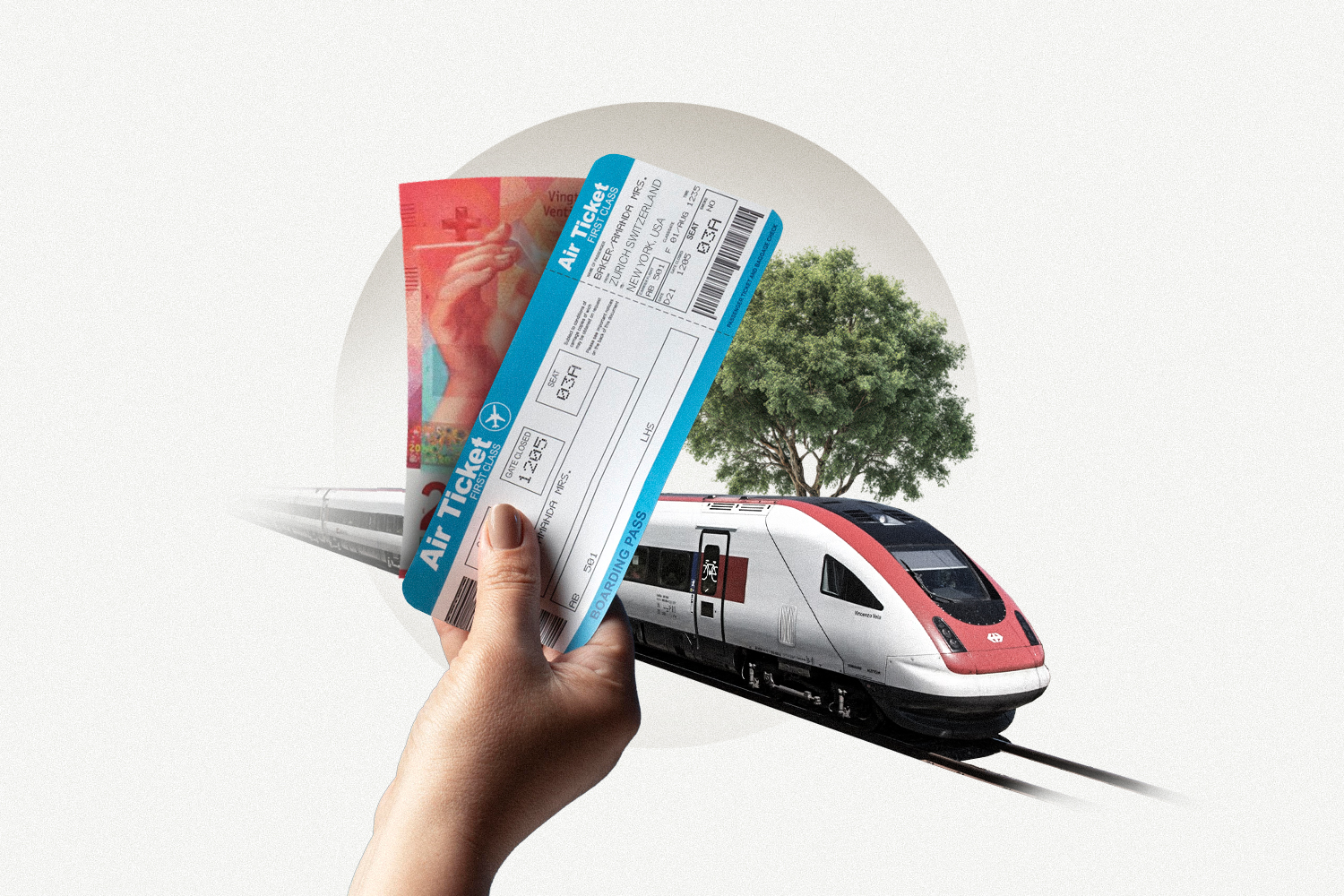
An initiative by an environmental NGO would tax every flight leaving Switzerland and hand most of the money back as vouchers for train travel. The plan faces opposition from airlines, skepticism from environmental experts, and indifference from travelers who have come to enjoy cheap flights.
Select your language
Generated with artificial intelligence.
Listening:
A Swiss initiative wants flyers to fund trains

Every day, roughly 90,000 people pass through Zurich airport, more than the population of the city of Lucerne. Air travel in Switzerland accounts for more than a tenth of the country’s total emissions, one of the highest ratios in Europe.
A new people’s initiative by an NGO aims to use that high number of flights to support greener transit options on the ground. Launched in April by the Swiss environmental organisation umverkehR, the mobility voucher initiative will force a nationwide ballot, if it is signed by 100,000 eligible voters within 18 months.
It proposes to put a levy of at least CHF30 ($37) on every ticket for flights leaving Switzerland, then use the money to give residents vouchers for trains, buses, and trams. The goal is to encourage people to fly less while making the alternatives cheaper and better.
But while the plan could generate hundreds of millions in revenue, experts wonder if the focus should instead be on reducing airlines’ carbon emissions.
More flights, higher emissions
In 2025, Zurich airport welcomed a record 32.6 million passengers, surpassing the pre-pandemic peak, and leading to an increase in carbon emissions from aviation. International flights out of Switzerland produced more than 5.5 million tonnes of CO2External link in 2024, up almost 10% from the year before, according to the Federal Office for the Environment. Emissions from aviation in Switzerland have grown by nearly 80% since 1990. Meanwhile, the country’s domestic emissions have fallen steadily, with pollution from buildings, industry and road transport dropping below 1990 levels.
The altitude at which air travel emissions are released makes the pollution more hazardous. Higher in the atmosphere, the emissions trap extra heat, roughly tripling the warming effects.
>>> Read more about Swiss emissions – and how tracking and reporting them can be a disputed exercise:

More
Switzerland’s emissions gap is larger than officially stated
How the flight tax would work
The levy would start at CHF30 for short-haul economy tickets and rise with distance and class; private-jet departures would pay at least CHF500 per departing flight. Exact rates would be set by parliament.
Supporters of the initiative have until October 2027 to collect the 100,000 signatures required to put the plan to a national vote. If they manage this, parliament will debate the text, and could put forward a counter-proposal. A public vote would happen in 2028 at the earliest. The campaign estimates the tax would raise around CHF1.5 billion a year. At least two-thirds would flow back to the population. Every Swiss resident, flyer or not, would receive an annual travel voucher worth over CHF100.
The voucher could be used for international rail tickets, or for a pass on local trams, trains and buses. Tourists visiting Switzerland would pay the levy on flights taken out of the country, but would not receive vouchers, which adds to the total pool. By the campaign’s reckoning, about 90% of residents would get more in vouchers than they would pay in fees. Only frequent or premium flyers would lose money.
The remaining money not given out in vouchers would fund night trains and cross-border rail connections that have thinned out over two decades.
“It’s not just taxing people and then not giving them any other solution,” says Thibault Schneeberger, a campaigner with umverkehR coordinating the initiative in French-speaking Switzerland. “We invest in the infrastructure, and we make the train cheaper for everyone with the voucher”.
>>> Night trains are billed as a way to cut down on flights within Europe, but can they deliver?

More
Europe’s night-train revival on ‘shaky ground’
The price gap between planes and trains is central to the campaign’s case. Swiss public transport already runs partly on public money – infrastructure is financed through a federal rail fund, and fares cover only part of the cost of regional services. Even so, ticket prices have nearly doubled in three decades, Schneeberger notes, while flying – which is exempt from VAT – is often cheaper than the train on the same route.
The campaign weighed a steeper frequent-flyer tax but ultimately rejected it. Tracking each person’s flights would require a central database, which many Swiss would resist as surveillance.
Doubts from every side
The aviation sector is under pressure to cut emissions, but representatives say a national levy is the wrong way to do so.
“National unilateral measures risk weakening connectivity and creating competitive disadvantages,” says Andreas Schürer, managing director of Aviationsuisse, a lobby group representing businesses and organisations that rely on air links. He warns that flyers could dodge a Swiss tax by departing from nearby foreign hubs such as Munich or Milan. Revenue from any kind of tax, Schürer argues, should fund decarbonising efforts within the industry, for instance research into alternative fuels.
“Aviation is not a luxury but part of the basic infrastructure of a modern country,” Schürer says.
Schürer adds that he supports international decarbonisation schemes like the United Nation’s CORSIA program, which requires airlines to buy carbon credits to cover any growth in their emissions above a fixed baseline.
Anthony Patt, a professor of climate policy at the federal technology institute ETH Zurich, opposes the tax too, but for a different reason. He says it’s not enough. He estimates that the tax would lead to between 4% and 7% fewer business trips and around 15% to 30% fewer leisure trips: a reduction, but nowhere near curbing the emissions from flying. Swiss law already contains a stronger initiative to curb emissions, Patt says. Since January, jet fuel at Zurich and Geneva must contain at least 2% sustainable aviation fuel, a share that must rise to 70% by 2050.
“We have 24 years to reach net zero, and making flying more expensive will be far less effective than measures that decarbonise it,” Patt says.
Switzerland has been here before
In June 2021, voters narrowly rejected (51.6% to 48.4%) a flight levy almost identical to this latest proposal. But the fee was one piece of a much larger CO2 law that also raised the price of petrol and heating oil, and analysts largely pinned the defeat on those other provisions, which would have been felt hardest in rural, car-dependent regions.
Switzerland’s neighbours have already implemented a similar tax. France, Germany, Italy and Austria all tax airline tickets, as do the United Kingdom, Norway, the Netherlands and Denmark. In most countries, the revenue flows into the general government budget rather than being earmarked for transport or climate measures, according to the airline association IATA. The trend is not all in one direction, either: Sweden scrapped its ticket tax in mid-2025, and Germany’s government plans to lower its levy from mid-2026 to relieve the industry.
Switzerland relies instead on the EU Emissions Trading System, which makes airlines buy a permit for each tonne of carbon dioxide they emit. This only applies to flights within Europe; long-haul routes, which make up the bulk of aviation’s emissions, fall outside it, which is why critics say roughly 70% of European aviation CO2 goes unpriced.
Whether a CHF30 levy would change how the Swiss fly is another question. In a survey commissioned by Aviationsuisse and run by the pollster Sotomo, 76% of respondents named travel time as their main reason for flying instead of taking the train. Only about a quarter of respondents said the lower price was a factor, which suggests that a CHF30 charge wouldn’t be enough to discourage flying.
The poll also found that 74% of respondents supported using taxes on flights to finance greener aviation fuel, but about 70% said they do not trust airlines to deliver on their climate promises.
The campaign’s own polling points the other way. A survey commissioned by umverkehR and run by the gfs-Zürich institute in late 2025 found that about two-thirds of Swiss would support a CO2 levy on flights. On this question, the answer seems to depend heavily on who asks, and how.
Join the debate:
External Content
Edited by Gabe Bullard and Virginie Mangin/amva


See more Swissinfo articles in your Google results. Learn more

In compliance with the JTI standards
More: SWI swissinfo.ch certified by the Journalism Trust Initiative

You can find an overview of ongoing debates with our journalists here . Please join us!
If you want to start a conversation about a topic raised in this article or want to report factual errors, email us at english@swissinfo.ch.