








Baby formula recall in Switzerland: why the delay?
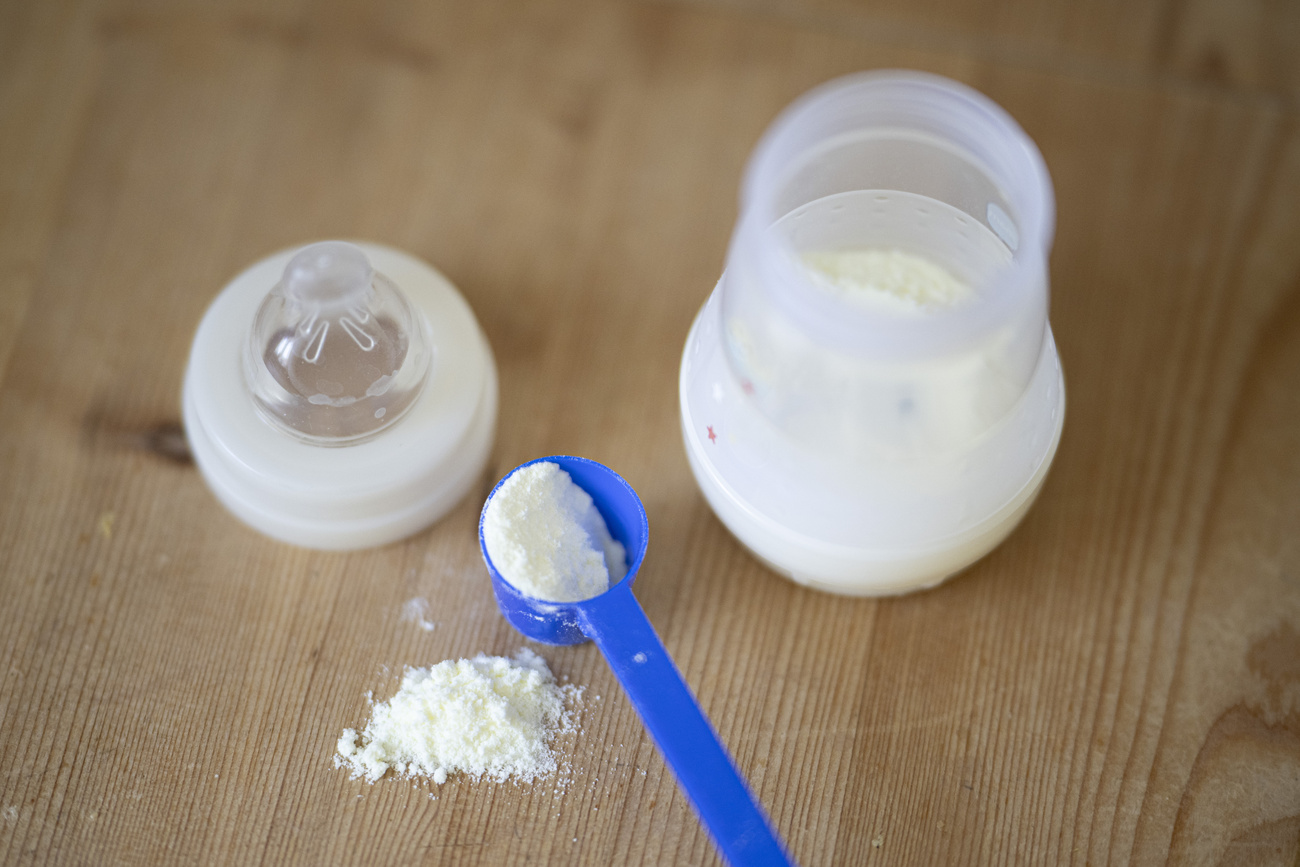
Several infant formula brands have recalled batches since January over traces of a potentially dangerous toxin, raising fresh questions about inspection standards. In Switzerland, food safety still hinges largely on manufacturers’ own controls.
Select your language
Generated with artificial intelligence.
Listening:
Baby formula recall in Switzerland: why the delay?
Nestlé was the first company to raise the alarmExternal link. Initially in the Netherlands, where the food giant detected the presence of cereulide, a toxin that can cause vomiting and diarrhea.
The company informed the country’s authorities on December 10, 2025 and issued the first recalls of powdered milk in 16 European countries on the same day. It also contacted the Federal Food Safety and Veterinary Office (FSVO) at that time, stating that Switzerland was not affected by the problematic batches.
On January 2, Nestlé contacted the authorities again, this time in the canton of Vaud, following further in-depth analyses. It was not until January 5 that the Swiss company issued a voluntary product recall.
Is trying to copy breastmilk increasing risk of contamination? Read our article to find out more:

More
Infant formula recall: Is trying to copy breastmilk increasing risk of contamination?
What happened between January 2 and January 5? Why did the canton of Vaud wait three days before taking action?
For its part, the FSVO states that it was informed by the cantonal authorities on January 5. It then published Nestlé’s recall. Did the Swiss authorities fail? Unanswered questions remain.
A self-regulation system
The Swiss system is based on self-regulation. Manufacturers, importers and retailers must themselves ensure that their products are safe for health. However, the Swiss government checks product safety at the border. The cantons verify the safety of products within Switzerland by means of unannounced inspections.
For a company that manufactures dairy products, the law requires an inspection at least every two years. When contacted, the authorities refuse to say how many times Nestlé had been inspected recently. But according to information obtained by French-speaking public radio RTS, the group underwent four inspections last year in the canton of Vaud and one this year. Nestlé has three production sites in the canton of Vaud.
External Content
Cantonal chemists also carry out laboratory analyses of products. Not all foods are systematically checked. The cantons must set priorities based on risks to the population, products most likely to be non-compliant and the type of population likely to consume the foods in question. Children and elderly people are indeed more vulnerable.
A laboratory in each canton
In 2024, 46 analyses were carried out on powdered milk in Switzerland. No problems were detected at the time. Back then, chemists were not testing for cereulide, as there was no standard test in this regard. It was only in early February that the European Food Safety Authority determined threshold levels.
In Switzerland, most cantons have their own laboratory, unlike certain other countries. This is a strength, says Geneva cantonal chemist Patrick Edder. “When we have crises, we have the equipment and scientific expertise to be able to rapidly develop analysis methods. For these dairy products, we managed to develop the method in less than a month.”
Since the scandal broke, the canton of Geneva has analysed more than 60 samples of powdered milk. Six showed traces of cereulide, but at levels deemed very low, well below the toxicological assessments of the European Food Safety Authority.
The canton of Vaud met with Nestlé to ensure that appropriate measures have been taken.
What is your opinion? Join the debate:
External Content
Translated from French by AI/cm/ac
How we translate with AI
We use automatic translation tools, such as DeepL and Google Translate, for some content.
Each translated article is carefully reviewed by a journalist for accuracy. Using translation tools gives us the time for more in-depth articles.
Learn more here about how we work with AI.

In compliance with the JTI standards
More: SWI swissinfo.ch certified by the Journalism Trust Initiative

You can find an overview of ongoing debates with our journalists here . Please join us!
If you want to start a conversation about a topic raised in this article or want to report factual errors, email us at english@swissinfo.ch.