








War in Iran: were the negotiations held in Geneva doomed to fail?

On Saturday, the United States launched a major offensive against Iran. This came despite two rounds of talks between American and Iranian delegations in Geneva in February, which ended without success.
Select your language
Generated with artificial intelligence.
Listening:
War in Iran: were the negotiations held in Geneva doomed to fail?


Late on Thursday evening, after long hours of talks described as “intense,” Iranian Foreign Minister Abbas Araghchi reported “progress” on social media. Following a second round of indirect negotiations in a matter of days in Geneva between Tehran and Washington over Iran’s nuclear programme, the diplomat added that discussions would continue, mentioning a technical meeting “in Vienna in the coming days.” The two sides had also met in Muscat, the capital of Oman, in early February.
The next day, Badr al-Busaidi, Oman’s foreign minister, who was acting as mediator, also welcomed the “significant progress” achieved the previous day on the shores of Lake Geneva.
But on Saturday morning, US President Donald Trump surprised the world by announcing the launch of a military operation called “Epic Fury” on Iran. Together, the United States and Israel carried out a series of airstrikes killing senior Iranian regime officials, including the Supreme Leader, Ali Khamenei, Iran’s leader since 1989.
Why diplomacy failed
“Donald Trump calculated that he would gain more by attacking Iran than by continuing negotiations,” says Cyrus Schayegh, professor at the Geneva Graduate Institute. He says the American president took advantage of the regime’s vulnerability to seize the opportunity for a political victory. The regime was weakened by a 12-day war launched by Israel and the US last June and the violent crackdown on protests earlier this year, which, according to NGOs, killed tens of thousands.
As part of the negotiations, Washington hoped to pressure Iran to completely abandon its nuclear programme and its long-range ballistic missiles. Tehran, which has said it has the right to develop nuclear capacity for civilian purposes, aimed to get the US to lift the sanctions that have been crippling its economy since 2018. Iran said it was ready to limit uranium enrichment.
The three rounds of indirect negotiations that took place earlier this year in Geneva and Muscat followed a series of similar talks interrupted last year by US and Israeli bombings of Iranian nuclear sites.
As a result, the two sides entered this new round of negotiations with seemingly irreconcilable demands, analysts say.
“There was mistrust. But if either side thought it was just a ruse from which nothing could be expected, it would not have agreed to commit to talks,” says Schayegh, adding that the US demands were not always clearly defined from the start.
This was particularly true regarding the ballistic program or Iran’s support for regional proxies, including Hezbollah in Lebanon and the Houthis in Yemen.

More
The special relationship between Iran and Switzerland
Taken by surprise
“Tehran must have seen progress in Geneva on Thursday and believed that another round of talks would take place, which would explain its lack of caution in organising a meeting on Saturday between the Supreme Leader and senior Iranian regime officials,” explains Schayegh. The New York Times External linkreported that the CIA had learned of the meeting in advance and informed Israel, which was then able to strike the government building where Ali Khamenei was located.
“The element of surprise is obviously crucial,” says Laurent Goetschel, director of swisspeace, a research institute based in Basel, adding that it is not uncommon for one party to launch an attack in the middle of negotiations.
According to him, holding talks also allows a party to “signal to the international community that it tried everything until the last moment to reach an agreement, but that the other side refused.”
Iran responded to the attack by immediately targeting Israel and countries in the Gulf hosting US bases, including Qatar, Bahrain, Kuwait, and the United Arab Emirates (UAE), with air strikes. At the time of publication, four US soldiers have been killed while nine deaths were reported in Israel and three in the UAE. According to the Iranian Red Crescent, Iranian casualties have exceeded 500.
More
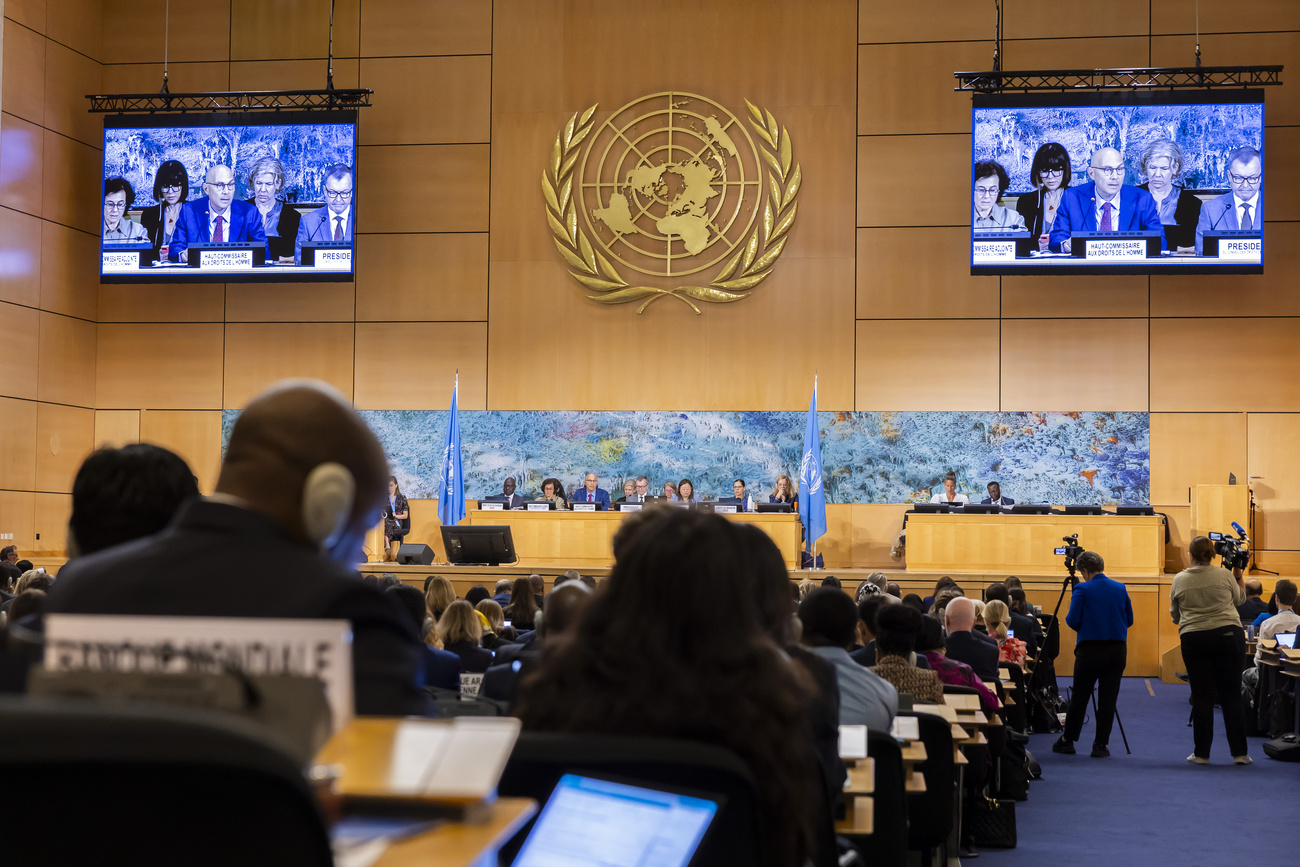
UN Human Rights Council demands investigation into Iran’s ‘brutal’ repression
No new negotiations
Donald Trump’s objective still remains unclear. The US president has hinted that he wants regime change in Iran, but he has also reiterated that he does not want a long war like the one conducted in Iraq after 2003. A period of uncertainty is therefore beginning, analysts say, with the risk of further escalation if other countries in the Gulf join the US and Israel in bombing Iran, which Saudi Arabia has suggested it would do in the event of an attack on its oil infrastructure.
The war will continue “in the coming days, or even weeks,” Schayegh says, adding a return to the negotiating table is unlikely in the short term. The head of Iran’s National Security Council, Ali Larijani, has also stated that Iran will not “negotiate” with the US, stating that the country is prepared for a “long war.”
According to Schayegh, for diplomacy to resume, Iran’s regime would have to reach a “breaking point,” perhaps with the emergence of a more moderate and pragmatic leader willing to offer concessions to the US. “But that will depend on the balance of power among the remaining senior officials. It seems that the hardliners, including the new commander of the Revolutionary Guards, Ahmad Vahidi, are gaining influence,” says the expert. To date, the succession of the Supreme Leader remains unknown.
Join the debate:
External Content
Edited by Virginie Mangin, translated from French using AI/vm/dbu
With the collaboration of Julian Busch
We use automatic translation tools, such as DeepL and Google Translate, for some content. Each translated article is carefully reviewed by a journalist for accuracy. Using translation tools gives us the time for more in-depth articles. Learn more here about how we work with AI.

In compliance with the JTI standards
More: SWI swissinfo.ch certified by the Journalism Trust Initiative

You can find an overview of ongoing debates with our journalists here . Please join us!
If you want to start a conversation about a topic raised in this article or want to report factual errors, email us at english@swissinfo.ch.