








Why Swiss Air-Rescue patronage doesn’t guarantee repatriation
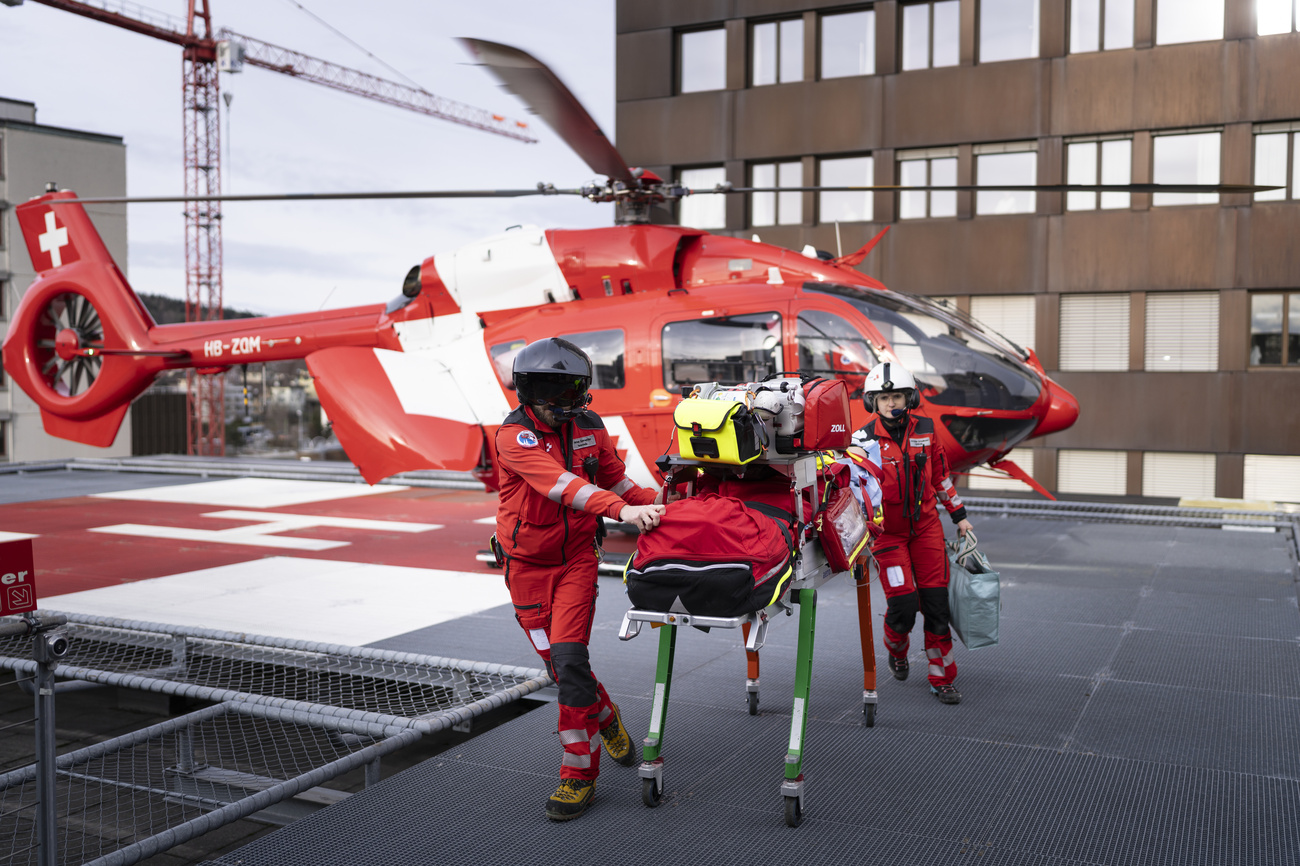
Many Swiss nationals abroad believe that, in an emergency, they will be picked up by the Swiss Air-Rescue (Rega). But the reality is more complicated, and repatriation to Switzerland is neither guaranteed nor automatically covered.

When his wife fell seriously ill in Hungary and was admitted to hospital, it was clear to Bernhard Otti that she should be treated in Switzerland. As a retired Swiss couple living abroad in Europe, they are both still covered by Swiss health insurance.
Otti has been living for several years in Balatonalmádi, a former spa town on Lake Balaton in western Hungary, and in April his wife spent two weeks in hospital. Otti describes the conditions as precarious: a lack of care, privacy, and a shortage of toilet paper and cutlery. He says he even had to bring batteries for the ECG machine to the hospital for his wife.
External Content
Otti rang Rega to enquire about repatriation. After all, the couple had been patrons for years. “I assumed that, as a patron, I would be entitled to repatriation,” says Otti. But he was soon disillusioned. Rega would not provide assistance.
“I was told: no residence in Switzerland, no repatriation,” says Otti, who had no choice but to accept the situation. After reading through Rega’s statutes, he was able to understand the refusal, but he was still disappointed: “I’m certainly not the only one to find themselves in such a situation abroad.”
What determines repatriation
Rega determines whether to bring a patient back to Switzerland on a case-by-case basis, guided primarily by medical criteria. Consulting doctors will look at, among other things, what treatment options are available locally, what the hygiene conditions are like, and whether there is a risk of complications following an operation. The expected duration of treatment and rehabilitation are also taken into account.
In the event of serious illness or injury, repatriation is usually carried out via a Rega air ambulance. If the patient’s condition is stable, the return journey can be arranged via a scheduled flight, accompanied by medical professionals.
“Repatriation must be medically necessary or sensible and must be organised through the support services of the relevant insurance provider. Transport organised independently is often not reimbursed, or only partially,” according to Swiss comparison service Comparis.
The cost of an ambulance flight or accompanied transport can quickly amount to CHF20,000 or even more than CHF100,000 ($25,490-$127,444), depending on the distance and medical support required.

Repatriation only for Swiss residents?
But what does the Otti case tell us? Are Swiss nationals living abroad categorically denied repatriation to Switzerland simply because they are not residents? In response, Rega paints a more nuanced picture in which the outcome is not decided by residence alone, but, alongside medical factors, above all a guarantee of follow-up treatment.
In practice, this means that before repatriation can take place, it must be confirmed that a Swiss hospital will admit the patient and that the treatment costs will be covered. Rega itself does not cover these costs. Once this confirmation has been received, Rega says that an address in Switzerland or abroad is sufficient.
For this reason, the foundation passes the baton to the health insurance companies. One of Switzerland’s largest health insurers, Helsana, responded that: “Repatriations to Switzerland are not covered by compulsory health insurance (OKP).”
However, in most cases, this cover ceases anyway if you are a permanent resident abroad. In European Union and European Free Trade Association (EFTA) member states, it may continue under certain conditions, as is the case with Otti. Nevertheless, it does not cover repatriation, which Comparis also confirmed.
Who pays for repatriation?
Helsana explains: “In principle, costs are only covered under supplementary insurance.” This poses a dilemma for older expatriates, as international insurance is either very expensive or not easy to obtain.

More
Swiss abroad health insurance – what are the options?
There is also another problem: many insurance policies do not cover repatriation to Switzerland, but rather to the country of residence or to a suitable hospital in the local region. “You would therefore need to take out a specific insurance policy that offers the option of being treated in Switzerland,” says Nicole Töpperwien, managing director of Soliswiss.
Soliswiss, a cooperative that looks after the interests of Swiss citizens living abroad, is aware of the problem, and Töpperwien confirmed she has already been in contact with Rega. She says: “As for everyone, this is a patronage, not an insurance policy, so there is generally no entitlement to repatriation or other services.” In fact, Rega patronage generally does not confer a legal right to repatriation, not even for Swiss nationals living in Switzerland.
Patronage remains useful for Swiss nationals living abroad, provided one is aware of the limitations, Töpperwien adds: “After all, you are also supporting a good cause.”
No false expectations
Rega is unable to provide figures on how many Swiss nationals living abroad are Rega patrons, even though they are no longer registered or covered by health insurance in Switzerland, nor does it keep statistics on how often requests for repatriation are turned down.

In total, Rega repatriated 1,046 people via one of its three ambulance jets and 310 people on board a scheduled flight in 2025.
Rega itself takes a sober view of the issue. “We are in regular contact with Swiss nationals living abroad and feel that our assistance is properly understood and that there are no false expectations,” writes media spokesperson Karin Zahner, adding that Rega provides assistance wherever possible, for example by offering medical advice.
“Our flight coordinators and doctors offer advice and assistance, for example, in selecting the nearest suitable hospital abroad, with language issues, translating medical diagnoses, liaising between treating doctors, dealing with medication issues (such as alternative substitutes), or organising the entire repatriation process to the patient’s destination hospital,” says Zahner.
To Switzerland by car if necessary
Otti is now caring for his wife at home. “The tests are still ongoing,” he says, but doctors have yet to determine the cause of her condition. For now, she is awaiting further appointments from home and has been given pain medication.
Should her condition worsen or results indicate that Otti’s wife needs to be treated in Switzerland, he will drive her there by car if necessary, provided her condition allows it. “If I drive, it will probably take me 14 to 15 hours,” he says.
Edited by Benjamin von Wyl. Adapted from German by Katherine Price/ds

In compliance with the JTI standards
More: SWI swissinfo.ch certified by the Journalism Trust Initiative

You can find an overview of ongoing debates with our journalists here . Please join us!
If you want to start a conversation about a topic raised in this article or want to report factual errors, email us at english@swissinfo.ch.