








With West Africa cocoa under strain, can Brazil supply more to Switzerland?

The South American country hopes to expand its role as Swiss chocolate makers seek more resilient and diversified sources of cocoa.
Select your language
Generated with artificial intelligence.
Listening:
With West Africa cocoa under strain, can Brazil supply more to Switzerland?
After two consecutive poor cocoa harvests in West Africa, in 2023-2024 and 2025-2026, Switzerland’s chocolate industry has been forced to confront a longstanding vulnerability: its dependence on a small number of suppliers for one of its key raw materials.
Cocoa production in Côte d’Ivoire and Ghana, which together account for around 60% of global supply, was hit by adverse weather conditions, pests and diseases. The 2023-2024 crop was further affected by the El Niño climate phenomenon, which brought droughts, excessive rainfall and unusually high temperatures, reducing yields and worsening disease outbreaks.
As a result, the raw material behind Switzerland’s most famous culinary export saw its average international price rise from roughly US$2,500 (CHF2,030) per tonne in 2022 to a record of more than US$10,000 per tonne in 2024, according to Intercontinental Exchange (ICE) futures data. Although prices have since retreated, they remain highly volatile as the market continues to respond to uncertainty over global supply.
>>>Despite not growing cocoa, chocolate is a firm part of Swiss DNA, especially abroad:
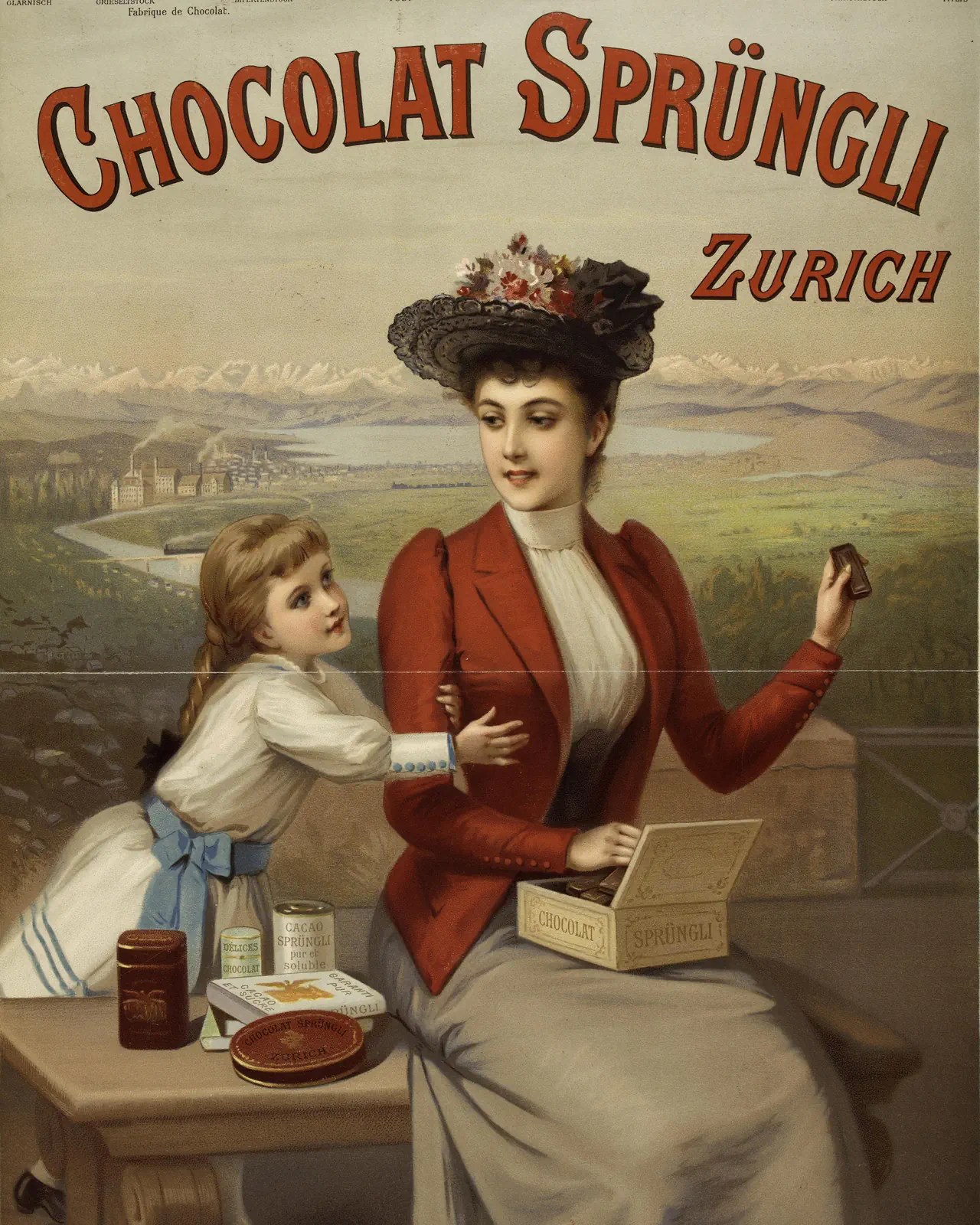
More
How Switzerland became known as the land of chocolate
The cocoa price shock has also affected major Swiss companies. Barry CallebautExternal link, the world’s largest chocolate manufacturer, reported lower sales volumes as cocoa prices soared in 2025.
“The increase in prices recorded in recent years made the industry realise that there is a huge dependence on West Africa, particularly Côte d’Ivoire,” says Christian Robin, managing director of the Swiss Platform for Sustainable Cocoa. “I believe that, in the coming years, Africa will remain extremely relevant. But, of course, companies are trying to diversify more. This is a clear trend, involving countries such as Peru, Ecuador and, of course, Brazil.”
The relevance of the issue for Switzerland goes far beyond the symbolism of chocolate. According to Chocosuisse (Swiss Association of Chocolate Manufacturers), the sector generates around CHF2.2 billion per year and the country exports more than 70% of its national production.
External Content
Data from the Swiss Platform for Sustainable Cocoa indicate that the country processes approximately 57,000 tonnes of cocoa annually, a raw material imported from Africa, Latin America and the Caribbean. As a result, the crop failures that affected main producers in recent years quickly became a concern for one of Switzerland’s most traditional industries.
This year, cocoa prices have eased as weather conditions improved. Even so, prices remain well above the levels seen before the West African crisis, indicating that the market continues to face structural pressures.
Crisis exposes vulnerabilities in the global supply chain
According to Robert Finger, professor of agricultural economics and policy at the federal technology institute ETH Zurich, the decline in African cocoa harvests reflects some of the growing resilience challenges faced by agricultural and food systems, driven, among other factors, by the increasing relevance of extreme weather events and the resulting crop losses, as well as market and institutional risks.
Cocoa is particularly vulnerable to climate change because it depends on relatively stable temperature and rainfall conditions and is concentrated in a narrow tropical belt.
For Finger, Swiss chocolate companies will need to adapt and seek new suppliers, even if that implies higher costs.
“Diversification of production, sourcing and income sources is certainly a viable strategy for dealing with these challenges. However, diversification always comes at a cost. When activities are diversified, cost advantages generally cannot be fully exploited, and transaction costs increase,” he says.
>>>Brazil isn’t the only country in South America with a Swiss cocoa connection:

More
How a project in Peru supports sustainable cocoa – and serves Swiss interests
One possible avenue for diversification lies in Brazil.
For much of the 20th century, the country was among the world’s leading cocoa producers. Concentrated in the southern part of the state of Bahia, cocoa cultivation transformed the regional economy and placed Brazil second only to Côte d’Ivoire in global rankings.
However, from the late 1980s onward, the spread of witches’ broom disease, which attacks cocoa trees, caused a sharp decline in production and reduced Brazil’s relevance in international markets.
Today, Brazil still ranks among the world’s ten largest cocoa producers, with around 200,000 tonnes per year. Yet it remains far behind Côte d’Ivoire and Ghana, which together produce 2.4 million tonnes annually, according to the International Cocoa Organization (ICCO).
“Structural weaknesses, particularly in West Africa, should indeed create long-lasting and structural opportunities for Brazil in the coming years, especially given the growing perception that cocoa can become a more profitable crop than it has been in the past,” says Lucca Bezzon, a market intelligence analyst at StoneX, a global financial services and market consulting company.
External Content
Brazil plays only a marginal role in Switzerland’s cocoa imports.
Swiss customs data show that imports of Brazilian cocoa beans increased from 64 tonnes in 2023 to 99 tonnes in 2024, a rise of almost 55%. Even so, Brazil accounted for less than 1% of Swiss cocoa bean imports, highlighting that any expansion is still at an early stage as Swiss buyers continue to rely primarily on suppliers in West Africa and Latin America.
As a result, the Brazilian government has set a short-term target of increasing national cocoa production to 300,000 tonnes. Seeking to regain relevance, producers in the state of Bahia are already looking for investment from Switzerland to access the Swiss market.
“Our Swiss importer raised the possibility of certifying our farms. We intend to propose a partnership under which the importer could help finance certification and provide greater incentives for producers,” says Orlantildes Santos, a cocoa farmer from Bahia and president of Coopercabruca, the Cooperative of Cocoa Producers of Southern Bahia. According to him, the cooperative produces 550 tonnes of cocoa per year and exports around 20% of that volume to Switzerland.
>>>As the cocoa market bounces around, unlikely-sounding alternatives are emerging:

More
Cocoa-free chocolate arrives in Switzerland
Even with more opportunities, Santos says, macroeconomic challenges such as Brazil’s benchmark interest rate, currently at 14.25% per year, have limited investment aimed at expanding production.
“The amount of investment is directly linked to cocoa bean prices, which are challenging and volatile. This means that investment levels have been low. Added to this is the lack of financing available from banks,” he says.
Sustainability as differentiating factor
The certification mentioned by Santos aims to meet an increasing demand for higher-quality cocoa with lower social and environmental impacts.
“Traceability is important to know where the cocoa comes from and under what conditions it was produced,” says Christian Robin of the Swiss Platform for Sustainable Cocoa. “There is the climate footprint, so to speak, the economic footprint, but also human rights risks. The trend toward greater transparency, greater traceability, stronger controls over human rights risks, ensuring that cocoa does not come from deforested areas, and promoting more regenerative, climate-friendly and carbon-neutral production models is certainly a long-term trend.”
This is where Brazil sees its opportunity. According to Thiago Guedes, director of the executive committee of the Cocoa Farming Plan (CEPLAC), an agency linked to Brazil’s ministry of agriculture and livestock, the country is unlikely to replicate the extensive production model adopted in some African countries. Instead, Brazil’s strategy is expected to be more sophisticated, combining scale expansion with value-added production and sustainability.
“It is important to understand that the global cocoa market is undergoing transformation. The trend is for Brazil to consolidate a hybrid position: relevant in terms of volume, but particularly strong in sustainability, quality and traceability,” Guedes says.

Sourcing decisions are made independently by each chocolate producer and depend on factors such as quality, availability, sustainability standards, traceability, reliability and price.
Barry Callebaut says it uses a cost-plus pricing model to mitigate raw-material volatility. However, the cocoa price shock has still weighed on demand. In its half-year results for fiscal year 2024/25, the company reported that cocoa prices had risen by 95% compared with the previous year and that the market disruption had led to a 4.7% decline in total sales volumes. It also said that significant cocoa bean price increases had negatively affected demand in its Global Cocoa business.
The company did not reply to requests for comment on plans to outsource more to Brazil.
Despite growing interest, however, analysts and industry experts note that Brazil faces higher production costs and strong competition from other agricultural crops, which could limit a rapid expansion of supply. Brazil is one of the world’s largest producers of soybeans, coffee, sugarcane, corn, oranges and beef, but cocoa accounts for only a small share of its agricultural output.
“In Brazil there are many competing crops. And Brazil is strong in all of them. So everything depends on price levels. If cocoa prices remain consistently high for several years, then I believe Brazil can once again become an important producer,” says Robin of the Swiss Platform for Sustainable Cocoa.
Edited by Virginie Mangin/ds

In compliance with the JTI standards
More: SWI swissinfo.ch certified by the Journalism Trust Initiative

You can find an overview of ongoing debates with our journalists here . Please join us!
If you want to start a conversation about a topic raised in this article or want to report factual errors, email us at english@swissinfo.ch.