








Hostage in the desert: situation of kidnapped Swiss woman remains dire
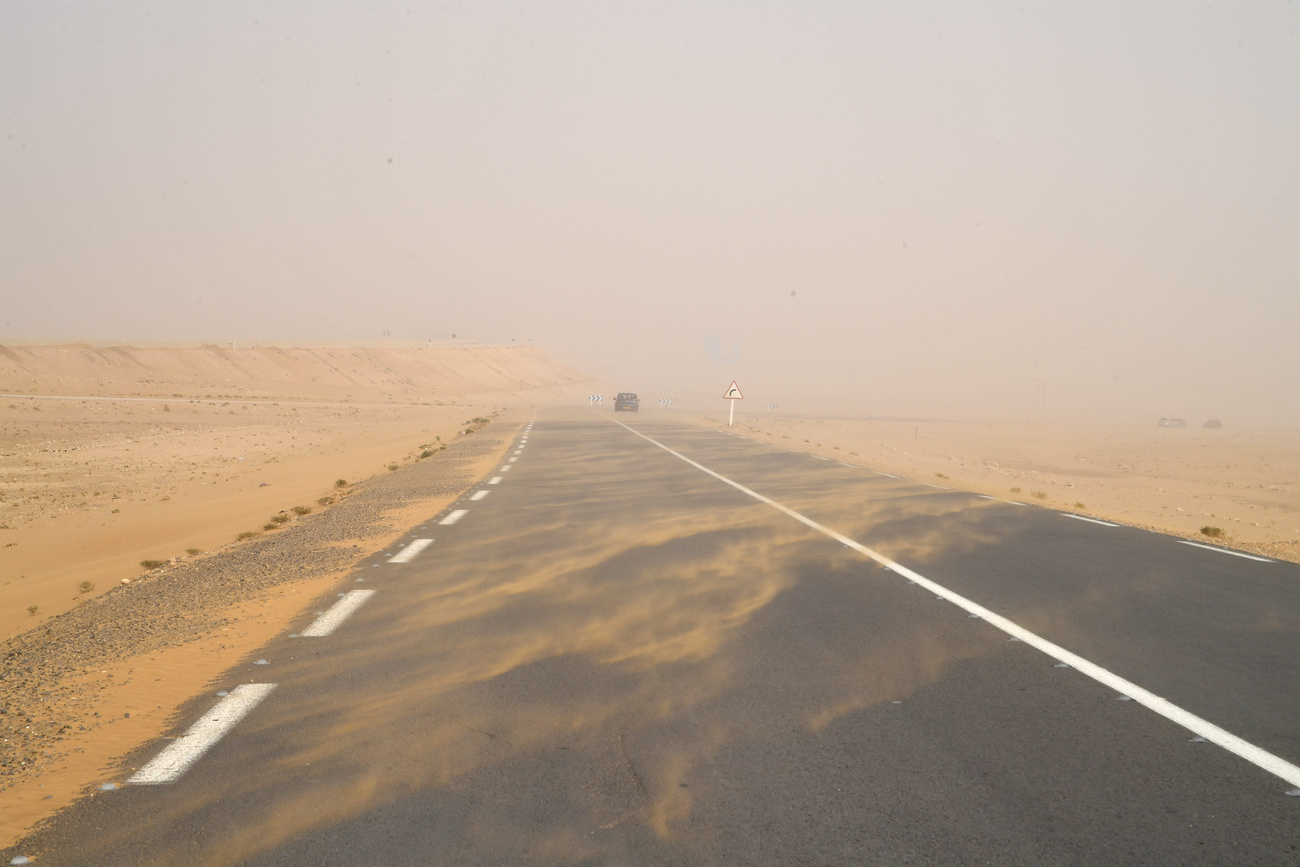
For over a year, a Swiss woman and an Austrian woman have been held captive by an Islamic State (IS) affiliate in the Sahel. Their condition is critical. What happens next? Swissinfo has spoken to the authorities, a relative and Jörg Lange, who spent more than four years in the group’s custody.
Select your language
Generated with artificial intelligence.
Listening:
Hostage in the desert: situation of kidnapped Swiss woman remains dire
It has been 15 years since the 67-year-old Swiss woman moved from Algeria to Niger. The former head of human resources at a major Swiss bank, who later became a travel entrepreneur, set up a cooperative there that produces leather goods for the European market.
The region is considered a high-risk area due to jihadist activities in the Sahel. The woman took great care, well aware of the risk of kidnapping. For example, she only left her town of Agadez with an escort, as she told the travel magazine Globetrotter three years ago. But the precautions were to no avail: on April 12, 2025, armed men broke into her house and abducted her. The Swiss woman has been held captive by a terrorist group for 16 months.
Just three months earlier, on January 11, the same thing had happened to a 75-year-old Austrian woman. She, too, was abducted from her home at night. She had founded an educational centre in Niger that supports young women and was helping local NGOs with vegetable cultivation.
The women were taken from Niger to a branch of IS in the desert region of Mali – the “Islamic State in the Sahel” (ISGS). They have been held captive together in the border region ever since. At the end of April 2025, a photograph emerged for the first time as proof that the two were still alive. It is uncertain how long the elderly women will survive in the heat, with a lack of food and medical care.
External Content
Switzerland and Austria are taking joint action
The two women’s home countries have pooled their efforts to secure their release, even though little of this is becoming public knowledge. The Swiss foreign ministry’s Crisis Management Centre has set up a taskforce. It comments briefly on these efforts: “The Austrian and Swiss authorities involved are working closely together to secure the release of the two hostages.” The foreign ministry also refers to a statement issued in April 2025.
In response to an enquiry, the foreign ministry writes: “The foreign ministry’s Crisis Management Centre formed a taskforce after the kidnapping came to light. In cooperation with the Federal Office of Police (fedpol), the Federal Intelligence Service and other federal agencies, the foreign ministry is working to secure the release of the kidnapping victim. To this end, the Austrian and Swiss authorities involved are working closely together. We do not comment on the work of the taskforce and refer to the information on our website.”
In its statement from April 2025, the foreign ministry writes that it is in contact with the victim’s relatives and the Niger authorities and refers to the taskforce that has been set up. All agencies are working together to secure the hostage’s release.
At the same time, the foreign ministry emphasises personal responsibility: since 2009, the foreign ministry has advised against travelling to or remaining in Niger, particularly due to the risk of kidnapping. Swiss citizens who remain in the country or travel there contrary to the government’s recommendations “are acting negligently and must be aware that Switzerland can only provide limited assistance in emergencies”.
Austria’s foreign ministry is also keeping a low profile. However, it refers to Peter Launsky-Tieffenthal, the Special Representative for Global Affairs. This senior diplomat has excellent international contacts and many years’ experience with kidnappings abroad. He says: “Austria and Switzerland are working continuously and in unison to secure the release of the two hostages. A solution involving a third country is also possible. Discussions have already taken place at the highest diplomatic level and among the security authorities.”
Morocco, Algeria or another mediator?
On April 22, 2026, Moroccan Foreign Minister Nasser Bourita paid a visit to the Austrian Foreign Minister, Beate Meinl-Reisinger. Officially, it was a strategic dialogue, with the Africa strategy being one of the key topics. The authorities are keeping quiet about whether the two hostages were also discussed. But one can assume that they were.
But why is a third country being involved at all? To understand this, one must realise that neither Switzerland nor Austria pays ransom for kidnapping victims. They do not wish to fund terrorism. Yet the kidnappers have not only financial interests, but political ones as well. This provides leverage in negotiations. The third countries are guided by geopolitical objectives: from recognising Morocco’s claim to Western Sahara, through Russia’s desire to push back Western influence in the Sahel, to efforts to enhance their own image.
More
Amid people smuggling and terrorism, Swiss tackle root causes in African hotspot
German hostage freed after just a few days
Another case illustrates just how tenacious Swiss and Austrian diplomacy can be: in early August 2026, a German citizen of Turkish origin, was kidnapped in Niger. After just two weeks in captivity, the gold trader was released and handed over to the Algerian army.
Speaking to Swissinfo, the son of the Austrian hostage is furious that his mother, who was the first to be abducted, has already had to endure 19 months in the desert. He himself grew up in Africa and has established contact with the hostages through intermediaries. He says: “Time is not a neutral factor in a hostage situation. Every additional day can make a difference – in terms of health and mental well-being – and ultimately determine life or death. I can understand that diplomacy takes time. What I cannot accept is that time itself becomes a strategy.”
In May, his mother was hovering between life and death. Medication was allowed to be brought to her on two occasions. The Swiss woman, who has a chronic illness, also received urgently needed medication in this way; her son is still living in Niger. The two are in contact with other people to exchange information. Among them is the German Jörg Lange (69), who spent 1,702 days in the hands of that group.
Close to death on several occasions
Speaking to Swissinfo, Lange describes the conditions in the camp. The kidnappers constantly changed their location in the desert to avoid being found. They spent the nights outdoors under trees. This involved snakes falling on him while he slept at night and painful scorpion stings. The “loo” was a bush in the open. They drank water from old canisters that smelled of petrol. Added to this were temperatures of 46°C, scorching heat, and a near-fatal bout of malaria.
Lange came close to death on several occasions. He says that only his faith gave him the strength to survive this ordeal for so long. The opposite could also have happened: on one occasion there was a discussion about whether he should be killed for blasphemy after he had spoken to a kidnapper about Jesus.
Lange must remain silent on the details of his release. However, as he was initially taken to Morocco, it is obvious that the country was involved as a third party. The son of the Austrian hostage believes that the Lange case shows that Morocco could play a genuine mediating role in the Sahel context. That said, he adds that “ultimately, it makes absolutely no difference to him which state, which mediator or which diplomatic channel brings about the breakthrough”.

‘The first bullet is for you’
Are ransoms being paid after all? At the very least, that is the suspicion. As a matter of principle, the authorities do not disclose ransom demands. However, sources familiar with the situation speak of CHF4.06 million ($5 million) per hostage being required for their release. Negotiations are being conducted by a crisis team in collaboration with the intelligence services. The home countries of the hostages generally keep a low profile in this regard. This is because citizens of countries that pay ransoms are more frequently targeted for kidnapping. Added to this is the risk of “copycat criminals” in the “kidnapping industry”.
The military government in Niger appears to be powerless. Indeed, any attempt to free the hostages by force of arms seems futile. Jörg Lange reports that he was told in this regard: “The first bullet is for you.” If a drone was spotted near their hideouts, one of the kidnappers would immediately sit down next to him with a Kalashnikov, and then they would move on.
Hopes for release rest on the US
Hopes for a release are also pinned on the US. This is because, on October 21, 2025, a US citizen – a 48-year-old pilot working as a missionary – was also kidnapped by the IS group. He is being held in close geographical proximity to the two women. The US has been in contact with Austria and Switzerland. However, it remains to be seen whether their involvement will bring a new dynamic to the hostages’ situation. The US is also among the countries that do not pay ransoms. So far, the US’s political clout has not been sufficient to secure the pilot’s swift release.
The hostages’ survival depends primarily on the geopolitical interests of those third countries that have functioning channels of communication with the jihadists. For the time being, the two women must continue to endure the scorching heat.
Update: On August 14, it was announced that the US hostage mentioned in the article had been released. The US government has not provided any further details regarding his release.
Edited by Marc Leutenegger. Adapted from German by Patrick Huwyler/ts

More
Our newsletter on geopolitics

In compliance with the JTI standards
More: SWI swissinfo.ch certified by the Journalism Trust Initiative

You can find an overview of ongoing debates with our journalists here . Please join us!
If you want to start a conversation about a topic raised in this article or want to report factual errors, email us at english@swissinfo.ch.