








Schweizerhalle chemical disaster remembered 40 years on

In the early hours of November 1, 1986, a huge fire broke out in a warehouse belonging to the chemical company Sandoz near Basel. The Schweizerhalle accident was one of the biggest environmental disasters in Swiss history.
Select your language
Generated with artificial intelligence.
Listening:
Schweizerhalle chemical disaster remembered 40 years on
At 5am, Basel Health Minister Remo Gysin was awakened by a strong chemical odour and the noise of police cars. Sirens echoed through Kleinbasel but not in Grossbasel, where the police had used loudspeakers to alert residents.
A few minutes later, Gysin, who was head of Basel’s health department at the time, received a call from the crisis management team. By 6am, the all-clear had been given.
“From my point of view, that was too early. At that stage, it was still impossible to assess the full extent of the situation,” the former cantonal minister told the Keystone-SDA news agency 40 years later.
In fact, the disaster had already begun the day before. On October 31, shortly before midnight, railway staff observed black smoke coming from the Sandoz chemical plant. However, they did not report it, as they thought it was normal, according to the historian Jelena Stefanovic. At 12:19am, a police patrol car and a Sandoz employee became aware of what was happening at the same time.
The local radio station Radio Basilisk received initial reports from listeners at 12:30am. The station then provided continuous updates throughout the early hours of the morning, advising people to stay at home and keep windows and doors shut.
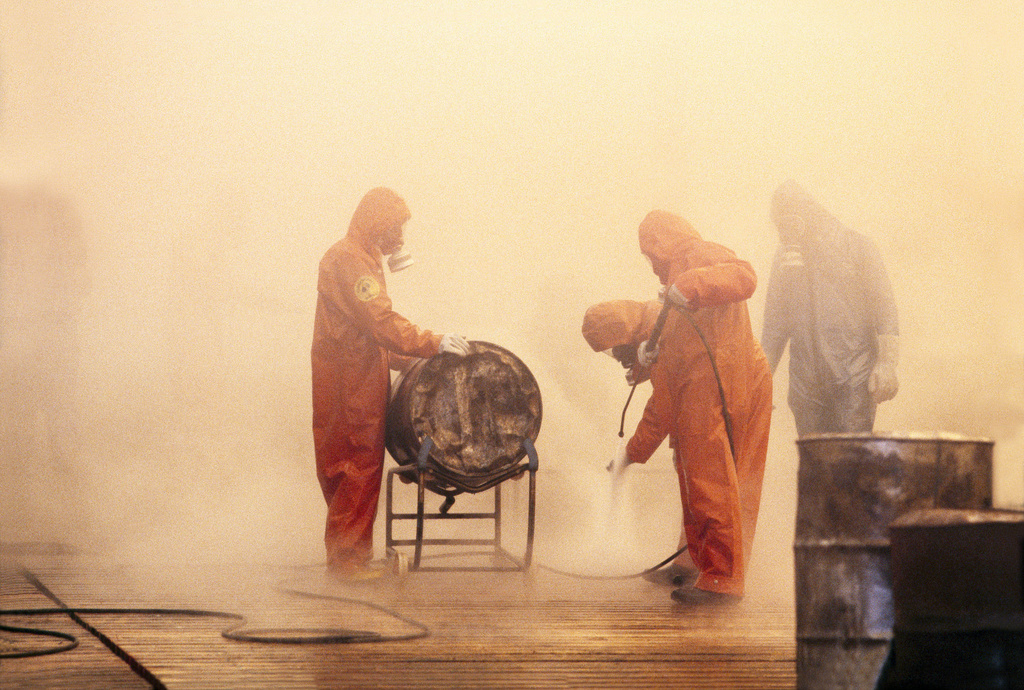
At the same time, the fire brigade was deployed for a major operation. Although 392 firefighters battled the flames, they were unable to bring the fire under control for a long time. Barrels exploded, which continually fuelled the blaze. The fire engulfed over a thousand tonnes of various chemicals.

More
Red river
Gysin remembers calling for an extraordinary meeting that Saturday morning. He said the president of the cantonal government refused this request, as the incident fell within the remit of the crisis management team and the police. This decision by the government, too, “did nothing to reassure the public”.
Confusion over school operations
That day was also unforgettable for Katja Hugenschmidt. She is now president of Ökostadt Basel, an environmental organisation founded in response to the Schweizerhalle accident.
On November 1, 1986, she was working as a secondary school teacher. Confusion arose that Saturday morning due to conflicting messages. Initially, it was announced that schools would be closed, but the authorities then reversed the decision.
More
Basel’s disaster
Hugenschmidt decided to use the lesson to talk to her pupils about what had happened. She herself had been very upset that day, while many of the young people from Kleinbasel did not even realise at first what had happened.
Fish deaths
A total of 1,252 people sought medical attention following the accident. They mainly suffered from irritation of the respiratory tract and eyes, as well as nausea. Asthmatics reported an exacerbation of their symptoms.
Although the all-clear was quickly given to the public, the disaster was devastating for the environment. Fire-fighting water, contaminated with chemicals, flowed into the Rhine. On November 1, 1986, the Keystone-SDA news agency reported many dead fish. In the days that followed, countless dead fish were recovered; the mass die-off was visible hundreds of kilometres downstream along the Rhine.
Hugenschmidt recalls the tense atmosphere in town. “People were talking to complete strangers in the street,” she says. When the Rhine turned red and dead fish could be seen, there was a palpable sense of anger. The chemical disasters in Bhopal in 1984 and Seveso in 1976, as well as the Chernobyl nuclear accident in 1986, were fresh in people’s minds, but seemed a long way off. “You had the feeling that something like that wouldn’t happen here,” said Hugenschmidt.
Gysin describes the mood after the fire in a similar way: first fear and uncertainty, then anger and finally disbelief. The accident marked the “end of faith in the chemical industry” in Basel. Moreover, hardly anyone would have expected the fire to break out in a warehouse rather than in the production area.
Looking back, he says that Sandoz initially tried to “play down” the accident. The disaster showed that companies’ personal responsibility had not worked at the time and that regulations were needed. The canton, too, had been ill-prepared. Prevention measures had not worked back then.
Panel flee protesters with dead fish
Reactions were not long in coming. On November 3, school pupils protested that they had been forced to attend school on Saturday despite the chemical accident. They criticised the Department of Education for having “misused them as a ‘sedative’ for the public”. Five days later, around 10,000 people demonstrated in Basel.
On November 9, 1986, a panel discussion at the Theater Basel got out of hand. Government and chemical industry representatives were in attendance. People from the audience placed dead fish on the table and responded to the speeches with a chorus of boos. When young people stormed the stage, the panellists fled through the back door.
The disaster had repercussions far beyond the Basel region. Sandoz paid compensation totalling CHF43 million ($52 million) in Switzerland, Germany, France and the Netherlands. Schweizerhalle was a major topic during the winter session of the Swiss parliament – the issue of oversight and accountability was the subject of much debate.
One of the most significant consequences at federal level was the 1991 Ordinance on Major Accidents. This requires businesses handling hazardous substances to implement safety measures. In general, disaster preparedness and regulatory mechanisms were strengthened. For example, risk registers and retention basins became mandatory. Canton Basel City also established a chemical inspectorate and a Rhine monitoring station in Weil am Rhein, Germany.
At a legal level, the consequences were less significant. A 1987 investigation report by the scientific service of the Zurich City Police concluded that the fire had most likely been triggered by the smouldering of the dye Prussian Blue.
The Office of the Attorney General of canton Basel Country investigated possible Sandoz officials but dropped the case in 1992. Only the unsuspecting head of the plant fire brigade and the head of the plant security service were fined. The criminal court accused them of breaching their duty of care whilst cleaning the site.
+ How we produce news in English
Translated from German, reviewed by an English Department journalist.


See more Swissinfo articles in your Google results. Learn more

In compliance with the JTI standards
More: SWI swissinfo.ch certified by the Journalism Trust Initiative

You can find an overview of ongoing debates with our journalists here . Please join us!
If you want to start a conversation about a topic raised in this article or want to report factual errors, email us at english@swissinfo.ch.