








Why Switzerland is missing from the debate over trust in government

How can governments regain the public’s trust? The OECD brought politicians, officials and civil society representatives together in Paris for a discussion. But Switzerland was absent, and the potential of direct democracy to rebuild that trust went unexplored. An analysis.
Select your language
Generated with artificial intelligence.
Listening:
Why Switzerland is missing from the debate over trust in government

Hundreds of government and civil society representatives gathered at the heavily guarded Paris conference centre of the Organisation for Economic Co-operation and Development (OECD) to confront a growing problem: public trust in government institutions is crumbling.
While participants debated among themselves inside the OECD headquarters, tens of thousands of school pupilsExternal link and university students were protesting on the streets of Paris. Later that week, over the weekend of October 17, there was looting and riots.
The scale of the problem is evident in the OECD’s Survey on Drivers of Trust in Public Institutions, published in summer 2026. It found that many people lack confidence in their governments’ ability to deal with major challenges such as global warming, migration and geopolitical tensions.
Across the 38 countries surveyed, an average of just 40% of people say they have at least a moderate level of trust in their government.
External Content
‘Growing expectations’ of a greater say in political decisions
According to the survey, fewer than one in three people feel that “people like them” have a say in government decisions, despite a large majority believing that elections can bring about change. This contradiction suggests voters want more ways to participate between elections. The report describes “growing and unmet citizens’ expectations about having a say in decision-making beyond elections”.
Switzerland is a clear outlier, where 62% of people trust the government, and 65% feel that those who have a say in political decisions are “people like them”.
For Switzerland, the findings could be seen as international validation of its political system. Regular nationwide votes help people feel heard, and a consensus government brings together almost all major political forces. This means nearly all voters have someone in the government who represents their part of the political spectrum.
External Content
On the face of it, Switzerland would seem an obvious case study for countries looking for ways out of the trust crisis. Yet the OECD report does not present it as an example, and its political model played no role in the conference discussions.
Participation models go largely unchallenged
Rather than endorsing a particular model, the study offers broader recommendations on what governments can do to build trust. These include giving citizens more opportunities to participate in decision-making and ensuring that the civil service is politically neutral.
Read our analysis of the OECD Trust Survey:

More
High Swiss trust in government sparks little interest abroad
Participation also featured prominently in discussions at the OECD conference. But speakers largely focused on what their countries were already doing. Costa Rica cited its social dialogue as a success story, and Andorra is making efforts to increase transparency in public administration.
Art O’Leary of Ireland’s Electoral Commission was particularly proud of his country’s citizens’ assemblies, where members are chosen by lottery. Their recommendations on same-sex marriage and abortion were put to referendums and approved by voters. The unexpectedly decisive results attracted considerable attention at the time.
O’Leary explained in detail how citizens’ assemblies work and how Ireland has used them. But he did not mention that Ireland’s last such assembly was three years ago, and that no more have been announced. No one pressed him on whether these assemblies, successful though they have been, are becoming a permanent feature of Irish democracy.
Read our article on the cancellation of a citizens’ assembly in Geneva and international developments in this field:

More
Are citizens’ assemblies on the decline in an era of eroding democracy?
When other politicians and civil servants at the OECD conference discussed what greater participation might look like, they often sounded as though their countries already had it largely under control. They showcased their petition systems, dialogues with citizens, and citizens’ assemblies. They seemed to suggest that others might follow their lead.
Yet these examples were rarely scrutinised. No one pointed out, for example, that the much-cited petition systems do not actually shift political power from politicians to citizens.
Plenty of concern, little talk of change
Calls are growing louder for participation that would genuinely shift political power to the people. The protests in Paris and elsewhere are only the latest sign of this, and speakers at the conference referred to them repeatedly.
“We have kids demonstrating right this morning in Paris,” Elsa Pilichowski, the OECD’s director for public governance, said as the conference opened. They have no say in decision-making, she added. Later, a Portuguese minister came close to shouting, as though he wanted to take to the streets himself: “People are angry, they are upset. They feel that governments are not solving their problems.”
No one denied the absurdity that inside, officials discussed public trust without the public, while outside, protesters encountered riot police and water cannons. Others saw the authorities failing to prevent the destruction of private property. Neither image does much to restore public trust.
Also, no one discussed what changes France might make to its political system in response to the protests. O’Leary presented Ireland’s experience with citizens’ assemblies but stopped short of suggesting that other countries adopt them. No one asked whether decisionmakers were genuinely prepared to surrender meaningful political power to citizens. In an international organisation, one does not interfere in another country’s affairs.
Still, many speakers seemed genuinely concerned. They appeared to recognise that technological and social change has fundamentally altered the relationship between citizens and the state. Governments and public institutions can no longer rely on the trust they once enjoyed. This is partly because people can now theoretically access vast amounts of information – and misinformation – on their own.
Those who ask must act
“All OECD countries are trying to improve trust. In a rapidly changing world, they are ready to take action. Hopefully, this will help stabilise public trust,” Pilichowski told Swissinfo. “In the past, people went to the polls every few years—and today, analysis shows that this isn’t enough.” That is why many countries are now developing forms of “participatory democracy”, she said.
External Content
Pilichowski said the data pointed to one clear conclusion: governments must react after consultations. “If you consult a representative group of citizens, decisions must follow,” she said.
Of course, it is unclear exactly how introducing more social dialogue would strengthen trust in society. Will angry citizens want to participate if they know they are only being listened to? The more consequential forms of “participatory democracy”, as Pilichowski calls it, require governments to relinquish some power. Under direct democracy, for example, the government must repeatedly win majority support from voters if it wants to get its proposals through.
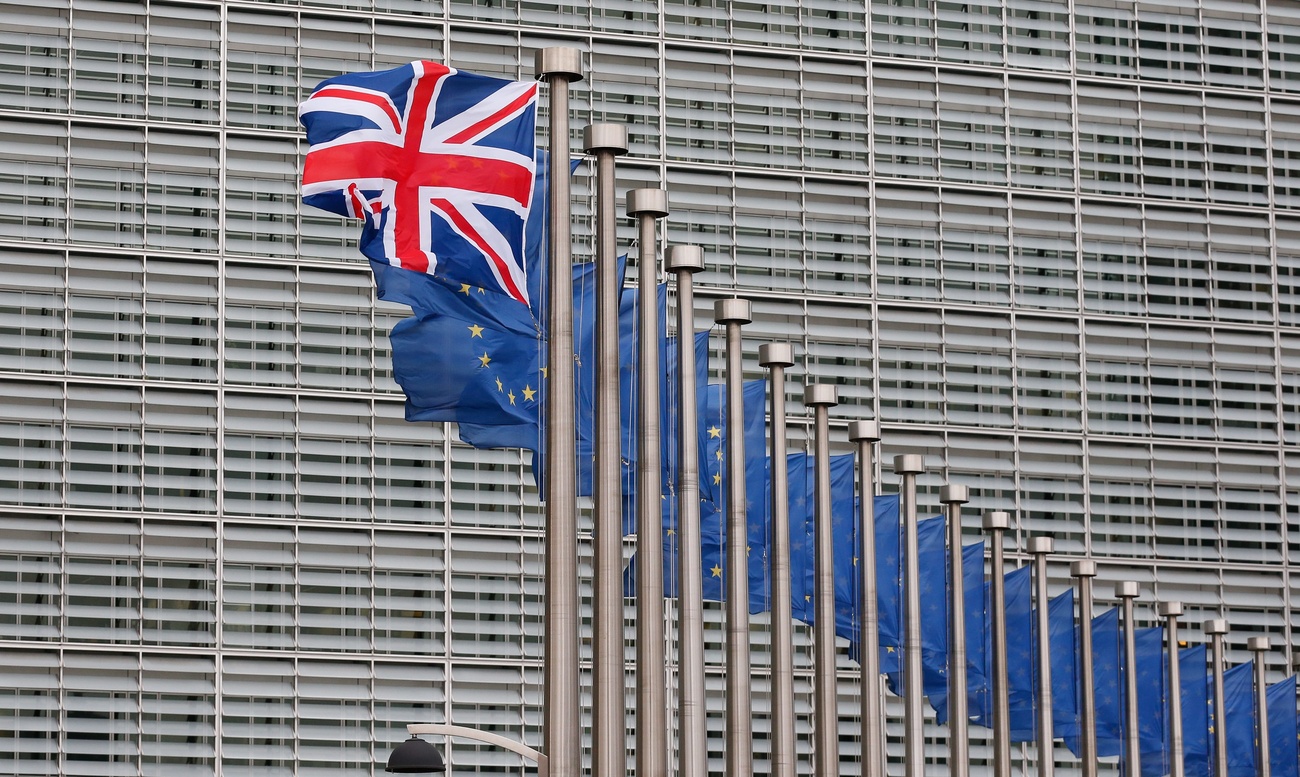
During the two-day conference in Paris, direct democracy was largely absent from discussion. When referendums came up, Brexit was the main example, and was framed as a negative, populist exception.
Brexit is still a major issue in the UK:
More
Ten years after Brexit, the ‘Swiss model’ just keeps popping up
But the Brexit vote was fundamentally different from Switzerland’s instruments of direct democracy, which allow citizens to initiate nationwide votes from the bottom up. Brexit was initiated by the British government. Despite the slogan “take back control”, the UK had, and still has, no mechanism for citizens to bring their own proposals onto the nationwide ballot.
Can Switzerland be an example for others?
Pilichowski says the Swiss model received little attention because Switzerland is a special case. Its mechanisms of direct democracy are “so deeply rooted in society”. They are the “most direct and obvious means” of giving citizens greater power, she says, but countries do have other options. “There are different ways, and countries can choose different paths.”
For its approach to feature more prominently, Switzerland would probably need to take a more active role in the international debate over trust. But whether it wants to is another question. The country often likes to see itself as a special exception.
The next debate at the OECD will be about an issue that Switzerland has not yet solved: the gap in trust between people with and without an advanced education. While 80% of highly educated people in Switzerland trust the government, the figure is only 45% among those with lower levels of education.
How confident are you in the state and society? Tell us:
More

Edited by Meret Michel. Adapted from German by David Kelso Kaufher/ts


See more Swissinfo articles in your Google results. Learn more

In compliance with the JTI standards
More: SWI swissinfo.ch certified by the Journalism Trust Initiative

You can find an overview of ongoing debates with our journalists here . Please join us!
If you want to start a conversation about a topic raised in this article or want to report factual errors, email us at english@swissinfo.ch.