








The American creative who devoted his career to an imaginary Swiss art school

Dan Levenson is an artist based in Los Angeles. He has invented a Swiss art academy that never existed, complete with a curriculum, furniture and tens of thousands of students. What drives him?
Select your language
Generated with artificial intelligence.
Listening:
The American creative who devoted his career to an imaginary Swiss art school
“It really appeals to me to make art in a language that is foreign to me,” Dan Levenson says. He works as an artist in Los Angeles, as far as one gets from Switzerland in terms of time zones. Yet for many years, his work has revolved around the Staatliche Kunstakademie Zürich (SKZ), or Zurich State Academy of Art. But the SKZ never existed. Levenson invented it. He has never made a secret of that.
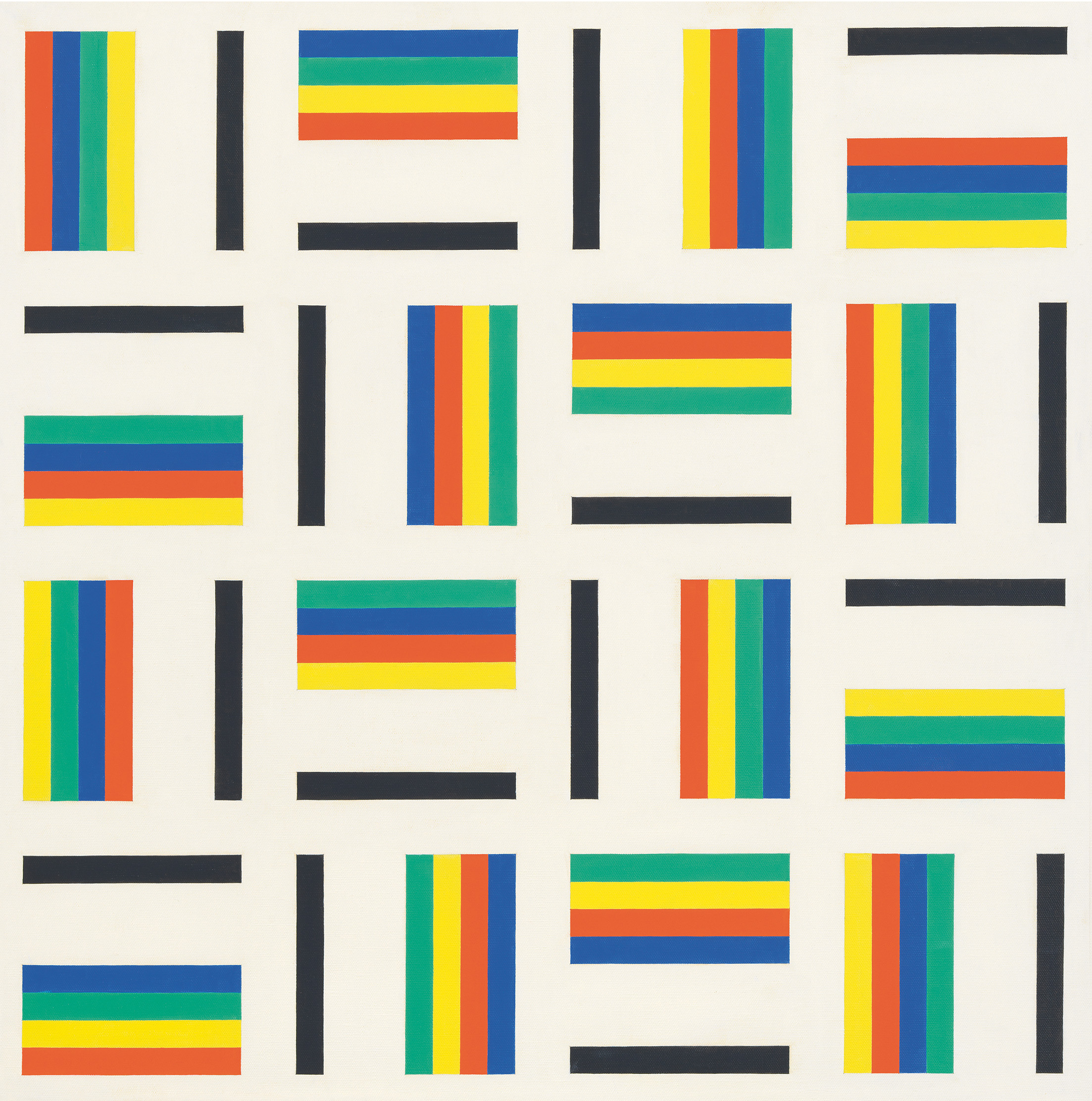
In his exhibitions, he shows exercises exploring colour scales and paintings built around basic geometric forms. Many of the works appear heavily aged. His performances recreate classes from the art school, and he sometimes exhibits painting aprons that look as though they have been used for years.

The artists whose names appear beneath the paintings – Hanneli Frick, Ramona Gutknecht and Christoph Randegger – never existed. In 2004, a computer programme generated their names from surnames in Zurich’s telephone directory and common Swiss first names. Levenson compiled 135,000 of these names into a book and published it. Ever since, he has drawn on this pool of names for his painting titles, in random order. No name is ever repeated.
Some of the furniture bears traces of genuine studio work. Other objects and paintings are subjected to processes that accelerate their deterioration: Levenson sands them down, soaks them in water and sometimes leaves them exposed to the elements for years. What remains are hairline cracks, scuff marks and stains – as if the objects had spent half a century in storage.

The SKZ is the centre of an entire parallel universe that Levenson has created over the past few years. Its fictional graduates sell their work through the “Little Switzerland” gallery, supposedly founded in the mid-1990s, according to Levenson’s account, by an idealistic group of newly graduated SKZ students.
They ship their art in sturdy wooden crates made by the fictional company Tsüri Logistik. While waiting for their paint to dry, they smoke the fabricated “Letzte” brand of tobacco or hang out at the equally fictitious “Rösti-Wirt” restaurant.

Why Zurich?
Levenson spent a long time thinking about where his fictional art academy should be based. New York was not an option: he was living there himself in the early 2000s, and it would have made the project too autobiographical. “With Berlin and Paris, the associations were too strong for me,” he says. He settled on Zurich.
Language was one factor. Swiss German, which Levenson neither speaks nor understands, crops up repeatedly in his work. His Social History of the SKZExternal link, for example, features fictional first-hand accounts by female students written entirely in Swiss German. For the recordings, he hired professional dialect speakers and translators.
“Even speakers of standard German often don’t understand this language, and I like that it doesn’t have a standardised orthography,” Levenson says. Just as he situated his project geographically at a distance from himself, he put it in a language foreign to him. “It’s twice removed from me,” he says.

Another factor in choosing Zurich was Switzerland’s reputation for being “somewhat harmless”. At the same time, the country plays a surprisingly significant role in the art world and is closely associated with the history of the 20th-century avant-garde.
In Zuefallsoperatione (Chance Operations), an art game for children in which shapes can be rearranged endlessly in different combinations, Levenson makes a clear reference to the chance-based games of the Dadaists, who repeatedly recombined words and forms through collage. The Dadaists came together in Zurich in 1916.
Modernism as a haunted house
The formal exercises Levenson paints under the names of fictitious Swiss artists are rendered in the style of classical modernism from the first half of the 20th century. In this tradition, good form was not merely a question of beauty; it was also bound up with the hope of creating a better world.

Yet the modernism that Levenson repeatedly revisits through formal exercises also resembles a haunted house. “Since the 1960s or 1970s, fine art education has moved away from this idea of fundamentals, of formalism, of composition, of colour theory,” Levenson says. “But the older generation remained a kind of antagonist, and that kind of painting and modernism and tradition haunted my generation of artists.”
Many of his exhibition pieces, with their dusty, museum-like appearance, seem like relics of a fallen regime. Levenson’s early works that explored Switzerland were interested in the aesthetics of bureaucracy: files and collective standards such as the A4 paper format, which is uncommon in American usage.
Given the strong connection to Zurich, it is tempting to see the strict geometries of his paintings as an echo of the Zurich Concretists. This movement, whose artists included Max Bill, set out to shape the entire environment for the better, “from the spoon to the city”. They later achieved international success, particularly with their meticulous typography and sophisticated corporate designs for major companies.
In the 1960s, modernism’s enthusiasm for form came under fierce attack, as young artists mocked it. Despite what his paintings might suggest, if nostalgia surfaces in Levenson’s work, it is directed less at early modernism than at the creative force of the 1960s.
He sees himself as part of the tradition of artistic institutional critique practised by Marcel Broodthaers. In 1968, the Belgian artist appointed himself director of his own Musée d’Art Moderne, Département des Aigles (Museum of Modern Art, Department of Eagles). He opened its first department in his Brussels apartment.

“As an 80s kid, with parents who lived through the 1960s, they were always talking about this magical but also disorienting time that happened just before I was born. I think I grew up with the feeling that I had somehow been born post-festum, after the party,” Levenson says.
While studying at the Royal College of Art in London in the 1990s, he was “constantly angry”. After the Cold War, art schools, too, began orienting themselves more towards the market. But Levenson had no desire to paint portraits for patrons, and he also struggled with the demand to specialise. He wanted to move between styles and work across painting, installation and performance.
“There’s something about being an art student that is more pure or authentic than being a professional artist. Art school should be years where you’re protected from the market. It should really just be about creativity, growth, exploration and community,” Levenson says.

That is why his fictional Swiss artists have no biographies. He used to invent them, he says, but found the exercise unsatisfying: “I really downplay their individuality. The important thing is that they are working together to try to solve a problem.”His imagined Switzerland also embodies this idea: it is an “idealised image of a true community, where people are bound together by a language, by a programme of research and by creative exploration.”
For Levenson, the SKZ is also a kind of second youth: “The point of my work is to send myself back to school.”
More
From Dada to Concrete Art: when Zurich was a modernist battleground
Edited by Virginie Mangin. Translated from German by Catherine Hickley/gw

In compliance with the JTI standards
More: SWI swissinfo.ch certified by the Journalism Trust Initiative

You can find an overview of ongoing debates with our journalists here . Please join us!
If you want to start a conversation about a topic raised in this article or want to report factual errors, email us at english@swissinfo.ch.