








High-end boom masks Swiss watch industry polarisation
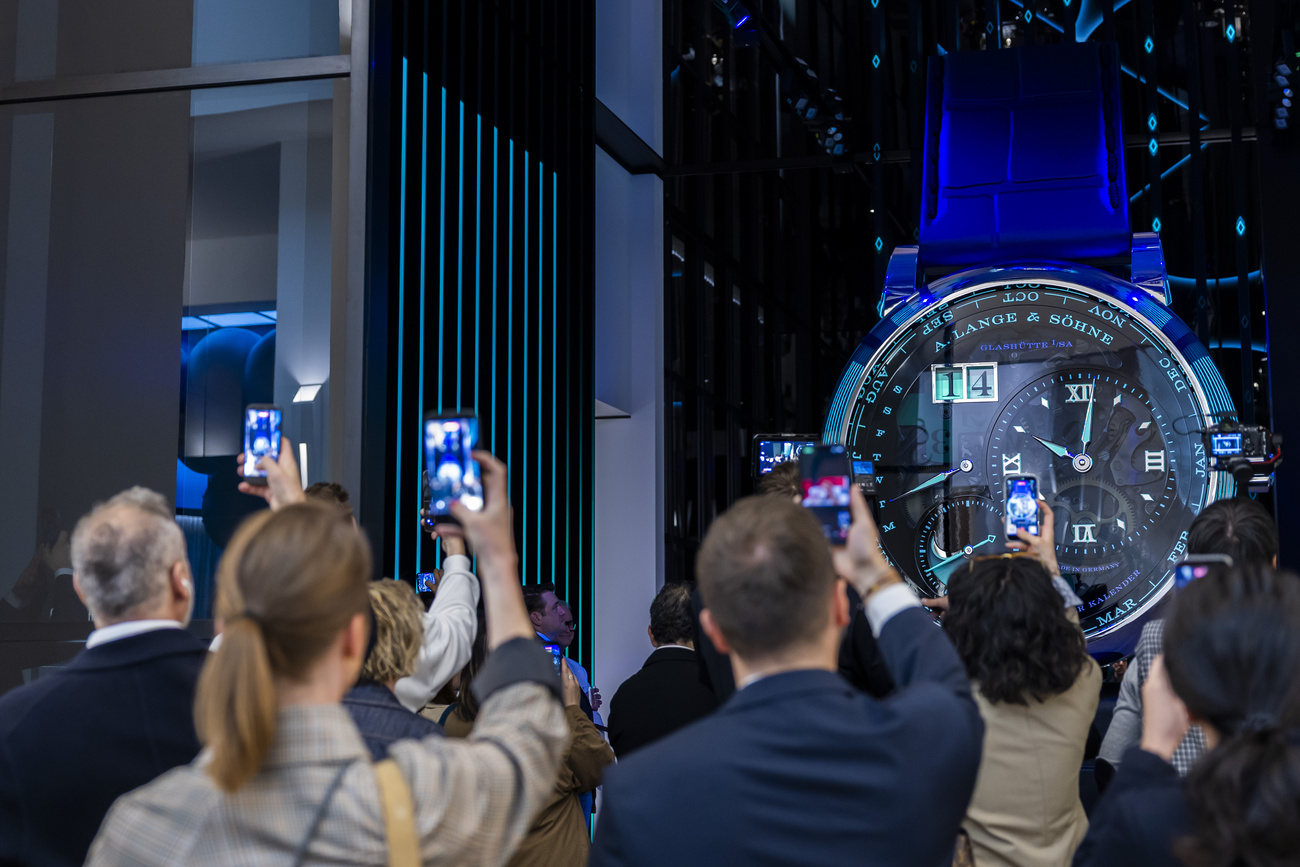
After three years of turbulence, Swiss watchmakers are searching for signs that the worst is over. Wars, tariffs, a soaring gold price, the strong Swiss franc and weaker luxury demand have all taken their toll. Now, export values have stabilised and volumes are rising again.
Select your language
Generated with artificial intelligence.
Listening:
High-end boom masks Swiss watch industry polarisation
But recovery is an increasingly difficult concept to apply to the Swiss watch industry as a whole. While some manufacturers are cutting production and relying on state support to protect jobs, makers at the very top of the market are struggling to keep up with demand. A tiny fraction of watches now accounts for most of the industry’s growth.
“This year has presented a lot of challenges and there is a lot of uncertainty in the industry,” says Yves Bugmann, president of the Federation of the Swiss Watch Industry (FH). “I hope that the situation will improve over the next few months.”
External Content

In the first half of the year, Swiss watch exports were worth CHF12.2bn ($15.1bn), down 0.6 per cent year-on-year. But the headline figure disguises growing polarisation.
Last month, Swiss watch industry consultancy LuxeConsult published a report based on FH data showing that 75 per cent of the market’s value growth had been added by watches accounting for only 1.3 per cent of volumes. “Growth of ultra-luxury was spectacular,” says Oliver Müller, LuxeConsult’s founder and author of the report. “And it shows where the whole market is going.”
The picture was less comfortable lower down the market. Watches priced between CHF25,000 and CHF50,000 were the hardest hit, falling 8.3 per cent, while “accessible luxury” watches priced between CHF7,500 and CHF12,500 rose just 0.5 per cent, helped by steel models from Rolex, Omega and Cartier. “The brands have to adapt to a new situation in which it became very complicated for retailers to continue to replenish their stocks,” says Müller.
‘Fatigue with existing brands’
At the same time, first-half export volumes rose 2.3 per cent, driven largely, according to Müller, by Swatch Group brands Longines, Tissot, Hamilton and Swatch.

More
Time’s up for Swatch?
The uptick was unexpected. Annual Swiss watch exports fell from 17 million units in 2023 to 14.6 million in 2025, according to FH data. Many brands and suppliers have sought to protect jobs and skills through RHT, Switzerland’s state-backed short working hours scheme.
The industry’s problems haven’t curtailed the rush of new watch brands. This week, House of Brands has revived Gallet after a hiatus stretching back to the 1980s, following its reintroduction of Universal Genève in the spring. In July, former Audemars Piguet chief executive François-Henri Bennahmias announced N3W5, which is due to launch its first watches next autumn. And earlier this year, Niton, another defunct dial name, was resurrected by former Girard-Perregaux executive Leopoldo Celi.
Bennahmias, whose watch company will sit under the umbrella of his The Honourable Merchants Group, believes the market is ripe for disruption. “Four years ago, the watch industry was on fire and even the lousiest brands were selling,” he says. “Now, the market is down, but is this a sign people don’t have money? No. They’re tired of the same things. To get on people’s radar, you have to do something out of the ordinary.”
Georges Kern, chief executive of House of Brands, agrees. “There’s fatigue with the existing brands,” he says. Gallet, also a sister brand to Breitling, will sell watches priced between £2,220 and £5,300, considered the gateway to luxury watches. “Saying there’s no business at this price point is nonsense,” Kern continues. “We’re not surfing on a wave any more, so you have to take market share from others, which means you need to be better than them. The retailers are happy to have something new. They don’t want the 20th version of something they already have.”
While establishment watchmakers are battling to protect volumes, many of the younger independents making short-run pieces are struggling to keep up with demand. Three years ago, industry veteran and former Hublot supremo Jean-Claude Biver created a company in his own name with his son Pierre. With a focus on high-end horology and hand-finishing, Biver watches can carry price tags up to CHF500,000.
“We arrived at the right moment,” says Pierre, now Biver’s chief executive. “The market came down after Covid, but it wasn’t a bubble bursting. There was a plateau and results are back up again now. That’s brought collectors confidence, but for independents launching now, they are faced with a bigger challenge because the market is looking for brands that feel safe.”
+ Swiss watchmakers feel pinch amid luxury slump
That, says Biver, is fuelling demand for watches made by independent sector totems such as FP Journe, Kari Voutilainen and Rexhep Rexhepi, a view borne out by recent auction results. In June, Phillips sold an FP Journe Chronomètre à Résonance for $13.9 million, making it the fifth most expensive watch ever sold. Biver will make around 100 watches this year. “We are limited not by desire but by our capacity,” says Pierre.
Niton’s owner Celi, whose watches start at CHF44,750, expects annual production never to exceed 500 pieces. “Small specialist brands are where the volumes will be diluted,” he says. “Big brands doing most of the volumes, that’s not the future.”

More
Rising June Swiss watch sales bucks 2026 trend
China down, US up
The market is also being reshaped geographically. Before the pandemic, China and Hong Kong were key markets for the Swiss watch industry, but both have since shrunk. Exports to China are down 7.1 per cent this year.
This autumn, Switzerland is due to sign a trade agreement with China that will reduce almost all export tariffs to zero. “It could give us a boost,” says Bugmann. “We paid CHF100 million a year in customs duties [to China] that will be eliminated over the next few years.”
Kern is less convinced it will change demand. “It’s only 3.5 per cent,” he says of Chinese tariffs, noting that brands with global distribution constantly balance pricing to accommodate regional currency and tariff fluctuations. “Nobody will decrease prices in China. Brands will enjoy a higher margin there.”
Meanwhile, the US has become the industry’s largest market. Exports for the seven months to July are approaching SFr3bn, close to 20 per cent of the total and almost as much as the next three largest markets combined. “I expect the US to show good performance for the next few months,” says Bugmann.
Many brands are now spinning the globe for signs of life. South Korea and Mexico are growing strongly, but it is India that is outperforming the market, albeit from a low base. Exports are up 30 per cent this year. Another Swiss trade deal means tariffs on most goods exported to India will drop to zero by 2031. “India today is as significant as any major European market,” says Kern.
Increasingly selective customers
But the industry’s longer-term challenge may have less to do with geography than value. Prices have risen sharply since the pandemic even as volumes have fallen, leaving consumers increasingly selective about what they are prepared to buy.
+ Six things you should know about the watchmaking industry
“Consumers are more and more aware of the comparison between quality and price,” says Pierre Biver. “Rolex and Cartier are able to produce some of the best quality at their price point. Someone buying at over one hundred thousand, they still want quality for what they’re paying. The challenge is how do you put enough value in the products?”
The pressure is particularly acute among suppliers and manufacturers still dependent on RHT. Bennahmias argues the scheme can preserve jobs in the short term but cannot resolve overcapacity. “It’s putting a band-aid on something that’s more important than a cut, but without it people won’t have jobs,” he says. “With this erosion of the supplier network, we’re putting the entire industry at risk.”
Kern says he stopped using RHT before the summer. “I think we’ve reached the bottom,” he says. “Companies have to adjust capacities and then take market share.”
There are other signs that consumers have not lost their appetite for watches altogether. Prices on the secondary market are rising: online marketplace Chrono24 said its price index increased 5.5 per cent in the first half of 2026, led by Cartier, Tag Heuer and Tudor.
Manufacturers are also taking a greater interest in the used market. Rolex’s certified pre-owned business, launched in late 2022, is growing, while Audemars Piguet is expected to introduce a programme of its own this autumn. “It will be another boost to the secondary market,” says LuxeConsult’s Müller. “It brings trust, and trust brings more transactions.”
Yet with prices still climbing — Rolex has raised them twice this year — and volumes uncertain, the shape of any recovery remains difficult to predict.
“With the exceptions of Rolex and Cartier, brands are squeezed, which is why they are moving upmarket,” says Luca Solca, head of luxury goods research at Bernstein.
“For new brands to succeed, they will need to have something unique to say with a focus at the high end. But the market is crowded and not growing very much, so I don’t see how new entrants could survive. It would be a rare exception that does,” he adds.
Bennahmias is more confident. “There is no bad or good time to launch,” he says. “There is always room to launch new things.”
“Watches are an eternal symbol of wealth and power,” says Pierre Biver.
Copyright The Financial Times Limited 2026


See more Swissinfo articles in your Google results. Learn more

In compliance with the JTI standards
More: SWI swissinfo.ch certified by the Journalism Trust Initiative

You can find an overview of ongoing debates with our journalists here . Please join us!
If you want to start a conversation about a topic raised in this article or want to report factual errors, email us at english@swissinfo.ch.