








Villars CEO: ‘The key is to boost our visibility while keeping costs under control’
Series CEO spotlight, Episode 18:
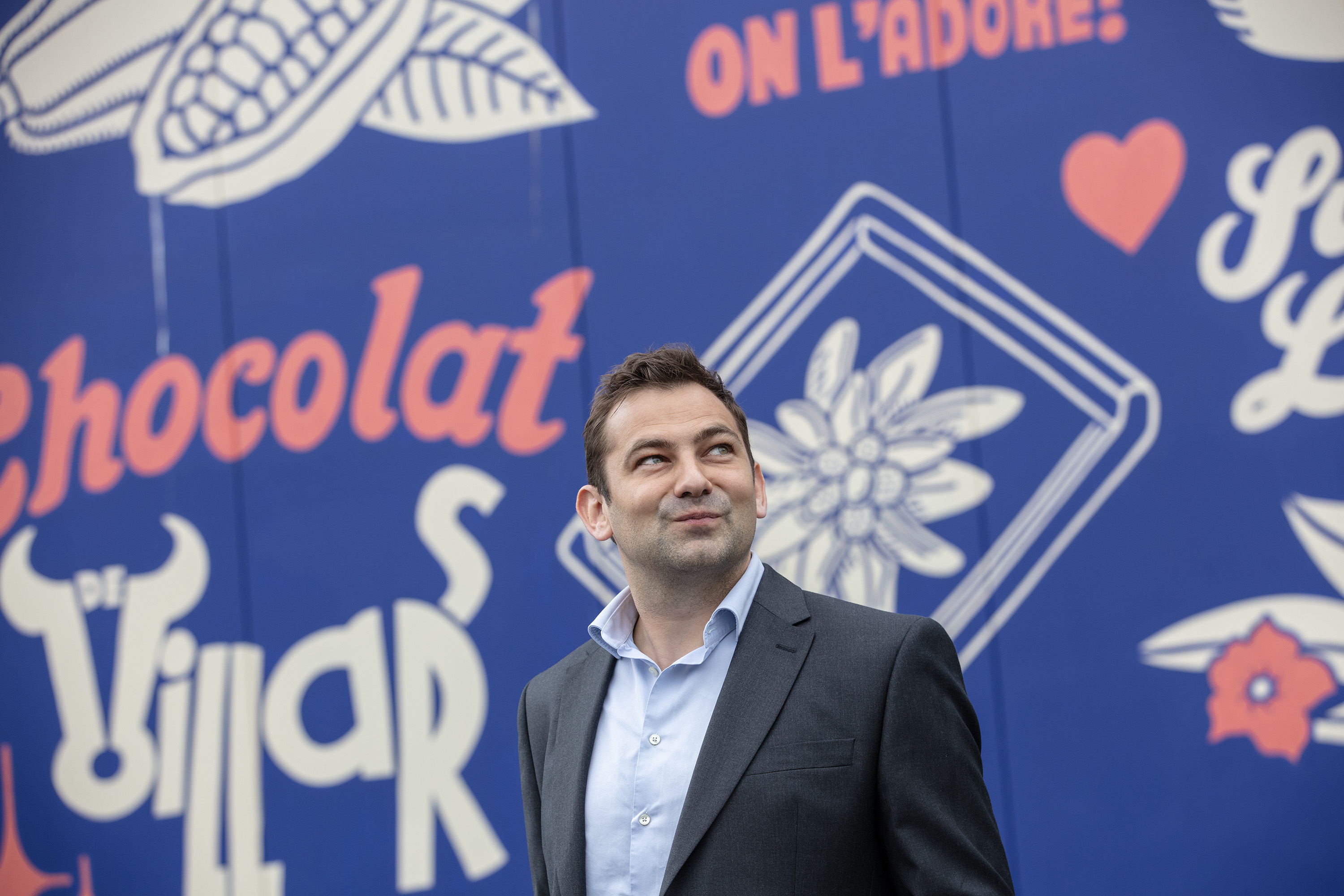
Villars CEO Nicolas Forget says the Swiss chocolate maker will stay in Switzerland despite rising costs.
Select your language
Generated with artificial intelligence.

Listening:
Villars CEO: ‘The key is to boost our visibility while keeping costs under control’

Forget, who has been at the head of Villars Maître Chocolatier since July 2025, wants to raise the international profile of the chocolate manufacturer.
In an interview with Swissinfo at the company’s Fribourg headquarters, the Frenchman explains why soaring cocoa prices, geopolitical tensions and rising protectionism could make that a difficult task.
Swissinfo: Before becoming CEO of Villars Maître Chocolatier, you held the position of director of transformation. What did that involve?
Nicolas Forget: I joined Villars with a mandate to take over the running of the company. I initially held a seven-month transitional role, to settle into life in Switzerland, meet the teams and carry out an assessment.
This role enabled me to gain an in-depth understanding of the company, its brand, its products and its challenges, in both the consumer and professional sectors, particularly among pastry chefs.
This period also enabled me to launch the first strategic and organisational measures to adapt Villars to a rapidly changing market, characterised in particular by the sharp rise in cocoa prices, geopolitical tensions and new customs barriers.

Swissinfo: What was your assessment of the situation?
N.F.: I joined a team of passionate people and could see straight away that the product is authentic and that the brand has a warm image that resonates with consumers. The company’s roots in Fribourg, the surrounding meadows and the local milk all contribute significantly to this identity. We also have an excellent repeat-purchase rate.
The real challenge lies elsewhere: our market penetration remains limited, and our brand awareness is insufficient, as many consumers are still unfamiliar with our chocolates, even in certain regions of Switzerland and France. The key, therefore, is to boost our visibility while keeping costs under control.
With this in mind, I’ve reorganised the management team, recruited new talent and fostered a culture more focused on growth, international expansion and performance, without ever compromising the product quality that has been Villars’ strength for 125 years.

Swissinfo: Since 1995, Villars has been part of the French agri-food group Savencia Fromage & Dairy, which employs around 26,000 people. What are the main synergies?
N.F.: The first is financial strength. Savencia also offers us access to existing international networks, whether they be distributors or retailers.
On the other hand, there are relatively few synergies in procurement or innovation, as the food sector is highly cultural and local, and our Swiss positioning dictates specific choices. Our product range is deeply rooted in Fribourg. Villars therefore retains a high degree of strategic and operational autonomy.
Swissinfo: Is it possible for a brand like Villars to remain independent, or is being part of a large group essential?
N.F.: It’s difficult for me to comment on that. The support from our group has been very helpful, but I’ve noticed that some competitors remain independent and also seem to be doing well.
Swissinfo: Has Villars’ positioning changed since the takeover?
N.F.: What has never changed – and never will – is our Swiss premium positioning: manufactured in Fribourg, using Swiss ingredients and Swiss labour.
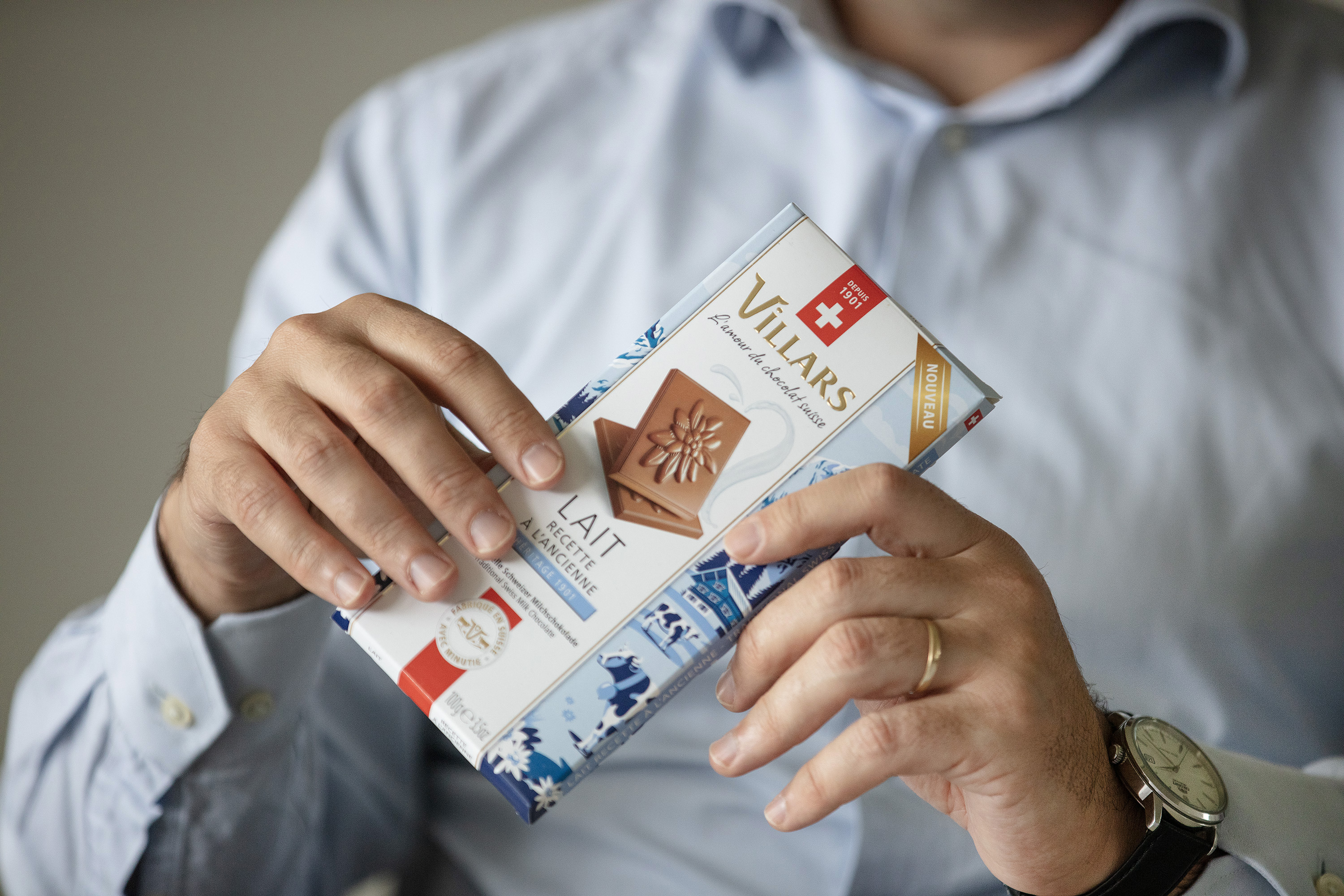
Take conching, for example – a crucial stage that involves grinding, kneading and heating the cocoa to remove acidity and develop the flavours. For many of our competitors, this process takes around ten hours; for some of our recipes, it can take up to 53 hours. While this represents a significant cost, it also gives our chocolates a unique signature.
Swissinfo: Villars controls the entire production chain, from bean to bar. What are the advantages of such vertical integration?
N.F.: While this strategy is certainly more expensive, it offers immense creative freedom and allows us to position ourselves as true master chocolatiers, capable of fully expressing our expertise and developing distinctive products. Many other players, in fact, purchase semi-finished products (cocoa mass or cocoa butter) from specialist groups.
Swissinfo: To what extent are you affected by geopolitical tensions and US tariffs?
N.F.: The most complicated aspect with the United States is the instability. At present, we’re facing tariffs of 15%, compared with 39% a few months ago and just 4% before the Trump era. It’s very difficult to predict how the situation will develop.
Fortunately, we operate in around 60 countries, which reduces our dependence on any single market. But, overall, we’re seeing a resurgence of protectionism almost everywhere in the world.
As for the Middle East, the direct impact remains limited as our presence there is modest. On the other hand, the conflicts are affecting international tourism and airport passenger numbers, particularly in Geneva.
Swissinfo: What about the strong franc and the price of cocoa?
N.F.: These are probably our main challenges. The price of cocoa doubled last year and accounts for up to 80% of the cost price of a chocolate bar. All players are affected, even though the very large groups sometimes have greater bargaining power with their suppliers than we do.
We’re therefore constantly working on industrial efficiency, process optimisation and reducing waste. We also work closely with our customers, as they are the ones who set the final prices – we are hardly retailers ourselves, with the exception of our historic shop in Fribourg.
Swissinfo: To combat rising cocoa prices, several manufacturers have reduced the percentage of cocoa in their products or made their products smaller. What about Villars?
N.F.: That is indeed a strategy we have seen our competitors adopt, sometimes to excess. We do not resort to this.
Swissinfo: You export to more than 60 countries. Where do you see the main drivers of growth?
N.F.: Our key markets remain Switzerland, France, Europe more broadly and the United States. We’re also keeping a close eye on Japan, China, India and certain major South American countries such as Brazil.
Swissinfo: How important are social media and influencers to you?
N.F.: They play an important role, but we remain very selective. In B2B [business-to-business], we work in particular with the Geneva-based pastry chef Christophe Renou, who perfectly embodies our high product standards and our authenticity. For the general public, we favour food enthusiasts – genuine “foodies” – who ideally have a connection to our Fribourg heritage.
Swissinfo: What are your main distribution channels?
N.F.: In Switzerland and France, we are stocked by major retailers, but we still have significant potential for growth, particularly in German-speaking Switzerland. We’re also active in “travel retail” [sales in travel areas, airports, railway stations and on aircraft] and with premium retailers such as Globus, as well as supplying corporate gifts to businesses. Finally, our business with professionals – pastry chefs, restaurant owners – is particularly significant in French-speaking Switzerland.
Swissinfo: What about direct sales, particularly online?
N.F.: As well as our long-established shop, we’re organising events to mark our 125th anniversary. We have suspended online sales, but we are seriously considering resuming them. Beyond turnover, e-commerce above all enables us to gather valuable data and direct feedback from consumers.
Swissinfo: Would you ever consider manufacturing abroad or using more non-Swiss ingredients to cut costs?
N.F.: No, that’s simply out of the question. For us, “Swiss Made” is not a marketing slogan but a reality. We will continue to produce in Fribourg using Swiss ingredients – except, of course, for ingredients such as cocoa, which are not available in Switzerland. And we will do so even if some competitors have made different choices.
Swissinfo: How are you progressing with your goal of 100% traceable and sustainable cocoa?
N.F.: Today, 100% of our cocoa is Rainforest Alliance certified, one of the most stringent environmental and social standards. We are also ready to meet the requirements of the forthcoming EU Deforestation-free Regulation (EUDR), which calls for rigorous traceability.
Swissinfo: How do you envisage Villars in ten years?
N.F.: I hope that Villars will be recognised worldwide as a human-scale ambassador for Swiss and Fribourg expertise: a mark of excellence, true to its roots. Our local roots – amid the meadows and the cows that provide our milk – are an integral part of our identity. We want to continue to promote this region, while remaining a unique and distinctive brand, recognised by our consumers for our exceptional chocolates.
Edited by Virginie Mangin. Translated from French, sub-edited by Thomas Stephens/gw
Nicolas Forget
Career
From December 2024: Villars Master Chocolatier (Savencia Group), Transformation Director. Since July 2025, CEO
2020–2024: Savencia Group, notably as Group Transformation Director
2013–2020: EFESO Management Consultants, Manager then Senior Manager
Education
2013: HEC Paris, Master of Science (MSc), Strategic Management
2011: Institut d’Etudes Politiques de Lille, Master of Arts (MA), Political Science and Public Administration

In compliance with the JTI standards
More: SWI swissinfo.ch certified by the Journalism Trust Initiative

You can find an overview of ongoing debates with our journalists here . Please join us!
If you want to start a conversation about a topic raised in this article or want to report factual errors, email us at english@swissinfo.ch.