








How drought affects Swiss forests

This year’s exceptional drought is causing irreversible damage to Swiss forests. But trees’ health is being undermined by more than just the lack of rainfall.
Select your language
Generated with artificial intelligence.
Listening:
How drought affects Swiss forests

With yellow treetops visible as early as July, the sight of Swiss forests this summer is unusual even for someone who has studied them for decades. “I knew this scenario would eventually occur. But I did not expect it to happen this year, nor with such intensity,” Ansgar Kahmen, professor of physiological plant ecology at the University of Basel, told Swissinfo.
The early drying and shedding of leaves is not merely a temporary defense mechanism against water shortages, Kahmen explains. It signals deep and irreversible damage to tree tissues.
For the researcher, 2026 is a turning point for Swiss forests. “The extent of the damage is such that we believe many of the trees that have already lost their foliage will die either immediately or in the coming years,” he says.
More
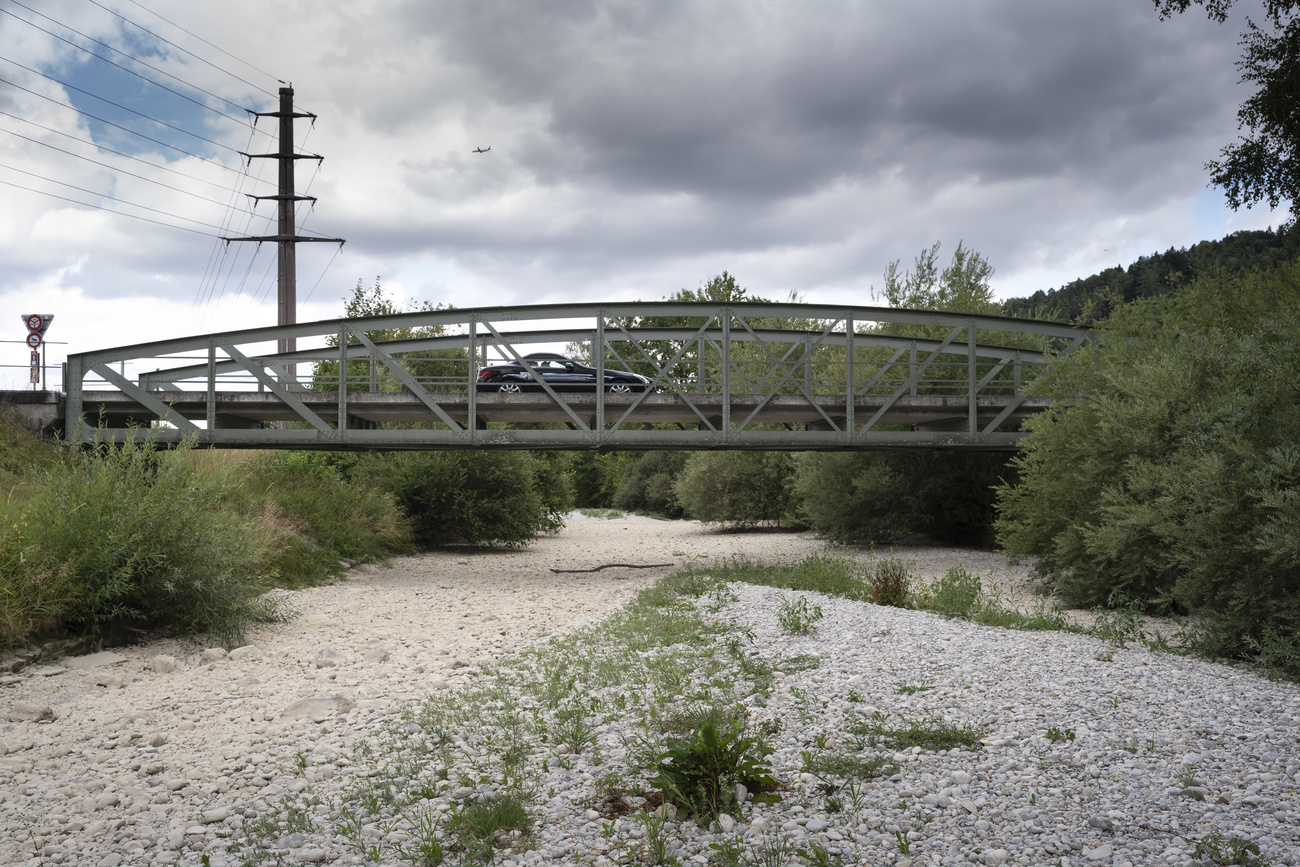
Drought in Switzerland: Europe’s ‘water tower’ runs dry
Rising tree mortality, driven by increasingly hot and dry conditions, could weaken the protective role of Alpine forests against avalanches, landslides, and other natural hazards. It also reduces forests’ ability to absorb carbon dioxide (CO2), a powerful greenhouse gas, and to help mitigate climate change. Water stress further makes trees more vulnerable to pests and diseases.
Swiss forests will not disappear, Kahmen emphasises. “But the forests we grew up with, which hold strong emotional value for people in Switzerland and Central Europe, will no longer exist.”
External Content
No new buds on drought-affected beech trees
This summer recalls 2018, when around 5% of Switzerland’s beech forest areas experienced premature yellowing. Beech trees account for approximately 19% of all trees found in Swiss forests. Many forest ecology experts initially suggested that the trees were simply undergoing leaf senescence, the natural aging process of leaves that normally occurs in autumn.
The following spring, however, many beeches failed to produce new buds, indicating that they had suffered severe and lasting damage. This was also confirmed by a recent studyExternal link conducted by the Swiss Federal Institute for Forest, Snow and Landscape Research (WSL).
Drought particularly affects the meristem, the tissue from which trees generate new leaves and shoots, Kahmen explains. Research carried out in Switzerland, including Kahmen’s own work in an experimental forest in the canton of Basel Country, indicates that many trees, especially beeches, struggle to recover after episodes of severe water stress.
Kahmen says it has been surprising to discover just how vulnerable some Swiss tree species are. The explanation ultimately comes down to one simple factor: access to water. Trees with roots deep enough to reach still-moist soil layers, or with more extensive root systems, are generally better able to withstand drought.

The ‘thirst of the air’ drains water from plants
Between 2018 and 2022, the number of dead and damaged trees increased in Switzerland, rising by around 50% in some regions, accordingExternal link to the National Forest Inventory. Tree mortality in 2018 exceeded levels recorded during the so-called “heatwave summer of the century” in 2003.
The succession of extreme drought episodes in recent years has contributed to increased mortality in Swiss forests. However, low summer rainfall and reduced soil moisture are not the only explanations.
Kahmen points out another factor: the “water thirst of the air,” known scientifically as vapour pressure deficit (VPD). As temperatures rise, the atmosphere can hold greater amounts of water vapour and therefore becomes “thirstier” for moisture. As a result, it extracts more water from leaves and from the soil.
These conditions put many plants in an impossible situation. They need to keep the tiny pores on the surface of their leaves, known as stomata, open to absorb the CO2 necessary for photosynthesis and growth. But in such dry conditions, plants also must close the stomata to reduce water loss. “For every molecule of CO2 absorbed, a plant loses about a thousand molecules of water,” Kahmen explains.
VPD increases exponentially with temperature. During a heatwave, when air temperatures rise from 25°C to 35°C, an increase of 40%, VPD rises by around 80%. According to a WSL studyExternal link, in the last four centuries, Europe’s atmosphere has never been as dry as it is today.
“I believe that declining atmospheric humidity has even greater effects on vegetation than rising temperatures, although the two phenomena are linked,” Kahmen says. With the same amount of rainfall, he adds, ecosystems dry out much faster today than they did twenty or thirty years ago.
More
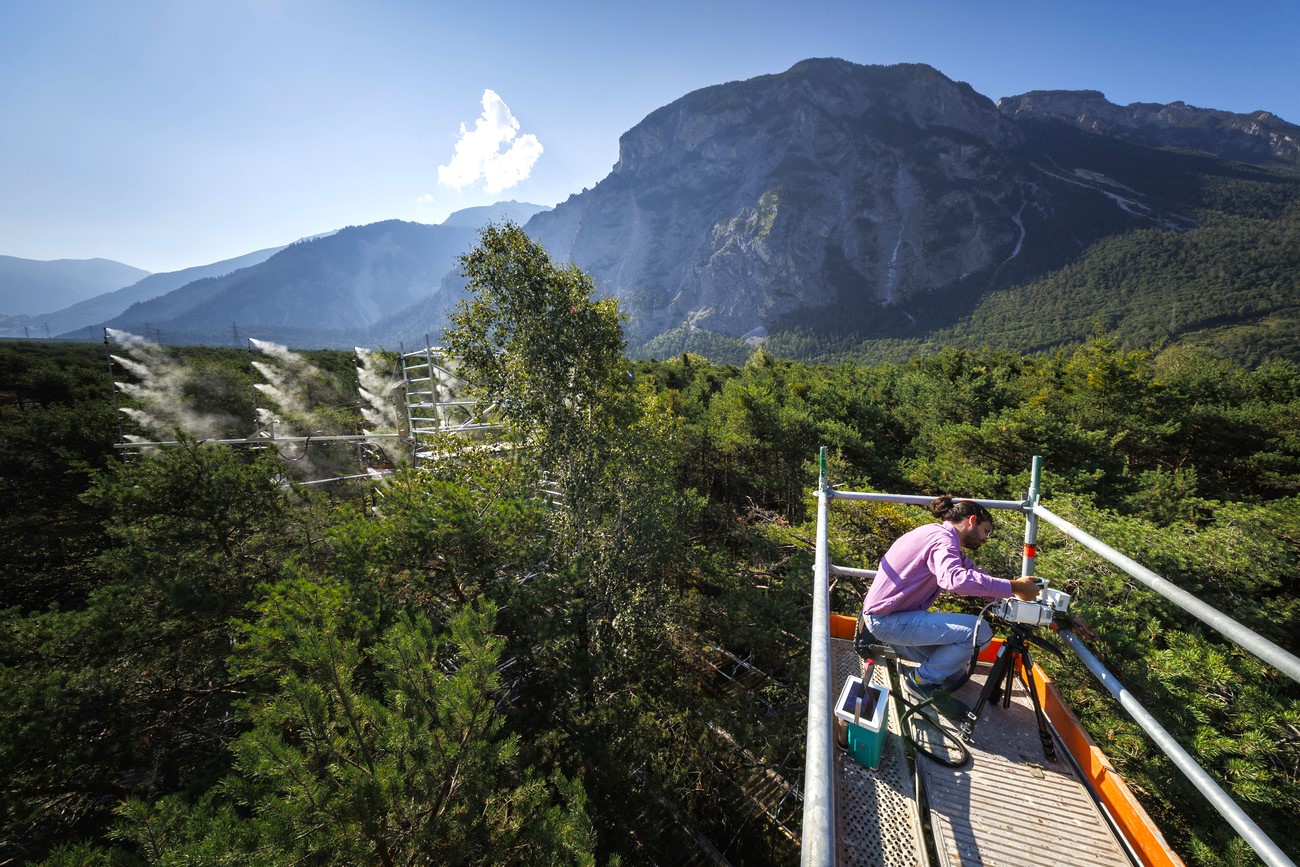
Swiss experiment targets forest drought, a driver of climate change
Which trees will make up the forests of the future?
Trees possess a certain capacity to adapt and, particularly in younger individuals, can alter their functioning or morphology when water becomes scarce, Kahmen explains. They may develop deeper roots or reduce the size of their crowns (the top of the tree).
“But there are structural limits: a beech tree cannot turn into a cactus,” he says.
Once those limits are reached, the species composition of a forest begins to change. In Switzerland, beech and Norway spruce are among the trees most affected by rising temperatures and increasingly frequent droughts. More resilient species include sessile oak, ash and wild service tree.
However, even native oak species that tolerate current temperatures more effectively are reaching their limits, the expert notes. “We need to consider the possibility of introducing sub-Mediterranean or even Mediterranean species.”
External Content
The challenge is determining which species will be suitable for tomorrow’s climate. According to Kahmen, this is far from straightforward because it requires decisions that extend beyond existing experience. Moreover, introducing non-native species may conflict with nature conservation goals, which by definition aim to preserve existing ecosystems.
For Kahmen, maintaining the greatest possible diversity in forests will be essential. The greater the number of species present, the higher the likelihood that at least some of them will be able to adapt to future climatic conditions, in which events like the drought of 2026 may become the norm.
External Content
Edited by Gabe Bullard/VdV


See more Swissinfo articles in your Google results. Learn more

In compliance with the JTI standards
More: SWI swissinfo.ch certified by the Journalism Trust Initiative

You can find an overview of ongoing debates with our journalists here . Please join us!
If you want to start a conversation about a topic raised in this article or want to report factual errors, email us at english@swissinfo.ch.