








Swiss district heating shows promise but faces big financial hurdles

Switzerland’s push to expand district heating is gathering momentum, but a series of abandoned projects shows how high costs, long payback periods and technical challenges are still holding back the country’s shift away from oil and gas.
Select your language
Generated with artificial intelligence.

Listening:
Swiss district heating shows promise but faces big financial hurdles
A major district heating project was due to be built in Romanshorn in north-eastern Switzerland, using the warmth of Lake Constance to heat buildings. But studies revealed that the project would struggle to turn a profit, so it was eventually abandoned last December.
There are several other similar examples. In Rapperswil-Jona, in canton St Gallen, a project was drawn up to use waste heat from an incinerator in Hinwil, in neighbouring canton Zurich, to cover 20% of the town’s heating needs.
“We examined the issue thoroughly and came to the conclusion that the risks and uncertainties would be too high,” Rapperswil-Jona mayor Barbara Dillier told Swiss public broadcaster SRF.
In district heating, heat is not produced within individual buildings, but in large thermal power stations that use renewable energy (such as wood or geothermal energy) or fossil fuels. A network of pipelines starts from these facilities and distributes the heat to the connected buildings.
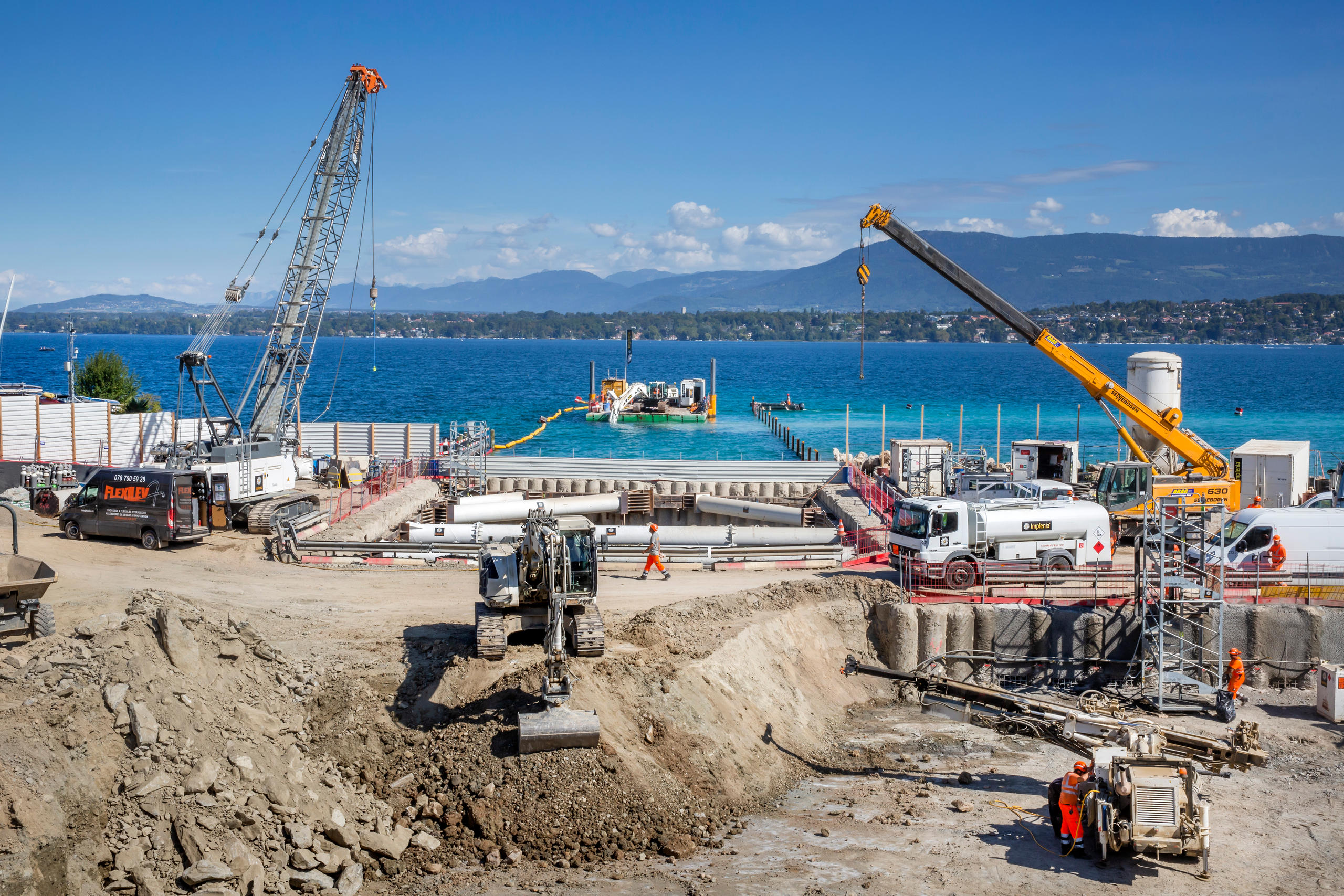
It is also possible to recover waste heat generated by waste incineration plants, industries or data centres. Lake water can also be exploited as a heat source, as is the case in Geneva, for example.
The project by energy supplier Energie Zürichsee Linth (EZL) would have cost CHF115 million ($146 million). “But there was no possibility of financing it,” Dillier said.
Martin Roth, chair of the EZL board of directors, says it would have been almost impossible to find enough new customers in the coming decades. “The risks were too high. The payback period is very long – we are talking about 40 to 50 years. If something does not develop as planned, this can mean, in the worst case, the end of the company.”
Financial and technical obstacles
Every district heating construction site is different. “For example, in an urban area where houses are relatively close together or with narrow alleys, you have to think about how you are going to lay the pipes,” Stefan Silat of the company Thermonetz, which is expanding the district heating network in the city of Bern, told SRF.
Engineers must also carefully check existing pipes and tunnels when planning and digging. This makes the work complex and expensive.
Bern’s energy provider EWB is investing almost CHF500 million ($633 million) to connect 9,000 additional households to its district heating network. A sufficient number of homeowners must sign up for this to be economically viable, said EWB spokeswoman Sabine Krähenbühl.
‘Things are moving at full speed’
Financial risks, technical challenges or opposition from local people – for example in Wil in canton St Gallen – can slow down district heating projects. But there are also positive developments, as highlighted at a conference in Bern organised by the Swiss District Heating Association at the end of January.
“Cities such as Zurich and Basel are leading the way, and Geneva, Bern and Lausanne are also expanding their networks. By 2050 they will invest almost CHF7 billion in expanding district heating networks,” said Andreas Hurni, director of the association.
“Things are moving at full speed here. And even in many smaller towns and villages the network is expanding rapidly,” Hurni added.
External Content
Data centres as a heat source
There are around 1,600 district heating networks in Switzerland, covering around 10% of national heat demand, according to Hurni. “By 2050, district heating could cover a quarter of heat demand.”
In addition to waste heat from incineration plants and industry, providers are increasingly relying on renewable sources such as water from lakes and rivers, wood-fired plants and, more recently, waste heat from data centres. Gas as a heat source, meanwhile, is becoming less important.

More
Can Switzerland’s power grid keep up with its data centres?
Breaking free from oil and gas dependency
In the European Union (EU), district heating covers 13% of heat demand and 44% of the networks are powered by renewables, Pauline Lucas of the Euroheat & Power association told the conference.
The key objective is to move away from oil and gas. “The decarbonisation of heating is not only about meeting climate targets; it is also about energy security,” Lucas said.
Two-thirds of gas consumed in the EU is used to produce heating and cooling for homes and industry. It is this dependency that needs to be reduced, she added.

More
More heat pumps and less oil: how the Swiss heat their homes
The Swedish model
Sweden is seen as an example for many countries. Swedish energy expert Mart Kivikas told SRF: “If you travel through Sweden in winter, you see very few smoking chimneys, because so many houses are connected to district heating networks.”
Waste heat from industry and incineration plants has been used for many years. In Stockholm, 90% of multi-family residences are connected to the local district heating network. “It works because cities finance investments in the networks and set cheaper rates than heating with oil, gas or coal.”
More
Using lake water to help reduce Switzerland’s carbon footprint
The original article was published on Swiss public broadcaster, SRFExternal link on February 7, 2026.
Translated from Italian using AI/amva/sb
How we translate with AI
We use automatic translation tools, such as DeepL and Google Translate, for some content.
Each translated article is carefully reviewed by a journalist for accuracy. Using translation tools gives us the time for more in-depth articles.
Learn more here about how we work with AI.
External Content

In compliance with the JTI standards
More: SWI swissinfo.ch certified by the Journalism Trust Initiative

You can find an overview of ongoing debates with our journalists here . Please join us!
If you want to start a conversation about a topic raised in this article or want to report factual errors, email us at english@swissinfo.ch.